Home & Living
Borrowed book return spot before the next handover
Use a small household return spot to keep borrowed copies identifiable until their agreed handover, without mixing them into a personal collection.
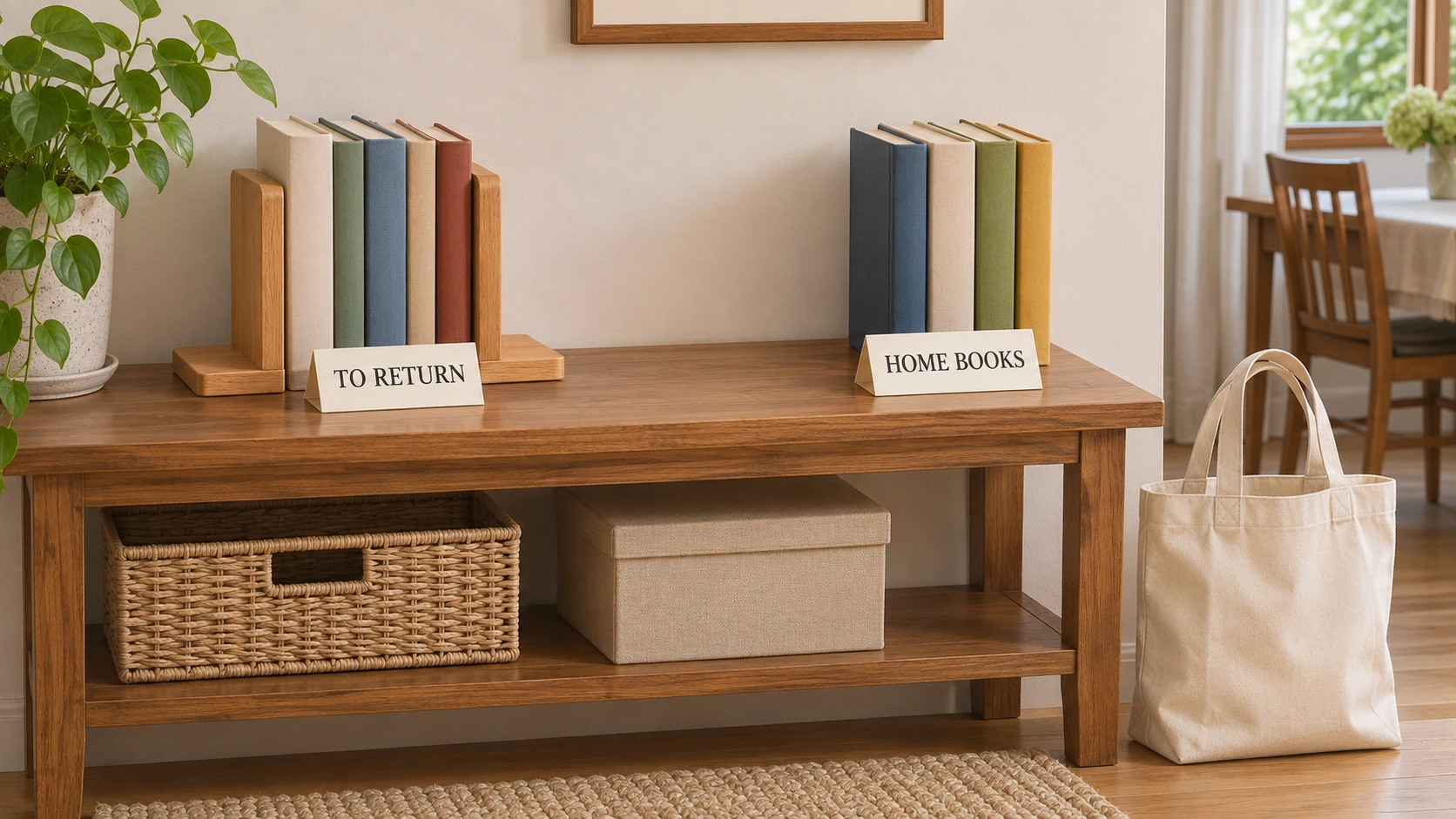
Borrowed book return spot ideas begin with books already in the house. You have finished a friend's novel, another copy is waiting for an arranged collection, and your own reading still occupies the shelf. Give the outgoing books an identifiable place while you prepare for the handover you actually agreed. A decorative support can be optional context for that place. The decisions belong to the household and the people whose copies are there.
A small group beside the everyday collection
Consider an invented household. Leah has Omar's blue hardback and Tess's cream-covered collection of stories. Omar expects his book at their next arranged visit. Tess will collect hers through a separate arrangement. Leah and her partner, Cal, also keep their own books on the console shelf. The people, copies and circumstances are fictional. Their task is to keep these particular borrowed copies recognizable while the books are still at home.
At first, the cream-covered book sits among the household's own reading. Cal moves it while looking for another volume. Nothing dramatic happens, but Leah has to look for it when she starts preparing for Tess's collection. She decides to give outgoing books a distinct place. This scene proposes a household arrangement. It reports no observed borrowing behavior and makes no promise that a shelf accessory will cause someone to remember a return.
Leah starts with the copies she actually has. She recognizes Omar's hardback from their loan conversation and Tess's collection from its cover. Where her memory is incomplete, she checks the information already available instead of filling the gap with an assumption. She keeps the return arrangements attached to the corresponding books. There is no shared reading queue to administer in this example. Each copy is going back to its own owner through the arrangement already made.
Give borrowed copies an identifiable place
Leah chooses a part of the existing shelf that she and Cal can recognize as the return spot. She keeps the home books apart from that group and puts a freestanding card on the shelf. The card describes the place. It is separate from the copies, without writing on a cover or attaching something to a page. This is an organizing choice for the example, with no claim that a particular card or arrangement is suitable for preserving a book.
The location needs to make sense in their actual home. They consider where the books are currently kept and where Leah will collect them before the planned handover. If they use a shelf or supports, they follow the equipment information and any handling directions that apply to the copies. This article supplies no furniture installation, bookend loading or book-care method. The household can make its return group understandable without adopting a new physical support.
Cal asks whether a personal book Leah intends to pass on should join the group. Leah leaves it elsewhere for now. She has not decided whom to offer it to, while Omar's and Tess's books already have known owners. That choice keeps the spot's meaning narrow enough for this household to use. Another home might choose a different arrangement, but it should describe that arrangement plainly to the people who will handle the group.
Keep a short note outside the books
A separate note can connect the particular copy to the return arrangement when that information would otherwise be difficult to find. Leah writes enough to distinguish the blue hardback from the cream collection and records the next practical action. She uses information she already has. The note does not need a complete reading history, an account of the owner's preferences or a new system for tracking every book in the house.
Keep the note with the task it helps you carry out. If the people involved need a private contact detail, use the communication record where it belongs instead of displaying it on an open shelf. A simple outside card can identify the group while a separate personal note holds the arrangement. The example proposes that division for Leah's home. It establishes no general requirement to label someone else's property or collect information about them.
Leah notices that her note describes Omar's visit in older wording. She checks the actual arrangement before preparing to leave. If the visit has changed, the books can remain in the return spot while she follows the revised plan. There is no reason to hide the unfinished task by moving the hardback into the personal collection. The place can continue to show that the copy is still in the house without supplying a new deadline of its own.
Prepare the particular copy for its handover
Before Tess's collection, Leah takes the cream-covered volume from the return group and checks that it is the copy involved in their arrangement. She follows any handling or carrying directions that actually apply. This guide gives no packing prescription or promise of protection from a particular bag. The household's return spot has helped her identify what she intends to hand over. She still needs to complete the handover itself.
Suppose Cal is at home when Tess arrives and Leah has already left. They can agree beforehand which book Cal will hand over and where Leah has left it. Cal need not infer that from a decorative motif or from the position of a cover in a photograph. If an essential detail is unclear, he can obtain the information before acting. This is a fictional household handoff, without an assumed authority to lend or distribute other people's books.
When Tess has actually received her copy, Leah can remove its entry from the short note. Omar's hardback remains in the return group because its own handover is still ahead. A clear space after Tess's collection need not be filled with another object. Leaving the remaining task visible may suit this small arrangement better than making the shelf look full again. The example concerns the household's use of that place, with no claim about a product's organizing performance.
On a later evening Leah reaches for one of her own books. The home books have stayed in their separate group, so she leaves Omar's copy where it is. Cal now knows what the return card means. They can reconsider the arrangement if the shelf's use changes or the group no longer fits their routine. The point of the example is to choose a place the people using the home understand, while the borrowed items retain their actual destination.
Read optional bookend accounts within their limits
The industrial pipe bookend account shows two complete wood-and-pipe L-shaped supports beside staged books. Its catalog maker is Unbranded, with no native model number. The pipe forms are integral to the depicted supports. Neither supplied real books nor independent plumbing equipment is established here.
The Contrast skull bookend account names a set of two, coherently pictured as two complete L-shaped supports. Model 7934 is a catalog field. Its metadata retains conflicting warning fields, including a Prop 65 text warning and a generic small-parts warning. No independent safety assessment is supplied.
These examples identify optional decorative objects, separate from Leah's fictional possessions. Their galleries establish no tested support performance or suitability for a particular borrowed volume. If you consider equipment for your own arrangement, obtain the information relevant to that actual use and follow its applicable directions. You can also keep the return group in an existing suitable place. A purchase is unnecessary to identify a copy's owner or carry out the arrangement already made.
Leave condition and permission questions with their own task
If you discover a change to a copy's condition, the damaged borrowed-book disclosure guide concerns telling the owner what happened and discussing their preference. Putting a book in the return spot supplies no condition assessment or remedy.
The guide to asking before annotating a borrowed book addresses permission for a proposed mark. A shelf label outside the copies does not settle a separate request about changing their pages. Keep the owner's actual directions attached to that question.
Leah's ordinary return arrangement can stay modest. She identifies the books, gives the outbound group a recognizable place and prepares the relevant copy for the agreed handover. If another question arises, she handles that question through the information and people involved. She need not turn her shelf into a repair station, a reading-group waiting list or a gift proposal. Those would introduce different decisions from the small household task described here.
Consider any later purchase separately
If you separately consider a bookend order at republeq.com and the actual checkout offers USDT or another cryptocurrency, review that transaction against the item you intend to buy. Identify the exact offer, selected variant and stated supplied contents. Keep any important unanswered question about the proposed goods open while the responsible seller explains it. A payment preference cannot establish a bookend's supporting performance or decide when a borrowed volume will reach its owner. Read the current total and the separate charges displayed by the services involved. Check the asset, network and receiving information presented for the authorized order before deciding whether to use that method. This article verifies no live checkout availability, receiving address, exchange rate, fee, settlement time or financial protection. Follow the current transaction instructions supplied by the responsible service. Never provide wallet recovery phrases or private keys in a product enquiry. Review the delivery and return terms that apply to the proposed purchase. Retain the exact item reference, applicable seller clarification, displayed terms and resulting confirmation according to the service's instructions. If you change the selected item, establish whether the earlier answer still addresses it. An unanswered request to amend an order does not confirm that the amendment happened. Reconcile an uncertain payment or order status through the authorized channel before considering another payment. Keep a later delivery discrepancy connected to the retained order record so the seller can identify the transaction involved. After delivery, compare the actual supplied identity and contents with the record and obtain the relevant equipment information. A purchase confirmation records an order. It supplies no inspection of a delivered support and completes no handover of a borrowed book. The household can continue its existing return arrangement while leaving an optional decorative purchase undecided.
Leave the spot reflecting what is still at home
A Borrowed book return spot can be a small, deliberate part of an ordinary home. Leah leaves Omar's hardback there until their handover happens, with Tess's completed return no longer shown as unfinished. The separate home books remain available for the household's own reading. In your arrangement, use the actual copies and the plans you made. Revisit the spot when those circumstances change, and let its contents reflect the books that are still in your care.
Separate borrowed copies from home books while the return arrangement is still pending.