Crypto Commerce
Bogen BG-CSD2X2 ceiling speaker vs C2G 41509 Drop-In Speakers for Ceiling Tiles
Compare Bogen BG-CSD2X2 ceiling speaker by tile fit, 25/70V transformer details, tap settings, mounting evidence, coverage, package count, and service access.
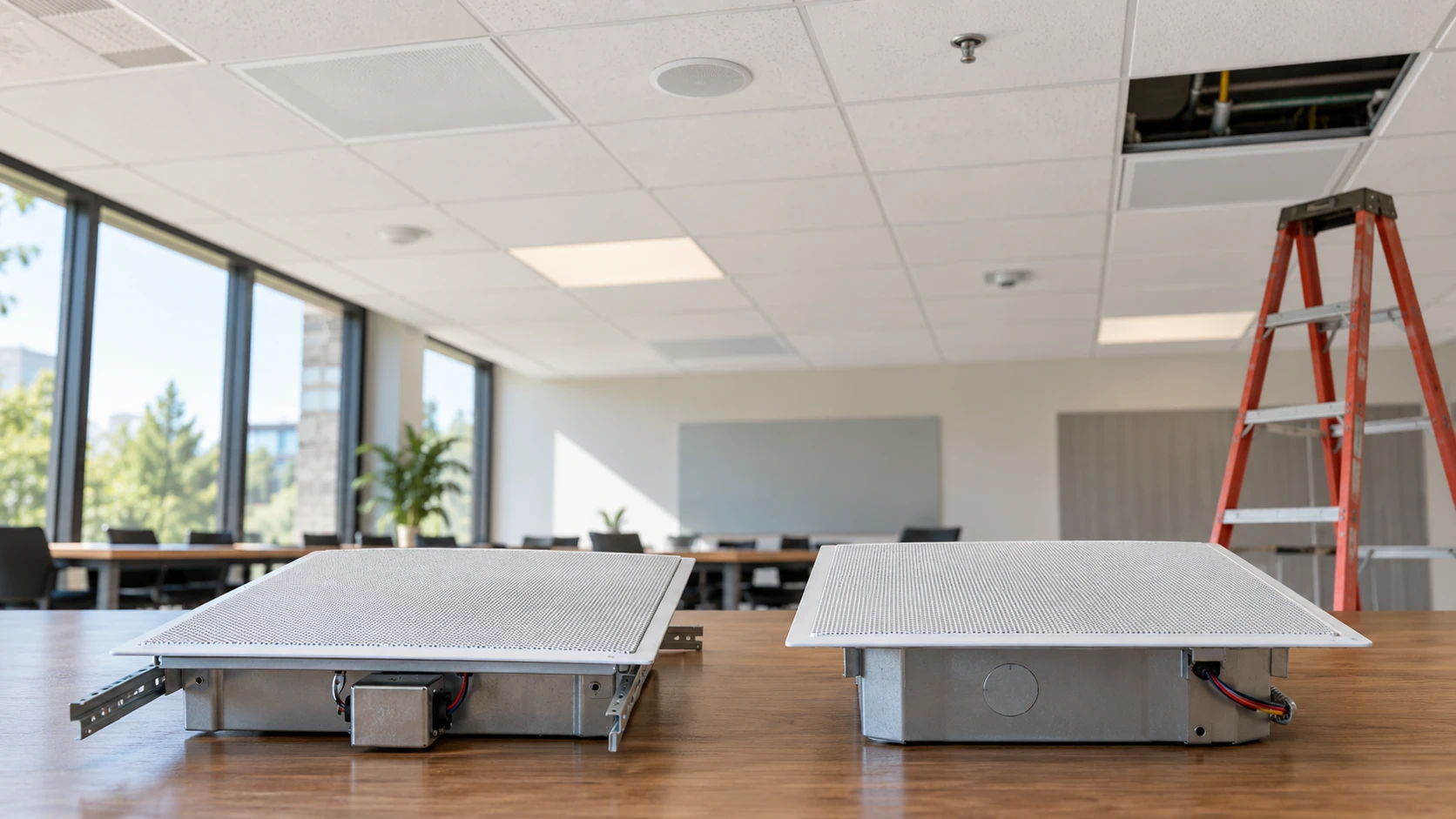
A drop-in ceiling speaker is chosen with the ceiling grid and audio system in mind. The Bogen BG-CSD2X2 ceiling speaker listing describes a two-pack with a 2-by-2-foot grille, support rail for a 2-by-4-foot tile grid, and a 25/70V transformer with selectable taps. The C2G 41509 listing describes a 2-by-2-foot drop-in unit with a plenum-rated enclosure, seismic tie-off points, and a 70/25V transformer. Both need a compatible ceiling and correctly planned distributed-audio wiring. Begin with the room drawing and the existing amplifier, not the color of the grille.
Mark where people need to hear speech or music, where lighting and sprinklers occupy tiles, and how maintenance staff reach the space above the ceiling. A tile speaker can make an installation look tidy, but the route of its cable and the support of the unit are hidden once the grid is closed. Ask the facility manager for the ceiling type and local installation requirements. The saved product excerpts cannot decide whether either assembly is permitted in a particular air-handling space or seismic zone.
Verify the tile and support structure — drop-in ceiling speaker planning
Bogen's source names model 1079820 and calls the package a two-pack of BG-CSD2X2 speakers. It says the full front has a 2-by-2-foot perforated grille and includes a support rail for 2-by-4-foot ceilings. The listed dimensions are 4.8 by 24 by 24 inches. Check whether the existing grid uses nominal 2-by-2 or 2-by-4 openings and how the speaker transfers weight to the structure. A tile face that appears to fit does not settle how the assembly is secured above it.
C2G's 41509 is described as a 2-by-2 drop-in speaker with a plenum-rated enclosure and seismic tie-off points. Its pinned text does not give full external dimensions, total weight, or a package quantity. Request an installation drawing and a box-contents list before ordering several positions. The presence of tie-off points does not tell an installer which cable, anchor, or building member may be used. Follow the current instructions and the applicable building requirements for the actual room.
The published guide on drop-in ceiling speaker planning considers a ceiling speaker kit alongside a floorstanding option. Here, both candidates put equipment above a suspended ceiling. That reduces floor clutter but shifts the work to grid support, cable routing, and access panels. Confirm the installation path before committing to a speaker count. If the ceiling cannot take a drop-in assembly, the right answer may be a different speaker location rather than forcing a tile product into the opening.
Check the finished appearance against the room. Bogen's description says the grilles are offered in off-white or bright white, and the listing specifies off-white, while another catalog color field says multicolor. Ask for a photo of the exact shipped finish. C2G's pinned excerpt does not state grille color. A mismatch across a row of tiles may be visible even when the audio system works. Establish whether replacement grilles can be ordered later if a tile is stained or damaged.
Match the distributed-audio system — C2G 41509 ceiling speaker
Both listings refer to 25/70V operation. That is a distributed-audio arrangement requiring a compatible amplifier and correct transformer connections. Identify the amplifier model, output mode, cable route, and the number of speakers already on the line before buying. Do not connect a 25/70V tap to an unspecified home stereo output by guessing at terminals. The product pages do not supply a complete system design or installation calculation for the room.
Bogen lists a rotary switch with five tap choices: four watts, two watts, one watt, one-half watt, and one-quarter watt. The installer can use taps to balance levels across locations, within the amplifier's supported load. Add the planned tap values for every unit on a line and allow the margin required by the system designer. Do not assume the maximum setting gives the best sound in a quiet hallway. A lower level at several well-placed speakers may make announcements easier to understand than one loud point.
C2G says it ships with a TBLU-5W-25/70V transformer and supports both 70 and 25 volts. The pinned excerpt does not list every tap value or its selection method. Obtain the wiring diagram and confirm whether the transformer is installed in the delivered unit or included as a separate component. Check terminal access before the ceiling is closed. A product label naming a transformer is not a substitute for tracing how the unit will be connected to the actual amplifier.
If the property already has a distributed speaker line, check its cable and zoning. A conference room may need independent volume control from a corridor, while emergency announcements may have different rules. Neither saved excerpt establishes that a unit is suitable for a life-safety system. Ask the system owner about priority inputs, monitoring, and required listings before adding any speaker to a protected circuit. Keep ordinary background audio separate from a regulated alert system unless the design explicitly allows the combination.
Compare coverage as a room problem — C2G 41509 ceiling speaker
Bogen's source lists an eight-inch cone woofer with a ten-ounce magnet and a tweeter. C2G lists an eight-inch dual-cone driver with a five-ounce magnet and a 100-degree coverage angle. Those parts do not provide a matched frequency-response or intelligibility test. The two designs may distribute sound differently in a specific room, but the pinned descriptions lack comparable polar plots. Ask for current acoustic data and try a sample installation if clarity matters for speech.
C2G's 100-degree figure is a stated angle, not a complete floor plan. Ceiling height, speaker spacing, furniture, and reflective surfaces determine where the sound remains understandable. Bogen's excerpt does not give a coverage angle. Lay out listening points at the edges and center of the proposed zone, then check sound level and speech clarity at ordinary volume. Avoid placing a speaker directly over one desk while leaving a distant corner inaudible. More tiles do not automatically produce a more even result if tap levels and positions are wrong.
Music and announcements place different demands on a room. A shop may need voices to carry through background noise; an office may want unobtrusive music that does not interrupt conversation. Neither excerpt gives a test for those exact conditions. Use familiar spoken material and ordinary program audio at the intended volume during a trial. A driver size or magnet weight alone is a poor reason to choose one system when the installed grid and amplifier may be the limiting parts.
Bogen is listed to UL 1480 for use in the United States. C2G's source describes a plenum-rated enclosure. Those are different statements and should be verified for the exact application; one does not automatically replace the other. Request the current certification documents and ask the project installer which ratings the space requires. If a ceiling is used as an air-handling plenum, wiring and enclosure rules may be stricter than in an ordinary room. The catalog text is a starting point for that review.
Before cable is pulled, mark which ceiling spaces are accessible and where the audio line crosses fire-rated or shared building areas. Ask the installer to select cable and supports approved for those spaces, rather than choosing by speaker price alone. Record which amplifier zone serves each tile and leave a way to isolate one line for testing. A ceiling plan that includes both the speaker and its cable path will also help future maintenance avoid moving unrelated lighting, sprinkler, or network equipment.
Count units, accessories, and service work — C2G 41509 ceiling speaker
Bogen's two-pack wording affects the quantity ordered for a row of ceiling positions. C2G's singular product title does not conclusively state how many units are in a retail package. Confirm carton count and what mounting or transformer parts are included for each listing. Check whether tile support rails, grilles, seismic hardware, and cable connectors are provided or sold separately. A lower price per listing may represent fewer speakers or less installation hardware.
Plan a service route after the initial installation. If a speaker stops working, maintenance staff need to identify its cable, transformer tap, and ceiling position without disturbing unrelated equipment. Label each line and record tap settings on a room drawing. The Bogen rotary switch and C2G transformer should remain accessible according to their manuals. Ask how a unit can be removed and replaced without damaging the grid or leaving a loose cable above the tile.
The pinned excerpts do not give full warranty terms, power handling for a direct low-impedance connection, or complete installation drawings. Obtain those from the Republeq's catalog or maker before approving the purchase. Verify the shipped model numbers and finish on arrival, then have the installation checked by the person responsible for the audio system. Test one speaker before ordering the rest when the grid or amplifier is unusual. A sample can reveal a fit or wiring issue while the work is still reversible.
Bogen gives a two-pack, a known set of five tap values, and a rail detail for 2-by-4-foot grids. C2G gives plenum-enclosure and tie-off claims, a 100-degree coverage figure, and a named transformer, with package and tap details still to confirm. The C2G 41509 ceiling speaker should be evaluated against the same room drawing and amplifier schedule as Bogen. Choose the assembly whose documented support, ratings, wiring, and coverage match the planned installation.