Crypto Commerce
Plan body camera recording boundaries for a shared workspace
A body-worn camera follows the wearer, so a demonstration that stays on one work surface can still collect views of neighboring activity when the wearer turns or walks away. Before an authorized recording in a shared workspace, decide what belongs in the recording, identify what must stay out, and rehearse the wearer's actual route. If the boundary cannot hold through that route, change the arrangement before recording. For body camera recording boundaries , verify each step.
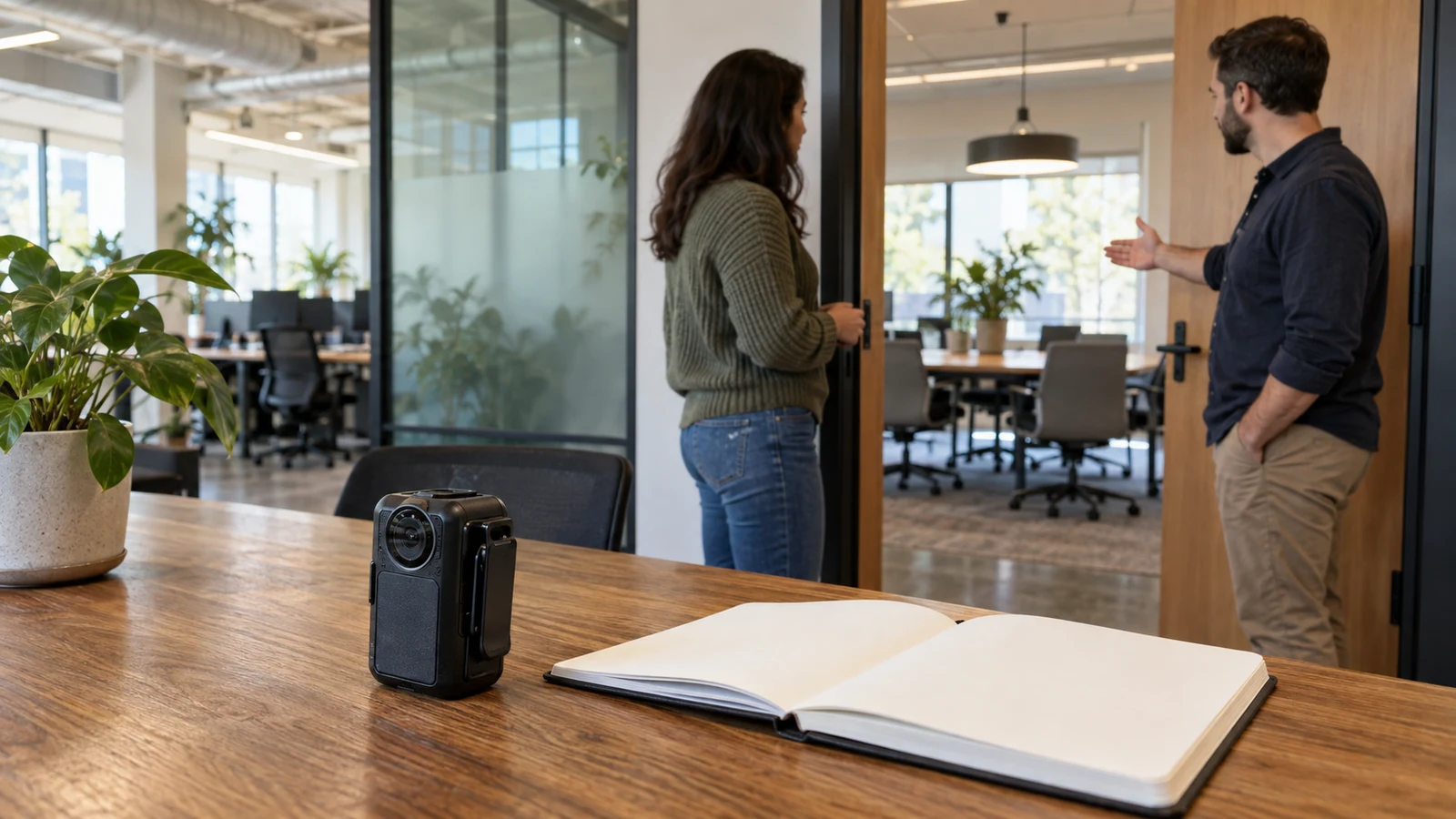
A body-worn camera follows the wearer, so a demonstration that stays on one work surface can still collect views of neighboring activity when the wearer turns or walks away. Before an authorized recording in a shared workspace, decide what belongs in the recording, identify what must stay out, and rehearse the wearer's actual route. If the boundary cannot hold through that route, change the arrangement before recording. For body camera recording boundaries, verify each step.
Consider a fictional demonstration in which one person handles an object at a cleared table, reaches to a nearby shelf for a second item, then returns to the table. Another desk and a doorway sit near the route. The example assumes permission for the intended demonstration only. It does not assume authority to record the other desk, its papers, people passing through the doorway, or their conversations.
Product Demo Video Planning Starts With The Permitted View
Write a short description of the authorized subject before choosing where a camera goes: the participating demonstrator, the object being handled, and the table where the action takes place. Name excluded areas just as plainly. In this example, the neighboring desk, its documents, and the doorway are outside the proposed recording. A person's willingness to demonstrate an object does not settle whether every nearby person or surface may be recorded.
Leave any unresolved recording authority to the people responsible for the space and the activity. The practical question here is narrower: can the proposed camera arrangement capture the agreed demonstration without repeatedly drifting into excluded surroundings? If no one can establish the permitted scope, postpone the recording decision rather than treating an empty room at the start as permission for the rest of the session.
For body camera recording boundaries, the Laiye C3/K3 listing gives a concrete body-worn camcorder to consider. Its description calls it compact and identifies a wide-angle lens. Those words do not tell you exactly what this particular arrangement would show at each point in the wearer's route. A tabletop that looks isolated from one standing position may share the image with the neighboring desk after a small turn.
Sketch the usable area from the wearer's perspective. Mark the starting table, the shelf, the path between them, the neighboring desk, and the doorway. The sketch is a decision aid, not a claim about the camera's measured field of view. Note where the subject is supposed to remain visible and where a change in direction might replace the subject with unrelated activity. Keep the excluded surroundings named even if they happen to be empty during a first look.
Body camera recording boundaries shift with ordinary movements: leaning to see an object, stepping sideways to make room, or turning toward someone who asks a question. A wearer may be concentrating on the demonstration rather than on what the device faces. That makes a dry rehearsal more informative than judging the scene from the start position alone. Walk through the intended actions without recording and mark each moment when the wearer's orientation changes.
At the cleared table, the first uncertainty is a reach across the work surface. Does the wearer have to turn toward the other desk to retrieve the object, or can the demonstration stay at the table? At the shelf, the question changes: what lies beyond the item while the wearer looks for it? On the return walk, the doorway may enter the wearer's forward view. These are possible boundary crossings in the fictional setup, not statements about footage from any particular device.
Product Demo Video Planning During A Movement Rehearsal
Give each uncertain movement its own decision. A turn toward the shelf can be avoided if the needed item is already on the permitted table, provided that moving it there is allowed and does not interfere with the demonstration. If travel is essential, consider whether that part belongs in the recording at all. A plan that depends on the wearer remembering never to glance toward an excluded area may be too fragile for the intended setting.
Do not assume a pause button, preview screen, particular mounting method, or precise lens coverage for the Laiye unit from its body-worn description. Check the exact device instructions for any control the plan requires. Where a permitted trial recording is appropriate, review what the proposed arrangement actually captures during a turn, a reach, and the walk. Arrange that trial within the same authorized limits as the intended recording; a trial is still a recording.
The trial should answer specific questions rather than invite a vague judgment that the view looks fine. Is the object visible while it is handled? Does a document at the neighboring desk become readable or even identifiable? Does the doorway appear when the wearer returns from the shelf? If a question cannot be answered without recording an excluded area, change the rehearsal conditions or leave that question unresolved. Do not treat uncertainty as a successful boundary check.
People can change the scene after the rehearsal. In the fictional workspace, a colleague could enter through the doorway while the demonstrator is returning to the table. Decide before the session what event should interrupt the recording plan: someone entering the agreed area, an unexpected paper placed within view, or a required movement toward the neighboring desk. Whoever organizes the activity should know what to do at that point, based on the permitted arrangement and the device's verified controls.
Sound needs a separate question. The supplied Laiye description does not establish whether this camcorder records audio, so do not assume either that conversations will be captured or that they cannot be. Check the exact device's recording behavior and the approved scope if speech may occur nearby. Keeping another person outside the image would not by itself settle whether a conversation belongs in a recording. If that issue remains open, the visual rehearsal alone cannot approve the arrangement.
A quieter room at one moment does not guarantee a quiet recording later. In a shared space, colleagues may resume speaking or walk into the area during a take. The boundary plan should name the condition under which activity stops and the team reassesses the recording. It should not promise that the wearer can repair an unwanted capture afterward, nor rely on an unverified control to prevent it in the first place.
There is also a communication limit. If the only permissible body-worn view hides the decisive action at the table, the boundary may be sound while the demonstration becomes hard to understand. The related guide to product demo video planning addresses how to make steps clear. Use that question here only to decide whether the allowed view can explain the action; this boundary plan does not replace a separate demonstration plan.
For example, a wearer who must look down at the object could lose the view of what their hands are doing. Conversely, keeping the device directed at the object might leave the wearer unaware that someone has entered the background. Those are competing risks to test in the proposed space, not features or faults of the listed camera. If preserving the permitted view and showing the action pull in opposite directions, consider changing the camera position.
Sony ZV-1 II Camera From A Chosen Position
A separately positioned camera changes the geometry of the fictional rehearsal. Instead of moving with the demonstrator between table and shelf, it could be aimed from a deliberately chosen place toward the permitted table, if that position is authorized and suitable. The listed Sony ZV-1 II camera is a compact vlog camera that records video. Its listing describes a bundle with a grip/tripod for handheld or tabletop use. Confirm the actual supplied kit and suitability before relying on any support in this workspace.
Choose a candidate position by asking what it includes from the whole table, not simply whether it can see the object. From one side, the camera might include the doorway behind the demonstrator; from another, the neighboring desk might appear beside the table. A position outside the wearer's path can reduce changes caused by the wearer's turns, yet it does not automatically keep other people or material out of view. Recheck the complete scene from that position.
In the fictional example, compare the moment at which the demonstrator reaches for the second item. If the item remains on the shelf, a camera aimed only at the table may miss that action. Moving the item onto the authorized table before the demonstration, when permissible, could keep the necessary action inside one area. If the journey to the shelf is essential to what the viewer must see, the selected position may be inadequate. The decision follows the permitted subject, not a preference for one camera category.
Check where participants would stand for the entire demonstration. A chosen position can be disrupted if someone has to step between camera and table, or if a colleague routinely uses the doorway behind it. Ask whether the space can remain within the agreed scope during the activity, not merely while a camera is first placed there. If you cannot establish a usable position without including an excluded area, the stationary alternative has not solved the boundary problem.
The two product descriptions do not establish that the devices share accessories, behave the same way with sound, or offer identical framing and controls. The decision is about this particular demonstration and authorized space. Verify any technical capability the proposed arrangement needs using the exact device and its instructions. A product listing can identify a candidate camera; it cannot certify the boundary of a future recording.
Purchasing is a separate decision from recording permission. Compare the current product listing and the options actually shown at checkout before ordering either camera. If a cryptocurrency payment option appears, review its displayed terms there rather than assuming a particular asset, network, fee, or deadline. Buying a device cannot expand the scope of what people have agreed may be recorded in the workspace.
Sony ZV-1 II Camera And The Written Boundary Decision
End the rehearsal with a short boundary record for the fictional table demonstration. Its intended capture is the participating demonstrator's handling of the two items at the cleared table. Its excluded surroundings are the neighboring desk and papers, the doorway, and any person outside the agreed activity. Record whether the second item can be moved to the table beforehand or whether the route to the shelf remains necessary. Those answers determine which camera position deserves a permitted test.
Next, record the moments most likely to cross the boundary: turning away from the table, reaching toward the shelf, walking back past the doorway, and reacting to an interruption. For each one, state whether the planned view is acceptable, needs a controlled test, or makes the arrangement unusable as proposed. Avoid a blanket approval for the whole session based on one safe starting view. If a movement has no safe treatment yet, mark it as unresolved.
The record also needs explicit interruption points. A colleague entering the capture area, a document arriving at the table, or an unplanned change to the route should trigger a fresh decision before the activity continues under the recording plan. Check the chosen device's actual controls before writing instructions that depend on stopping or restarting it. If stopping safely cannot be established, reschedule or redesign the arrangement instead of hoping the interruption will not occur.
Finally, list what remains unknown: the exact camera view through the proposed movements, any audio recording behavior that matters, and whether the permitted image still communicates the action. A trial within the authorized scope may settle some of these points; the device instructions and the people responsible for the space may settle others. Neither the Laiye body-worn setup nor a selected Sony position earns an automatic yes. Choose only after the specific boundary questions for this demonstration have answers.