Crypto Commerce
Bobomoti 1225 robot vacuum vs Enboya robot vacuums for maps and mop upkeep
Compare Bobomoti 1225 robot vacuum by navigation, room controls, suction claims, water handling, docking, and maintenance.
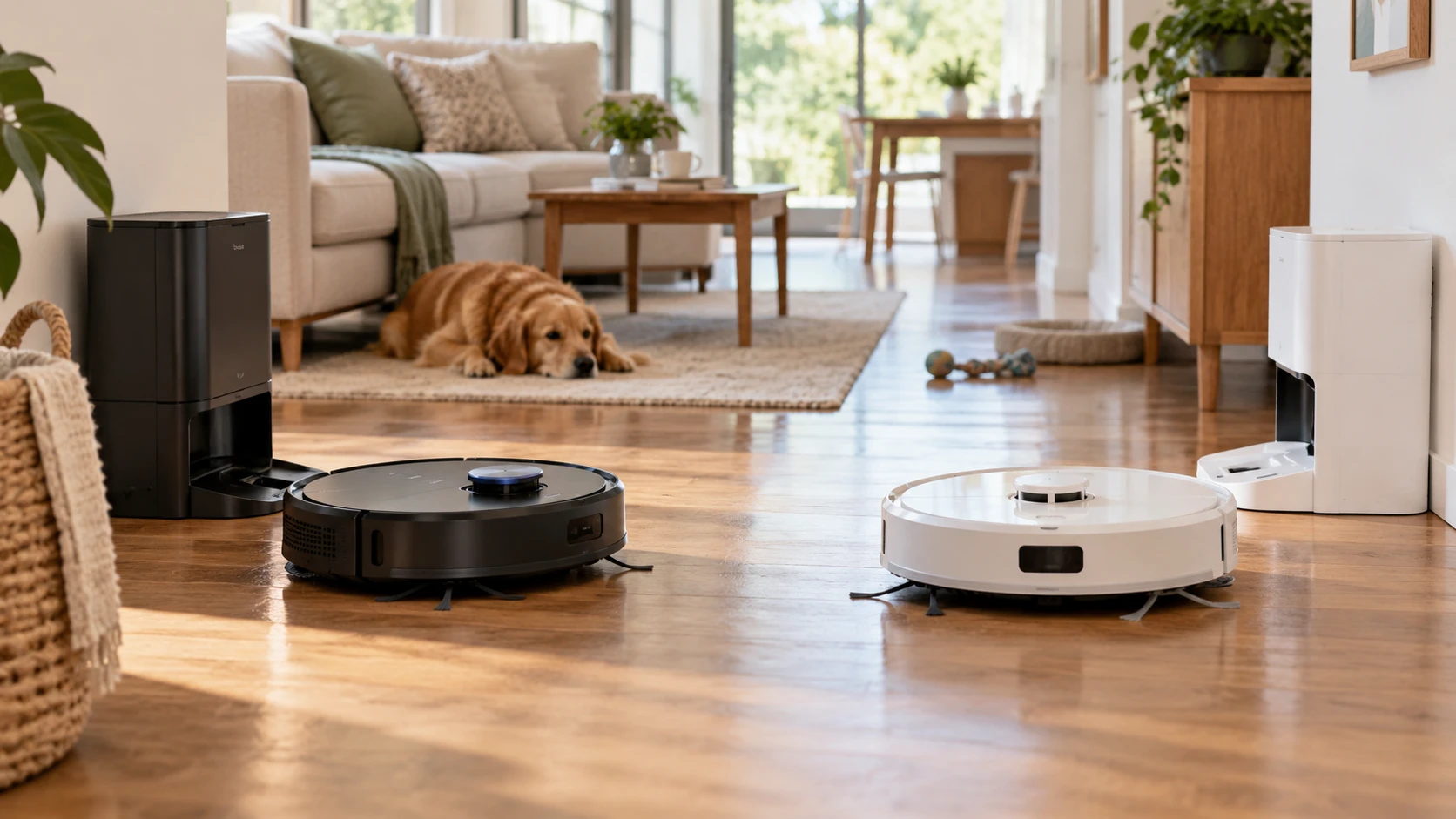
The Bobomoti 1225 robot vacuum is described as a sweeper, vacuum, and mop using gyroscope navigation. Its listing also names a self-emptying system and automatic mop washing and drying. Enboya's vacuum-mop description emphasizes dimensional laser mapping, app room controls, automatic carpet suction changes, and a long quoted quiet-mode runtime. Those are different ways to reduce daily floor work. Before choosing, ask which obstacles are in your rooms, whether you need to exclude particular areas, and how much cleaning you still expect to do at the dock. A robot can have a long feature list yet still need cables cleared and parts washed.
The published guide on robot vacuum mapping controls explains the practical questions behind maps and room restrictions. Its examples are not tests of Bobomoti or Enboya. Start with a floor plan: hard floors, rugs, thresholds, furniture legs, pet bowls, and loose cords. Mark any place a mop must avoid. That plan shows whether a simple systematic route is enough or whether stored maps and no-go zones would save time. It also reveals that a claimed suction number cannot solve every cleaning problem; access to the dirt and a workable route come first.
Compare navigation with your rooms in mind — Enboya LiDAR robot vacuum
Bobomoti's saved description says gyroscope navigation follows systematic routes and helps move around obstacles. It does not describe stored room maps, virtual walls, or app-defined no-go zones. Those functions may be absent or merely omitted from the short excerpt; request the current manual before relying on them. A button on the robot is described as enough to begin cleaning. That could be convenient in a simple room where you want to start a whole-floor pass without setting up an app. Check how it resumes after an interruption and whether it can target a particular room if your home has several distinct areas.
Enboya's source says its laser-based navigation maps the home and that its app can store up to five maps. It lists cleaning schedules, up to five virtual walls, and ten no-go zones. If the same robot moves between floors, stored maps may reduce repeated setup, provided it recognizes the correct one and the dock arrangement works. A virtual wall can help keep a mop off a rug or stop a vacuum near a pet bowl. Test those boundaries in the actual home. The saved description does not report boundary accuracy or how the robot behaves when furniture is moved after mapping.
Neither navigation claim eliminates preparation. Bobomoti's excerpt warns that wires should be cleared before a run, but unexpectedly calls the machine “V9 pro” in that sentence rather than Bobomoti 1225. Ask whether the advice and listed functions apply to the exact product offered. Enboya's slim design is said to help it reach under low furniture, yet no exact clearance height appears in the short source. Measure the space beneath the sofa or bed and compare it with the current robot dimensions. A mapped route cannot clean a gap the robot cannot enter, and a loose cord can still wrap around a wheel or brush.
Think about daily routines rather than the initial map alone. If chairs are moved each evening, can the robot find a path without repeated rescans? If a child leaves toys in the same area, does a no-go zone avoid them without sacrificing too much floor? Enboya gives more explicit room-control tools in the saved text. Bobomoti gives a more basic navigation description and a direct start button. There is no independent coverage test here, so neither can be called the better navigator from the listing alone. The useful trial is a full run through your own rooms with the normal obstacles in place.
Treat suction numbers as claims to reconcile — Enboya LiDAR robot vacuum
Bobomoti's source says suction is up to 3000 Pa, then lists four modes: Quiet at 500 Pa, Standard at 1000 Pa, Strong at 1500 Pa, and Max at 4000 Pa. The headline and Max figure conflict. Check Republeq's product page for the exact model's measured suction specification and mode table before comparing it numerically with another robot. The “V9 pro” wording in the same description adds a separate model-identity question. Do not assume the four-mode table is confirmed for Bobomoti 1225 until that is resolved. A product title and one copied specification can point to different variants.
Enboya advertises 9000 Pa suction and says it increases power automatically on carpet. The excerpt does not state the test method, carpet type, or how long the higher mode can run. A higher Pa claim in a listing is not a guarantee of better pickup on your floor. Brush design, edge access, debris size, and maintenance matter. If pet hair or crumbs are your main problem, look for tests on that debris and flooring. Ask whether the carpet boost can be disabled where a rug is delicate. The saved description does not provide a measured head-to-head cleaning result against Bobomoti.
The robots also describe different floor priorities. Bobomoti is presented for hard floors and a sweep-vacuum-mop routine. Enboya says it vacuums and mops simultaneously with a water tank offering three adjustable levels, while also mentioning carpet detection for suction. Confirm how its mop is kept away from carpets; the short source does not say whether it lifts the pad, avoids the rug, or requires a no-go area. For Bobomoti, ask whether vacuuming and mopping are simultaneous or separate passes. “3-in-1” names functions but does not define the order in which they operate.
Check how the mop and dock behave — Enboya LiDAR robot vacuum
Bobomoti's listing describes self-emptying and automatic mop washing and drying. Those promises could reduce manual work if the exact dock includes the required water and waste handling. The excerpt does not state tank capacities, washing method, drying time, bag type, or dock dimensions. Ask for a photograph of the actual dock and a maintenance schedule. The robot's dustbin is described as detachable and its mop pad washable, which suggests there are still parts to handle. Automatic care does not remove the need to check for hair, residue, and a full clean-water or waste-water container.
Enboya's description says it returns to the dock when the battery is low, recharges, and resumes cleaning. It does not describe self-emptying or automatic pad washing. Those may not be offered, but absence from a short excerpt is not a definitive feature check. Get the exact dock and accessory list. Its source names a HEPA dustbin filter and claims it captures 99.69 percent of dust particles without giving the particle size or test conditions. If filtration is important in your home, look for a model-specific test and replacement-filter availability. A quoted percentage cannot tell you how the whole robot handles air leakage during emptying.
Mopping takes water and pad care for either machine. Check which floor finishes the manual permits and whether detergent is allowed. Enboya gives three water levels, but the saved source does not translate them into flow rates or floor-area coverage. Bobomoti's automatic washing claim does not establish that a pad is clean enough to use indefinitely. Plan where to fill, drain, and dry the system without blocking a hallway. A dock that looks compact in a listing may need extra room for opening lids, removing bins, and reaching an outlet. Measure that working space before ordering.
Match runtime and controls to a full cleaning pass — robot vacuum mapping controls
Enboya advertises up to 250 minutes in quiet mode. Its return-and-resume feature may help on a larger floor, but the quoted time does not apply automatically to carpet boost or frequent mopping. Ask for runtime at the modes you expect to use and see how long a full run takes in a comparable layout. Bobomoti's saved description gives no battery-runtime figure or recharge behavior. Do not infer one from the mode names. If a short morning window is important, find the actual charge time and whether a partial run can be scheduled or resumed reliably.
Enboya lists voice control and 2.4 GHz Wi-Fi connectivity. Confirm compatibility with the assistant and phone you use, and check what happens if the network is unavailable. Bobomoti's excerpt mentions a start button but not network requirements. For someone who wants simple whole-room cleaning, a physical control may be enough. For someone who needs schedules, mapped rooms, and excluded zones, Enboya's stated app tools offer more to configure. Either way, make sure essential cleaning and stop functions are accessible to the people who share the home, even when the primary phone is elsewhere.
Before comparing prices, list consumables and maintenance work. Filters, brushes, mop pads, bags, and cleaning solution can affect long-term cost; neither short source gives a full replacement schedule or parts prices. Check whether the named accessories match the exact model number on the offer. This is especially important for Bobomoti because of its V9 pro wording and conflicting suction figures. For Enboya, confirm that the app can still be installed and that maps and schedules can be managed on your current phone. A feature that depends on an unavailable app will not help clean the floor.
The Enboya LiDAR robot vacuum provides the more detailed mapping and room-control description, plus a stated quiet-mode runtime and recharge-resume behavior. Bobomoti emphasizes dock care and direct start, but its exact suction modes and model identity need clarification. Test the route, mop boundaries, and dock maintenance against your floor plan before treating either listing as a promise of hands-off cleaning. The best choice is the one whose confirmed controls and upkeep fit the rooms you actually have.