Cooking & Food Prep
Blender auto cycles, speed controls and cup roles
Understand SmartSense ingredient-load cycle claims and manual speeds alongside Sangcon cup and cooling roles, with actual features and recipe limits.
Blender auto cycles are described as responding to the ingredient load in the SmartSense NBF50700 offer. Its automatic cycle adjusts speed, time and function, according to the listing, alongside five selectable speeds. A household deciding how much control it wants has two stated control choices to investigate.
The Sangcon BL955AB offer adds a different set of details: a power-fan cooling system, a six-blade assembly and three cups named for juice, smoothies and grinding. Its account concerns motor cooling and supplied vessel roles. It does not explain an ingredient-responsive cycle. Reading the two packages together helps separate what controls a blend, what supports the motor and which container is meant for an intended preparation. It does not establish a winner on drink texture.
What the SmartSense automatic claim covers
The SmartSense NBF50700 blender combo names an automatic cycle that senses ingredient load. The description says it changes speed, time and function to produce the smoothest possible result. The adjustment is the stated feature; the smoothness is a performance claim. No recorded recipe test establishes the finished texture for a reader's particular ingredients, portion or vessel.
Someone who wants the machine to make some cycle decisions has a reason to investigate that feature. Someone who prefers selecting a speed and observing the mixture has a separate reason to examine the manual settings. These preferences concern the way a person intends to work. Neither proves that an automatic cycle will finish a recipe sooner or that manually selected speeds will produce a better result.
The listing does not identify the sensing hardware or explain the decision process behind the adjustment. It provides no table showing how the cycle changes for a given quantity of fruit, liquid or another ingredient. You can therefore treat ingredient-responsive adjustment as the advertised function while leaving its exact behavior open. A claim about sensing the load is more specific than a generic automatic-program label, but it remains an untested description here.
Keep ingredient response separate from container recognition
A container-dependent control and an ingredient-load claim answer different shopping questions. The actual Zwilling and Vitamix blender guide describes Vitamix A2300 connectivity that adjusts the base's maximum blending time to a compatible container size. That is a specific claim for the A2300. The same guide distinguishes Zwilling's six speeds and unspecified display functions from the Vitamix's documented pulse and manual recipe-tracking timer.
SmartSense's current description concerns the ingredient load and the cycle's speed, time and function. It does not say that it uses the A2300's container-recognition arrangement or supports the same additional containers. This difference matters if you want to change vessels. A shopper needs the applicable operating information for the supplied SmartSense pitcher and cups, rather than treating a different blender's connected-container feature as an explanation of this one.
For blender auto cycles, identify the condition the offer says prompts an adjustment. Here that condition is the ingredient load. Then identify the outputs it says can change: speed, time and function. Keeping those words together makes the claim easier to assess and prevents a display, a container option or a motor rating from being mistaken for evidence of the same control function.
Blender speed selection alongside the auto cycle
SmartSense describes its manual range as speeds one through five. It says the range offers precision for preparations from delicate nut flours to emulsified nut milk. The account also claims nut milk needs no straining. Those uses provide concrete reasons to look at blender speed selection, but the description supplies no recipe, ingredient ratio or measured result for either end of that range. The number five is a control inventory, not a texture score.
A reader who wants to make adjustments during preparation should establish how the selected speed is changed and which operation is supported for the intended recipe. The listing does not describe a complete button sequence or say which adjustments remain available during the automatic cycle. That is consequential for someone expecting to move between automatic and manual control. Owning both named functions does not, by itself, explain how they interact.
Think about one familiar preparation when assessing the controls. Would you normally choose a setting yourself, or would you prefer to use the described automatic adjustment? Keep that preference with the recipe's applicable instructions. A reader may value automatic cycle decisions for one task and selectable speeds for another. The offer gives a reason to investigate that flexibility without proving which arrangement will be easiest for every cook.
What the buttons and display establish
The SmartSense description names simple buttons and a dot-matrix display for setting and timing blends. That is useful interface information because it identifies both physical controls and a display role. It does not enumerate every indicator or specify what appears while an automatic adjustment is taking place. A display that helps with timing should not become an assumed countdown, stored recipe history or indication that a particular texture has been reached.
When the interface influences the purchase, look for the actual panel and its documentation. Identify how the chosen mode and setting are shown, including the information available during the task you intend to use. This is a more concrete question than whether the design is described as intuitive. The current offer does not record a user trial, establish visibility from your counter position or demonstrate that different household members will interpret it identically.
The Sangcon description says the blender is designed for easy use and cleaning, but does not supply a comparable panel walkthrough. That omission leaves its exact controls open. It is insufficient to classify the Sangcon as exclusively manual, assign it a pulse button or state that it has no automatic function. Keep the specific SmartSense interface account with that offer and obtain the operating information relevant to the actual Sangcon unit.
Blender pitcher and cup roles
The SmartSense offer's title names a 64-ounce pitcher and 32-ounce and 24-ounce cups. For blender pitcher and cup roles, those are separate vessels to consider against the quantities you intend to prepare. The title does not supply working fill limits, minimum loads or a cycle-by-vessel operating chart. The largest printed capacity cannot establish the permissible amount of every mixture, and a smaller cup cannot automatically be assigned all the pitcher's uses.
A shared batch and an individual drink can call for different preparation plans. Record which vessel you expect to reach for most often and which ingredient task it will handle. If the automatic function is central to your choice, establish how that function applies to the relevant supplied container. The description's ingredient-load claim does not answer every question about loading the pitcher or using either cup.
The package name gives no complete lid, blade or accessory inventory. It also gives no permission to fit containers from another model, even one with a similar name. Keep the exact NBF50700 identity with the contents and operating inquiry. A vessel that appears comparable in size is not established as a compatible replacement or as part of this offer merely because it appears in another blender guide.
The Sangcon cups identify different preparation jobs
The Sangcon BL955AB blender package lists a 700 ml juice cup, a 500 ml smoothie cup and a 300 ml grinding cup, together with a recipe guide. Those names and capacities give a more specific vessel inventory than an undifferentiated set of cups. They identify advertised roles without providing all the ingredient permissions or operating limits for each one.
If grinding is an intended task, the actual grinding cup deserves attention as a separate component. The listing does not give a complete allowed-ingredient list, loading quantity or assembly sequence. The word grinding cannot establish that every dry ingredient or desired powder texture is supported. Keep the intended ingredient with the manual and recipe-guide inquiry, rather than transferring SmartSense's nut-flour claim to this cup.
The juice and smoothie cup labels likewise do not provide a complete definition of the resulting drink. They supply named roles and nominal sizes. For a household that usually makes one drink, the relevant question is which supplied vessel supports that actual recipe under its instructions. The larger number is useful for identifying the package, but does not establish a finished-drink yield or a reason to combine several different recipes.
Use earlier combo guides for the right questions
The actual nutribullet and Cuisinart pitcher-and-travel-cup guide separates container needs from control names. Its NBF50500AW offer describes three speeds, pulse and an extract program; its Cuisinart offer includes a food-processing role with incompletely described attachments. The guide asks what each actual package lets the household prepare and which parts it will use.
That question is relevant here, while those older models' specifications remain with them. The NBF50500AW's named tamper, lids, care permissions and extract program cannot complete the current NBF50700 account. The two similar model codes are different offer identities in these guides. Likewise, a Cuisinart food-processor label does not establish an attachment or chopping method for the Sangcon's grinding cup.
Use the earlier guide to distinguish an included container from an operating function. A pitcher, a cup and a processor bowl describe equipment choices; a speed or program describes a control choice. The present SmartSense claim adds an ingredient-responsive adjustment to that inquiry. The Sangcon inventory adds separately named cup roles. Neither lets a reader assume all containers and functions can be freely combined.
Cooling and blades are separate from cycle decisions
Sangcon lists a 1,000-watt motor for ice, frozen fruit and dense ingredients. It says a power-fan cooling system helps prevent overheating. This is a motor-support claim, distinct from SmartSense's account of adjusting a cycle to the load. A cooling feature should not be credited with ingredient recognition, automatic texture selection or a guarantee that a blender can keep running for an unspecified period.
The Sangcon source also describes an upgraded six-blade assembly intended to improve performance and reduce wear. It gives no shared blade test or service-life record. The count establishes the described assembly, while the improvement and wear statements remain claims. It cannot determine which mixture will require another permitted step or whether the finished drink will match a reader's preference.
Keep any required operating and rest intervals with the actual unit's instructions. The listing does not establish a continuous-duty arrangement or a thermal limit for a chosen recipe. If your intended use involves several separate preparations, that missing information is relevant to planning them. It is not a reason to invent a runtime from the motor's wattage or assume that a fan removes the need to follow the documented limits.
Interpret the food claims without adding a heating mode
SmartSense's title names smoothies, ice and frozen fruit, nut milk and soup. A soup use case does not establish that the machine heats ingredients or permits every hot-liquid preparation in each container. Keep the recipe's temperature and vessel instructions with the exact model. The source provides no heating-system description or complete hot-liquid permissions, so this article cannot prescribe a soup method based on that word.
The nut-milk claim is similarly specific about a proposed result but incomplete about the method. The phrase about needing no straining is not a recorded trial with a known ingredient and quantity. A reader considering the blender for that result should seek evidence and instructions for the actual preparation. Neither the five-speed range nor ingredient-load adjustment establishes a nutritional benefit or a universal finished consistency.
For a frozen-fruit drink, use the actual model's supported loading guidance and recipe rather than a wattage comparison. SmartSense's 1,400-watt title and Sangcon's 1,000-watt account provide stated motor figures without a shared recipe test. They do not support a percentage difference in blending time, a power-saving estimate or a ranking of the smoothness produced by these two offers.
Choose a control arrangement around an actual preparation
Someone interested in blender auto cycles can investigate SmartSense's stated ingredient-load adjustment and its relationship to the five selectable speeds. Keep the intended vessel and preparation alongside that inquiry. The buttons and timing display add interface information, but the automatic claim still needs applicable operating instructions and recipe evidence if a particular result is essential to the purchase.
The Sangcon account is useful to a reader examining a separately named grinding cup alongside juice and smoothie cups, with its cooling and blade claims kept in their own roles. Establish the permitted ingredients and handling of each component before relying on the inventory. They cannot promise the same result across different recipes, vessels or operating conditions.
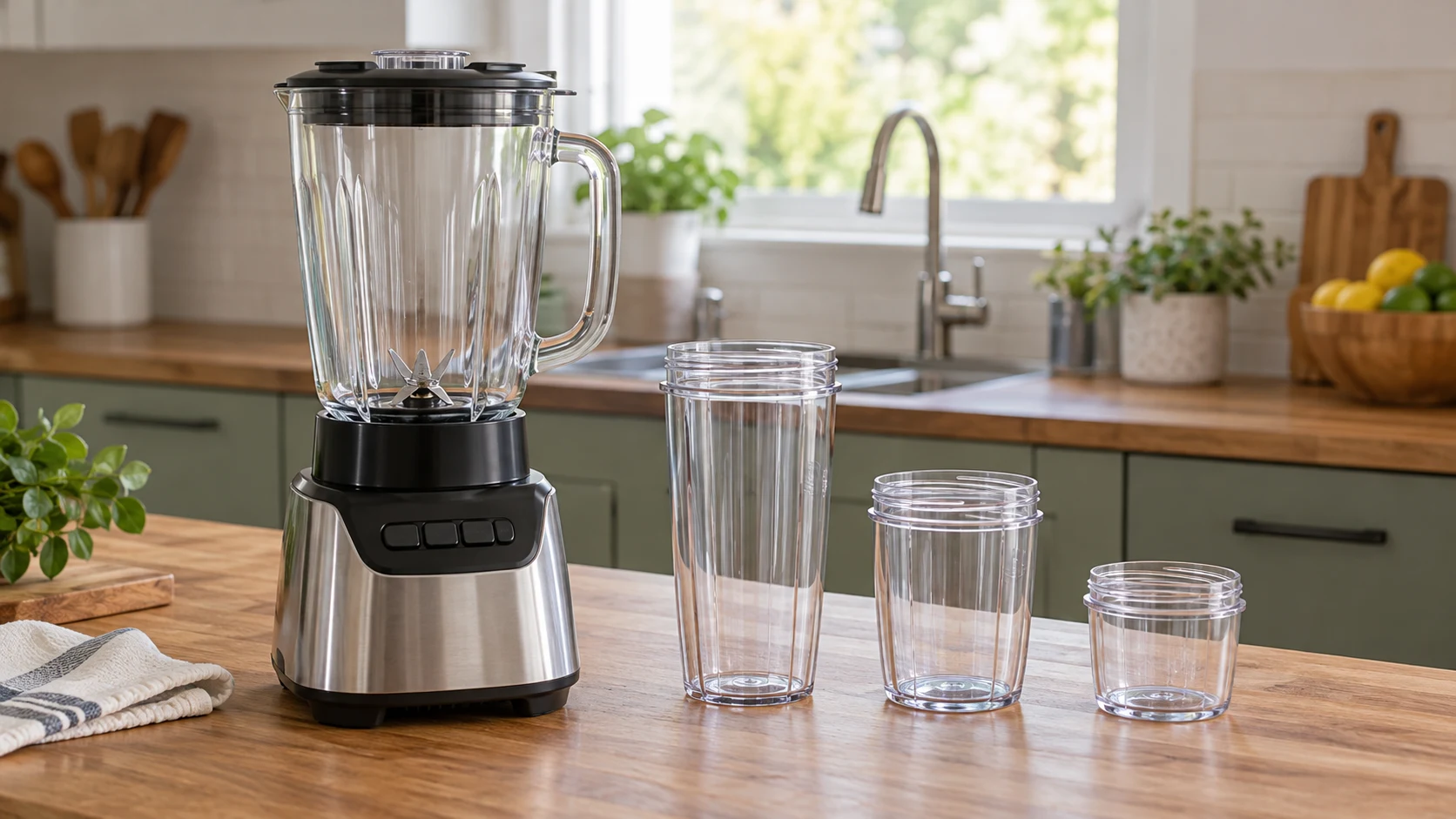
Conceptual editorial cover for blender auto cycles: a generic switched-off blender, empty pitcher and separate cups, without depicting exact retail models, supplied capacities or compatible operating configurations.