Garden Care & Watering
A bird seed mix percentage needs its whole amount identified
A fictional mass-percentage example shows why percentages attached to unequal whole amounts cannot simply be averaged, while actual ingredient proportions remain unknown.
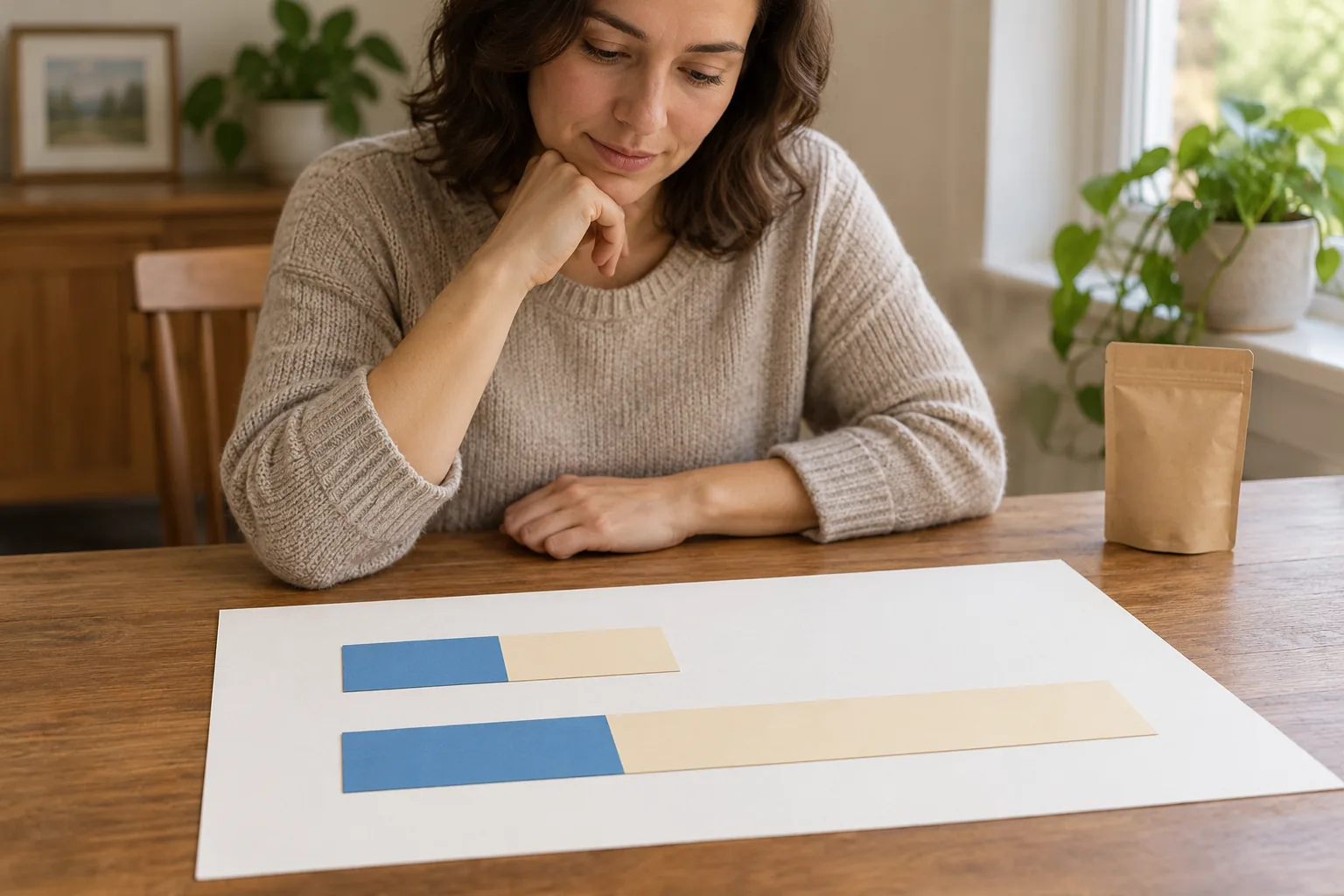
A bird seed mix percentage needs the amount and named component it concerns. A bag weight, an ingredient list and a percentage attached to another quantity do not supply the same information. This original fictional paper account explains the arithmetic distinction. It gives no feeding recipe, nutrition assessment or instruction to combine actual foods. None of its invented percentages describes either retail mix below.
Define a fictional component before calculating
Imagine Noor writing a paper example using an invented component called X. X is only a label in the arithmetic. It is not sunflower seed, a nutrient or a recommended food. Noor stipulates that every percentage in the example is an exact mass fraction of X in an identified whole. No real product sample has been weighed, sorted or analysed.
Her first fictional account, A, has a whole mass of one kilogram and an X fraction of twenty percent by mass. The second, B, has a whole mass of three kilograms and an X fraction of sixty percent by mass. Both use the same invented component and the same mass basis. Those conditions are explicit inputs, rather than assumptions taken from a retail picture or ingredient list.
Convert each stipulated percentage into its component amount
Twenty percent of one kilogram is 0.2 kilogram. Noor records that as A’s X amount. The rest of A is 0.8 kilogram under the defined two-part accounting, so the parts sum to the stated one-kilogram whole. The calculation describes only the stipulated paper account. It does not identify the actual composition of a bag someone owns.
Sixty percent of three kilograms is 1.8 kilograms. B’s remaining amount is 1.2 kilograms, and those parts sum to three kilograms. The larger percentage belongs to a larger whole here. Retain both numbers instead of putting twenty and sixty into an unlabeled average and expecting the result to describe their combined mass account.
Add component mass and total mass separately
For component mass and total mass, Noor adds like quantities to like quantities. The X amounts are 0.2 and 1.8 kilograms, giving two kilograms of X altogether. The whole amounts are one and three kilograms, giving four kilograms altogether. Her hypothetical combined account therefore has two kilograms of X out of four kilograms total.
Two divided by four is one half, or fifty percent. That is the X fraction of this combined paper account under the explicit no-loss, no-additional-material assumptions. It is not a recommended seed mixture. The example supplies no actual ingredients, handling method, feeder suitability or reason to combine any real products.
See why the simple average gives a different result
The ordinary arithmetic mean of twenty and sixty is forty. That calculation is correct as the mean of two percentage labels. It is not the mass fraction of Noor’s unequal one-kilogram and three-kilogram accounts. Treating it as that fraction would give the smaller whole the same influence as the larger whole while ignoring their stated amounts.
The two labels belong to different whole masses. B supplies three of the four kilograms and contains 1.8 of the two kilograms of X. Keep that contribution visible. The fifty-percent result follows from adding the component amounts and whole amounts, not from choosing the percentage that sounds more plausible or rounding the two original labels toward each other.
Equal whole amounts make a different example
Now create a separate version in which A and B each have a whole mass of one kilogram, while their exact X fractions remain twenty and sixty percent. Their X amounts are then 0.2 and 0.6 kilogram. Together they contain 0.8 kilogram of X in two kilograms total. The combined paper fraction is forty percent.
In this equal-whole version, the result matches the ordinary mean of the two percentages. That agreement does not repair the unequal-whole version, whose inputs are different. Keep the one-plus-one account separate from the one-plus-three account. A calculation can work for one stipulated arrangement without becoming a rule that ignores the whole amounts in another.
Changing the whole amount can change the component amount
Return to A’s twenty-percent fraction. If a different fictional account has two kilograms total at that same exact fraction, it contains 0.4 kilogram of X. The percentage stayed twenty while the component amount doubled from 0.2. A shared percentage therefore does not establish that two accounts contain equal component masses.
Conversely, a 0.2-kilogram X amount could belong to different wholes and thus different percentages. In a one-kilogram whole it is twenty percent; in a two-kilogram whole it is ten percent. Keep the denominator with the amount. The same numerator does not preserve the fraction when the whole changes.
Scaling the whole account preserves its fraction
Double every stipulated amount in Noor’s original unequal-whole account. A becomes two kilograms at twenty percent and B becomes six kilograms at sixty percent. Their X amounts become 0.4 and 3.6 kilograms, adding to four kilograms of X in eight kilograms total. The fraction is still one half. Scaling the entire paper account changed its amounts without changing their proportion.
Compare that change with adding only another three-kilogram B account to the original. The new total would be seven kilograms, containing 3.8 kilograms of X. Those numbers do not retain the original two-out-of-four fraction because the added account changes the relative contributions. Keep the stated addition beside the new result instead of assuming that any larger account keeps the old percentage.
These are checks on a defined arithmetic model. They add no real food, establish no mixing process and supply no reason to change a feeding arrangement. The account stays on paper with its invented component X.
Unknown ingredient shares stay unknown
Imagine a different fictional note that names X and gives a total of four kilograms but supplies no X amount or percentage. The total alone cannot fill the missing proportion. There could be many different X amounts consistent with that whole. Noor leaves the X field unanswered instead of copying twenty percent from another account with a familiar-looking description.
A list naming several ingredients likewise does not supply exact mass fractions merely by naming them. This article uses no ingredient-order rule to infer a percentage for either offer. Nor does it count visible pieces in a product photograph and treat that count as mass. The actual composition question needs the relevant product information rather than a convenient invented denominator.
Do not change the basis halfway through the account
Noor’s calculation defines every share by mass. Replacing one whole with a count of pieces would change the stated basis. Ten pieces of X among fifty pieces answers a count-fraction question. It supplies no mass fraction in this example because the masses of those pieces have not been established. Keep the kind of quantity visible beside each number.
The same care applies to volume labels. A container’s stated volume is not the kilogram total stipulated here. This paper account supplies no density, conversion from scoops to mass or sampling method. A household note can retain an unanswered quantity rather than treating a container that looks full as a measured composition result.
Distinguish exact model inputs from bounds
The twenty and sixty percent in Noor’s example are exact stipulated fractions. A statement giving only a minimum or maximum would describe a different condition. A lower bound does not establish that the value equals the bound. Without another actual value, the exact arithmetic result above cannot simply be assigned to a bounded statement.
Keep the named quantity with any bound as well. A percentage attached to crude protein, crude fat or crude fibre is not automatically the fraction of an ingredient named X. This exercise gives no nutrition interpretation or relationship between an ingredient and those quantities. It does not transform a nutrient-analysis label into an ingredient recipe.
Read the economy mix’s actual words and gallery
The selected economy twenty-five-pound wild bird mix offer names sunflower seeds, cracked corn, millet, wheat and milo. Its gallery also names grit and shows nutrient-analysis bounds. The description and images supply no exact ingredient mass fractions adopted here. Attraction, nutrition, feeder suitability and handling claims are not established by Noor’s arithmetic, and pictured piles are not a measured composition sample.
Keep the BestNest account with its own amount
The selected BestNest forty-pound Premium Classic mix offer names sunflower seed, millet and peanuts. Its gallery names additional ingredients, including safflower, striped sunflower, red millet and artificial flavouring, alongside nutrient-analysis bounds. No exact ingredient mass fractions are established for this guide. Its forty-pound whole is separate from the economy offer’s twenty-five-pound whole, and neither is Noor’s fictional kilogram account.
Both actual products are mixed wild-bird food, rather than empty feeder hardware or planting seed. Their ingredient names, package amounts and gallery statements remain attached to their own offers. This article makes no recommendation to mix them, replace one with the other or feed a particular bird. Follow actual applicable product and wildlife-care guidance for any real feeding decision.
Keep the related guides within their actual scopes
The winter bird seed planning guide keeps food identity, feeder requirements, storage and household stock with the intended purchase. Its fictional transfer example separates a moved quantity from household food still present. Noor’s new account instead compares component fractions across specified whole amounts. It supplies no winter reserve forecast or storage procedure.
The winter simultaneous bird-count guide keeps its maximum-per-species rule separate from added appearances and feeder capacity. Its personally observed count supplies no ingredient mass fraction or food-consumption amount here. Keep the observation question with that guide and the explicitly stipulated mass-percentage question with this paper exercise.
Keep a Republeq crypto order with its real food enquiry
If a reader considers wild-bird food through republeq.com, retain the exact offer and the unresolved product questions relevant to that real order. Noor’s paper account requires no purchase and establishes no actual ingredient percentage, nutritional suitability, feeder compatibility, attraction result or amount a household should buy. Confirm the selected food, package quantity and applicable product information before deciding whether to order. If the actual checkout offers cryptocurrency, including USDT, consider the methods and conditions presented for that particular basket. This article establishes no current token availability, network, payment address or amount and gives no transfer procedure. A preferred payment method cannot supply an unknown ingredient share or turn a product photograph into measured composition evidence. Read the delivery and return terms applying to the actual order, and retain necessary unanswered questions while making the decision. If a transaction is made, keep its real order identity and payment response. An uncertain result needs reconciliation through the merchant before another payment is considered. Several notes about one proposed bag do not, by themselves, establish several orders or justify another payment. Use the actual transaction information for that question. Likewise, adding the weights from unrelated offers would not establish the quantity in the order that was actually placed. A successful transaction would certify neither food condition nor an appropriate feeding arrangement. Keep the purchasing decision, product enquiry and transaction result connected through their real records, without allowing one completed step to fill an unanswered question belonging to another.
Finish with the whole amount still attached
Noor’s unequal fictional accounts contain two kilograms of X in four kilograms total, giving fifty percent. Her equal-whole version gives forty percent under different inputs. Neither result describes the selected foods. A bird seed mix percentage is clearer when its component, basis and whole amount stay attached, and actual missing product proportions remain unknown instead of inheriting a number from a paper example.
Different paper wholes and colored portions represent an invented percentage account.