Sewing & Crafts
Bias tape folds: flat trim and an edge wrap
An explanation of pre-folded sewing trim profiles, with a fictional apron detail and clear limits for two catalog examples.
Bias tape folds describe a sewing supply's prepared profile. Begin with the job shown in your project: a band across a surface or a finish surrounding an edge. Those locations can look similar in a distant picture while asking different things of the trim. Understanding the vocabulary gives you a more useful starting point than choosing a pleasing color and hoping the rest will follow.
This explanation uses two sewing references and two actual catalog offers. No material has been sewn, washed or tested for this article. The fictional apron example below concerns a design decision before construction. Keep the pattern's own supply requirements and instructions available when you move from understanding a term to making the project.
Single-fold bias tape as a prepared flat band
In Linda Griepentrog's American Sewing Guild article, single-fold bias tape is a fabric strip with its long edges pressed underneath. The article describes a flat trim band as one common use. Read that description as a construction term: the prepared edges belong to the strip itself. It is not an instruction to count every visible crease in an unfamiliar photograph.
The same reference discusses other applications and ways of attaching trim. This guide adopts the profile distinction, without prescribing those procedures. In particular, single-fold bias tape does not become a universal answer for every decorative detail merely because a project includes a band. The actual pattern remains responsible for what its design calls for.
Double-fold bias tape and the edge-wrap profile
Seamwork's bias-tape tutorial explains double-fold as single-fold tape folded again along its center. It describes this form as typically encasing a raw edge. That provides the second useful picture: trim continuing around an edge, rather than sitting only across a fabric face. Its making instructions and width calculations are outside this explanation.
A prepared profile is one feature of a supply. It does not specify every property needed for a project. Treat double-fold bias tape as the relevant construction name while leaving a particular pattern's material and supply specification intact. An illustrated example can explain the term without establishing that an unidentified roll is suitable.
Give the proposed detail a place in the drawing
Imagine an adult beginner, Mara, planning an apron for personal use. This is an invented example, with no completed garment or successful seam behind it. Mara's first sketch contains a coral line running across the middle of the apron front. A separate teal line follows the outer boundary. The colors are simply a way to keep two ideas visible in a drawing, rather than an assignment of retail products.
Mara initially describes both marks as “the trim.” That shorthand is enough while choosing a color scheme, but it leaves an important part of the design unstated. She gives the interior mark its own caption: a decorative band across the front. She describes the boundary mark separately: a finish around the existing edge. The sketch now communicates two locations without pretending to be a construction diagram.
The flat-band and edge-wrap explanations above give Mara words for discussing those different intentions. Nothing has been cut or attached. She can still decide that the apron should have only one detail, that the colors should change, or that the project should wait. A design sketch is useful precisely because a change on paper need not be reported as a change to an actual garment.
Suppose Mara removes the coral mark because it interrupts a printed motif in her imagined design. The remaining teal mark does not inherit every decision previously attached to the coral one. It has its own location and purpose in the sketch. Revising one element therefore changes the plan, rather than proving that the two proposed supplies were interchangeable all along.
Keep a pattern decision separate from a personal redesign
Now give the fictional project a pattern chosen by Mara. The pattern has its own supply list and instructions, neither reproduced nor evaluated here. Mara can compare the sketch with that actual design before buying anything. If she wants to add an element that the pattern does not contain, she should recognize the change as her own proposed redesign. The original pattern has not silently approved it.
That distinction is helpful when sharing the plan with a sewing tutor. Mara can show the pattern as published and the separate drawing as an idea. The tutor can then see where the question begins. An invented change does not need to be defended as something already instructed, and the original design does not need to be blamed for a feature it never included.
Suppose a friend admires the coral-and-teal sketch and asks Mara to make a second apron. Mara has not yet decided whether to build even the first one. She can share the idea while explaining that it remains a plan. Interest from another person does not turn the drawing into a tested pattern or establish that a chosen supply has produced a satisfactory result.
The friend might prefer a plain apron with no added detail. That is a complete design preference, even though the vocabulary lesson remains useful. Learning a supply term need not result in adding that supply to every project. Mara can retain the drawing as an abandoned option and proceed with the actual pattern she chooses, without inventing a failed sewing experiment.
Read the illustration as an explanation
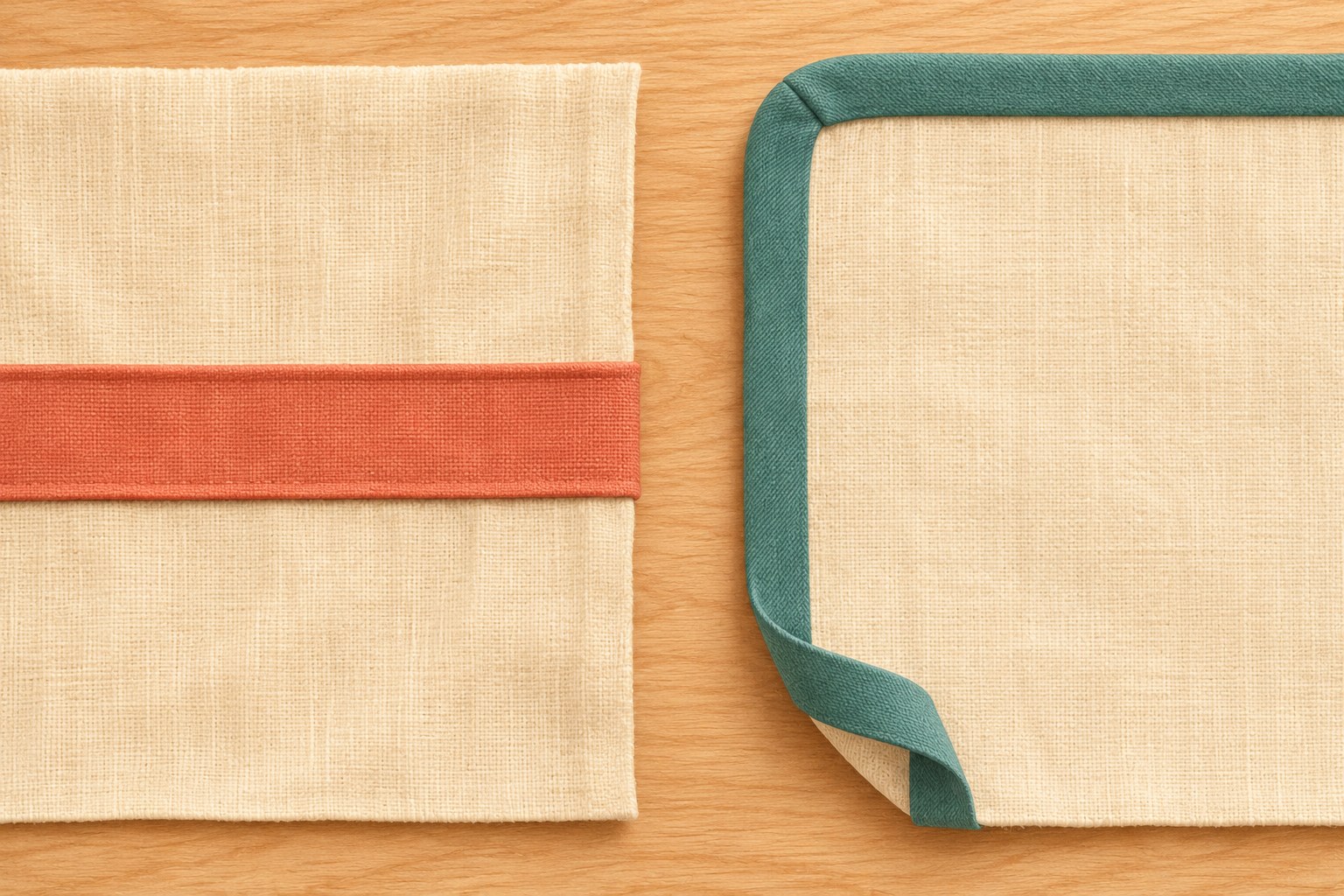
The conceptual cover gives each idea a separate fabric sample. The coral band crosses the face of the left sample. The teal detail occupies the boundary of the right sample, with a turned-up corner making the underside visible. Those deliberately different viewpoints help communicate the intended locations. They do not represent photographs of the two catalog offers or evidence of how a particular package was made.
A cover also leaves much of a project out. There is no complete apron, wearer or machine in this illustration. Its orderly appearance is a choice made for explanation, rather than the outcome of a documented making session. Mara could point to either sample when describing her sketch while still needing the actual pattern for construction. The illustration's role ends with that explanation.
For a discussion of the proposed design, this is enough. Mara can say which part of the picture resembles her intention and which details are merely illustrative. The coral and teal colors need not become requirements, and the separate sample panels need not become a patchwork plan. A visual reference can clarify one choice while leaving the rest of the project to its own brief.
Read the Unbranded offer within its catalog limits
The Unbranded single-fold bias tape offer identifies UPC710456800627 and SKU18685419832. Its description lists 20 rolls, 10 colors, polyester and a stated length per roll. The sole original image shows multicolor wound textile stock. It does not authenticate the delivered count, length, material, width or fold profile.
Keep those catalog claims attached to that offer. No readable maker or model label is established by its photograph. A colorful arrangement can help identify the account being discussed while leaving the actual contents of an order unresolved. It supplies no sewing trial for Mara's invented project.
Retain the CRAFTME alternatives as alternatives
The CRAFTME STUDIO double-fold bias tape offer has UPC345496984817. Its White × 50 Yards headline sits alongside Natural, Gray and White alternatives, while its description mentions 5 or 50 yards. The first actual variant is Natural. The three original pictures show wound trim on integral carriers, without establishing a selected variant or delivery of all three.
The description's cotton, linen and Japan wording remains attributed catalog information. No material or origin authentication is reported here. The carriers are part of the stock presentation, not an independently supplied organizer offer. Neither product account establishes that Mara has ordered, received or used anything.
Use related guidance for the question it actually answers
The grosgrain ribbon width guide considers nominal ribbon width and coverage on a gift. That is a different reader decision. Its ruler and paper-layout examples do not explain a bias-binding profile. Keep a width question with that guide rather than borrowing its gift-box demonstration as a sewing test.
The embroidery floss separation guide concerns identifying thread before attempting strand separation. It distinguishes a preparation method from a different thread construction. That article supplies no bias-tape attachment method. A useful limit on one craft supply remains useful without becoming instructions for another.
Mara's sketch also leaves several other questions open. It does not specify a fastening, a pocket, a strap arrangement or an intended wearer fit. Adding one of those decisions would extend the project brief. Keeping the drawing modest makes its present purpose clear: communicate the proposed visual detail so the next discussion starts with the same design in view.
If Mara returns to the idea months later, the old drawing can still be labeled as a proposal. A later photograph of a finished apron would be different evidence, belonging to whatever was actually made. There is no need to erase the earlier sketch, but there is also no reason to let its attractive appearance stand in for a missing construction result.
Keep the purchase and payment decision specific
If you decide to buy sewing supplies on republeq.com, keep the payment decision attached to the particular order. An interest in crypto does not establish that a selected trim meets a pattern's requirements. If you prefer USDT, first confirm whether the actual seller and current checkout offer it for that transaction. This article establishes no acceptance. Check the selected item, variation, stated package, delivery details, total and terms through the responsible service's current information. Obtain any applicable asset, network, amount and receiving destination from that service for the specific order. Do not copy payment instructions from a product image, a previous purchase or an informal message discussing a craft project. Keep an unclear instruction unresolved while seeking clarification. Retain the actual order reference and what was confirmed, without treating an acknowledgement as proof of material, origin or successful sewing. If payment status becomes uncertain, reconcile that status before considering another transfer. Uncertainty does not establish that nothing happened. This paragraph gives no wallet address, fee estimate, transfer guarantee or recovery procedure. A completed payment cannot establish a folded profile, authenticate a delivered package or approve an alteration to a pattern. You can leave an order unplaced while a real product question is answered. If someone else is ordering for you, give that person the exact selected reference and any remaining limitation so an unresolved assumption is not silently carried into the transaction. Keep a later product enquiry attached to the item actually selected, rather than to another color or a remembered photograph. Record the information supplied by the responsible service and retain the distinction between a proposed purchase and a confirmed transaction.
Return to the project with its present decision visible. Mara can now explain what she intended in the drawing and distinguish that intention from the pattern and the catalog examples. Bias tape folds give her a vocabulary for the supply profile. The actual project still needs its own specified materials and instructions before the design becomes something made.
Conceptual sewing illustration of flat trim and an edge wrap; no exact retail product or completed sewing trial is shown.