Crypto Commerce
BHUIK 13 lb twin tub washer vs FGYRYK 20 lb Twin Tub Washers for Small Loads
Compare BHUIK 13 lb twin tub washer by stated load capacity, wash and spin tubs, timers, drainage, footprint, and daily setup.
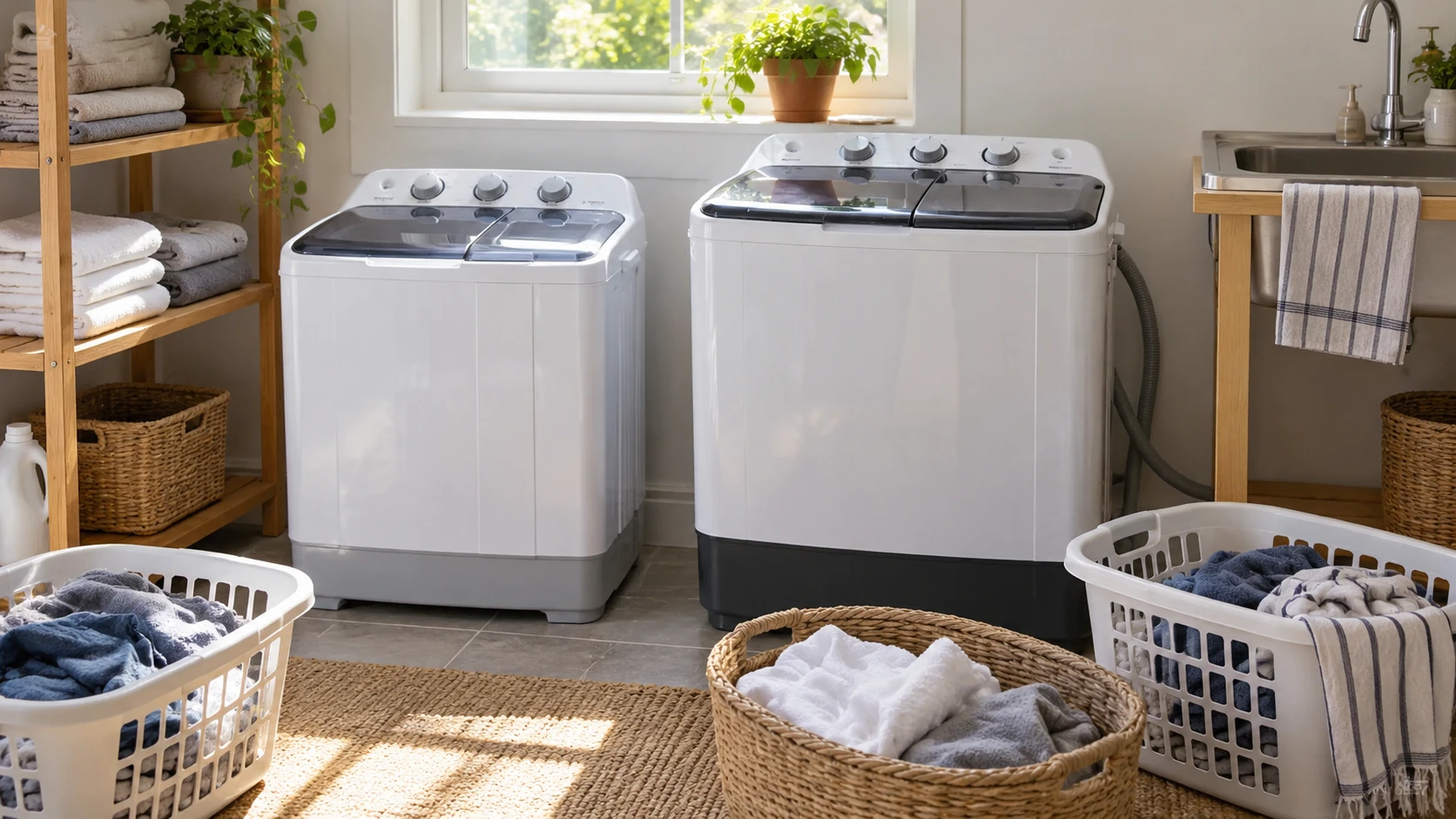
The BHUIK 13 lb twin tub washer and FGYRYK XPB45-428S are portable machines with separate washing and spinning tubs. They ask the user to move wet laundry between compartments rather than running an unattended automatic cycle. BHUIK states a 13-pound capacity, but its pinned description does not say how that total is divided between wash and spin sides. FGYRYK states 20 pounds total, divided into a 12-pound wash tub and an 8-pound spin tub. That split shows why a headline capacity cannot be treated as the weight of one wash batch.
The published portable top load washer comparison concerns larger top-load choices, but its central questions about load size and controls are useful when examining a small twin-tub machine. Weigh a typical basket of the clothes that will actually be washed: perhaps work shirts, towels, or a set of sheets. Separate bulky items that soak up water. Then compare that dry load with each manufacturer's wash and spin limits. The FGYRYK spin side is smaller than its wash side, so a full wash load may need to be spun in more than one round.
The FGYRYK XPB45-428S twin tub washer listing gives two separate timers, rotary controls, and a 1,300 RPM spin-speed claim. BHUIK specifies wash timing up to 15 minutes and spin timing up to five minutes. Both descriptions imply an active routine: fill the wash side, run it, drain or rinse according to the manual, transfer clothes, and spin. Before ordering, read each manual's water-fill, drain, and electrical instructions. The pinned excerpts leave several setup details open, including hose dimensions and the safe location for the drain outlet.
Compare usable loads, not package labels — portable top load washer comparison
FGYRYK's 12-pound wash tub and 8-pound spin tub are more informative than its 20-pound total. If a dry load weighs 10 pounds, it is below the stated wash limit but above the stated spin limit. It would need to be divided for spinning if the manual permits that wash size. The listing does not specify a recommended water level for each load or whether bulky items require a lower weight. Ask for the manual's examples and do not fill the tub to its edge merely because the dry weight seems acceptable. The clothes need space to circulate through water.
BHUIK's page says 13 pounds of capacity without a wash-versus-spin breakdown. Identify with Republeq each tub's maximum dry load for the exact SKU. A total derived by adding two tub ratings would be a different promise from a 13-pound wash rating. Until that is known, a capacity ranking is premature. The model is described as suitable for apartments, dorms, RVs, and travel, but those use cases do not establish how many towels or sheets fit. Check the actual tub openings, especially if bedding is the reason for buying a portable washer.
Try sorting an ordinary laundry week before choosing either machine. A small twin tub may work well for frequent modest loads, while a large blanket could be too bulky even when its dry weight is below a published limit. If several loads must be washed back to back, include the time needed to fill, drain, rinse, transfer, spin, and hang or dry the clothes. The listing capacities do not tell you how fast that complete process will be. Ask whether the manual limits consecutive cycles or calls for motor rest periods after repeated use.
Map the water path first — FGYRYK XPB45-428S twin tub washer
BHUIK's listing says it drains by gravity. That means the drain outlet must be able to discharge toward a lower approved drain point; the pinned excerpt does not provide hose length or outlet height. Plan the machine's location beside the sink, shower, or another suitable drain only after checking the manual and local rules for that space. A raised tub lip can stop a gravity hose from emptying properly. Test the proposed route with a drawing that shows height changes, and make sure the hose cannot slip out during a drain cycle.
FGYRYK's excerpt says to plug in, fill, and wash, but does not describe its drainage mechanism or included hoses. Do not assume it uses the same gravity path as BHUIK. Ask how the wash water and rinse water leave the machine, where the hose must end, and whether a pump is involved. An extra foot of floor space may be needed for a bucket or hose curve. Before making the first load, check the manual's permitted water source and electrical placement. A portable machine placed near water needs a stable, dry connection suited to its instructions.
Water handling also changes where the appliance can be stored. A twin tub that must be moved to a sink each time should be light enough to move safely when empty, and its hose and cord need a storage place. BHUIK lists a 24-pound machine weight. FGYRYK's pinned description gives dimensions but no weight. Ask whether wheels or carrying grips are included, and whether the appliance must be completely drained before moving. A portable label does not mean it should be carried with water in the tubs. Check the floor's ability to handle vibration and occasional splashes as well.
Read the controls for the whole routine — FGYRYK XPB45-428S twin tub washer
BHUIK describes separate timers: up to 15 minutes for washing and five minutes for spinning. This provides control over a short load, but the excerpt does not give water levels, agitation settings, or a rinse program. Ask whether the user must reset the timer for each rinse and how to pause safely to add an item. Timing a wash side does not automatically wash out detergent. Follow the manual's rinse process and detergent amount, then inspect the clothes before moving them to the spin side.
FGYRYK also lists separate timers and rotary knobs. Its 1,300 RPM figure describes the spin claim, not how dry every fabric will feel. Load balance, fabric type, and the amount placed in the spin tub affect results. Ask whether a cover or pressure plate is required above the clothes and whether it is included. A large towel can wrap unevenly around a spin basket. Stop and redistribute a load if the unit shakes or knocks, following the manual rather than letting a noisy cycle finish unattended.
The models' motor and power information is uneven. BHUIK lists 240 watts for washing and 120 watts for spinning. The FGYRYK pinned excerpt makes a lower-water-and-power claim but gives no wattage or measured consumption. Those figures cannot establish a running-cost winner, since the duration and water used per load also matter. If utilities are a deciding factor, ask for comparable electrical and water-use data for the same type of load. A few additional rinse rounds can change the practical resource use of a semi-automatic washer.
Fit the machine and laundry around it — FGYRYK XPB45-428S twin tub washer
FGYRYK lists dimensions of 25.2 by 14.2 by 28.4 inches. Confirm the order of width, depth, and height before planning a cabinet or bathroom corner, since the pinned excerpt presents the numbers without labels. Add space above the lids for loading, space beside the unit to transfer wet clothes, and space for hoses. A machine can fit between furniture and still be awkward to use if the lid cannot open fully. Ask for the footprint including any protruding drain or inlet fittings.
BHUIK's description gives a 24-pound weight but no exterior dimensions. Its lids are described as large to help loading and unloading. Ask for the opened-lid height and the size of each tub opening. A dorm or RV may have narrow doors and limited room to turn while carrying wet laundry. Measure the route from storage spot to use spot and consider where a basket can sit during transfer. Put the machine on a level surface specified by the manual. A small washer can move during spinning if it is uneven or overloaded.
The care labels on clothes still matter. A twin tub is an option for items that can handle its wash and spin action, but the pinned pages do not describe delicate settings or temperature controls. Sort fabric by the manufacturer's label and ask whether the machine can handle the chosen water temperature. Check pockets, close fasteners, and avoid mixing a heavy item with only a few light pieces in the spin basket. If a clothing item calls for a gentle or hand-wash method, a timer setting alone does not prove the portable machine is suitable.
Check the missing details before buying — FGYRYK XPB45-428S twin tub washer
For BHUIK, request the separate wash and spin load limits, exterior dimensions, tub openings, hose lengths, and complete drain instructions. Its 13-pound claim and 24-pound machine weight are useful starting facts, but they do not settle a family's largest weekly load. For FGYRYK, confirm the dimensions, 12/8-pound split, drain design, machine weight, and instructions for the 1,300 RPM spin cycle. Neither pinned description gives warranty terms or a full included-parts list. Keep Republeq's catalog answers tied to the exact SKU because similarly named twin tubs may differ.
Choose the unit around the available water route and the actual wash basket. If a confirmed BHUIK tub split fits small frequent loads and its gravity drain has a safe downhill path, its stated timers and lower listed machine weight may suit a temporary setup. If the FGYRYK's 12-pound wash side handles the usual load, allow for the smaller 8-pound spin side and its larger stated footprint. Verify every connection and load limit from the manual before the first use. The practical result depends on whether the full wash, rinse, transfer, spin, and drain routine fits the space and the person's time.