Crypto Commerce
Best Connections 14-gauge CCA speaker wire vs GearIT: choosing 14-gauge speaker wire for the route
Compare Best Connections 14-gauge CCA speaker wire by material, route, listed length, connectors, installation needs, and total project cost.
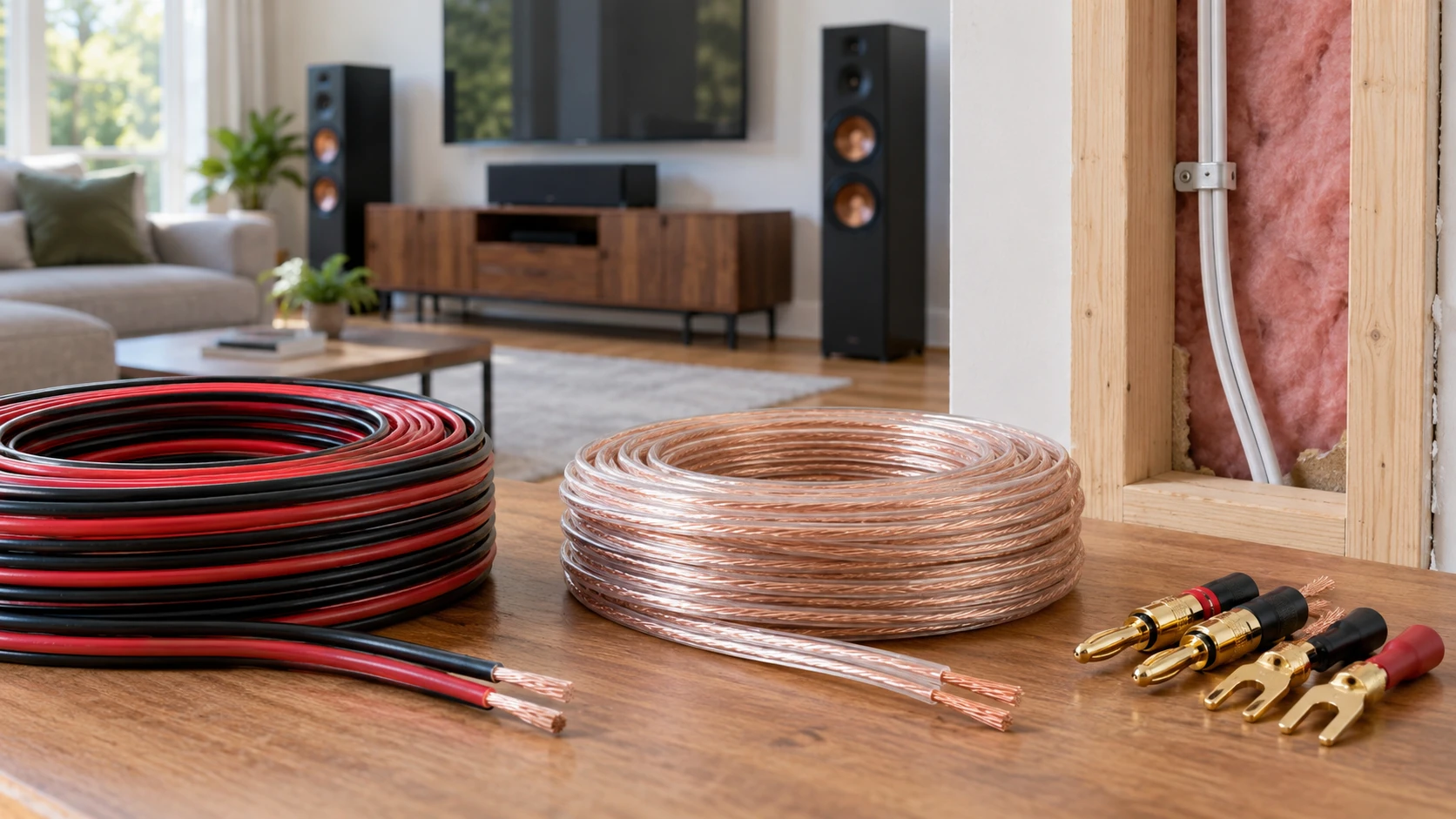
Both listings say 14-gauge speaker wire, but gauge is only one part of this purchase. Best Connections describes bonded red-and-black copper-clad aluminum conductors with a PVC jacket. GearIT describes high-strand oxygen-free copper with a UL CL2 rating for in-wall use. The intended route, length and termination method should decide which listing to investigate. A spool that is convenient across an open room may be unsuitable for a concealed run, and a cable with the right installation rating still needs the right quantity for the actual speaker positions.
The Best Connections 14-gauge CCA speaker wire listing calls its material copper-clad aluminum, often shortened to CCA. Its two conductors are bonded together in a red-and-black zip format. Color coding makes it easier to follow the same polarity from amplifier to speaker, especially when a system has several similar runs. The source presents the wire for home theater, car audio and other speaker installations, but it does not show an in-wall rating in the saved description. Confirm the rating required for the route before placing it inside a wall.
What the same gauge does and does not tell you — GearIT Pro Series 14 AWG OFC wire
The 14 AWG label gives a nominal conductor size category. It does not make CCA and OFC the same material. Best Connections states a copper-clad aluminum conductor, while GearIT states oxygen-free copper. GearIT's listing claims conductivity and corrosion advantages over CCA, but neither saved page provides a measured comparison of these two exact products on a given amplifier and speaker load. For a short exposed run, handling and fit at the terminals may be the most visible differences. For longer or more demanding runs, ask the equipment maker or installer for a material and gauge recommendation tied to the actual route and speaker impedance.
Avoid relying on a promise of audible improvement without knowing the system. Speakers, room placement, volume and recording quality can dominate what a listener notices. The immediate questions are more concrete: whether the conductors are correctly sized for the route, whether the jacket and rating suit the installation, and whether the bare wire or connector fits the terminal. An advertised conductivity benefit does not fix a loose connection, damaged insulation or a cable run that is too short.
GearIT's source says its OFC construction uses many strands. Best Connections also calls its CCA conductors stranded and flexible. Both descriptions suggest wire intended to bend around practical routes, though the saved text does not give a bend-radius limit for either. Plan broad, protected turns and avoid pinching the cable under furniture or at a terminal. If a run must pass through a wall or ceiling, choose materials and an installation method that meet the applicable requirements rather than guessing from a general “speaker wire” label.
Exposed runs and concealed runs — speaker wiring for a 5.1 room
The Best Connections listing explicitly describes a PVC jacket and a bonded zip pair. Those details are useful for a route behind a cabinet or along a baseboard where red and black can be traced easily. The product page does not establish a CL2 or similar in-wall rating in the saved source. A claim that the wire is suitable for home theater does not answer whether it may be concealed in a particular building. Check Republeq's product page for the cable's printed jacket markings and the applicable installation documentation if the route leaves the open room.
GearIT states UL CL2 rated for in-wall installations. That is a relevant distinction if speakers are to be wired through finished surfaces. It does not automatically resolve every local requirement, cable pathway or fire-stopping detail. An installer should review the planned route, local rules and the actual jacket marking. The source does not give a spool length, so the rating alone is not enough to order the right quantity. Check the exact item variant and length on the live listing before calculating a project total.
Think through speaker wiring for a 5.1 room before buying a large coil. Mark the amplifier and each passive speaker location, then trace a realistic path around doors, furniture and permanent fixtures. A straight-line measurement across the floor will usually be shorter than a neat routed cable. Include enough extra length for the equipment to move for service and for each termination to be remade if needed. Check whether every component in the planned system actually needs a passive-speaker wire; a powered or wireless unit may use a different connection.
The length wording needs confirmation — GearIT Pro Series 14 AWG OFC wire
Best Connections describes a two-item package marked BC-#14-500RB x 2. Its title says 500 feet each and 1,000 feet total. The body also describes red and black bonded conductors and uses “combined” length wording. A bonded two-conductor cable is normally measured by the length of the paired run, not by adding the red length to the black length. The saved text is not clear enough to establish whether the purchaser receives two separate 500-foot paired runs or some other packaging. Check Republeq's product page for a photo of the labels and the usable two-conductor cable length before ordering for a project that depends on 1,000 feet.
GearIT's saved source does not specify the length included with its listed item. It describes material, rating and connector compatibility but leaves the quantity unclear. That blocks a reliable per-foot price calculation from the catalog snapshot. Find the exact spool length on the current variant, then compare the price of the amount you will actually receive. A cheaper price per package can be a worse value if it leaves one room short and requires another order.
For either product, draw each speaker route separately and total the lengths only after allowing for the path and termination slack. Long, uninterrupted runs may favor a larger spool with fewer joins. Short, different routes may leave significant unused cable on a large package. Keep a simple record of planned and cut lengths so you know whether enough remains for the final speaker. This small step avoids discovering the shortage after furniture has been moved or holes have been made.
Connection and polarity at each end — GearIT Pro Series 14 AWG OFC wire
GearIT states that its wire can be used with banana plugs, spade tips and bent-pin connectors to connect speakers to a receiver or amplifier. That does not mean those connectors are included. Choose a termination compatible with the binding posts on both devices and with the installed conductor. Some spring-clip terminals may accept bare wire but not a large plug. The right connector depends on the actual equipment, and a tidy-looking plug is no benefit if it cannot seat securely.
Best Connections emphasizes red and black color coding. Use that consistent identification across every run and check the markings again at the speaker end. A reversed pair will still carry sound, making the error easy to overlook until the room is fully wired. Cut and strip carefully so loose strands cannot bridge adjacent terminals. GearIT's saved source does not specify a comparable red-and-black jacket scheme, so verify how its two conductors are marked before cutting several similar runs.
Label both ends of each run with the speaker position before connecting the receiver. That matters when several cables emerge together behind a cabinet or wall plate. A label such as rear left or front right can save time during later equipment changes, and it helps isolate a connection problem without pulling every wire back through its route.
If the cable will pass through a car, the route needs a different check from a living-room receiver. Both listings mention automotive use, and GearIT specifically claims benefits in car-audio installs. Check the vehicle's routing and protection needs, the amplifier and speaker terminal sizes, and the environment around moving parts. A general home-audio connector list does not establish that a particular cable or jacket is suitable near heat, water or abrasion in a vehicle.
Price, warranty and the purchase decision — GearIT Pro Series 14 AWG OFC wire
The saved catalog lists Best Connections at $268 and GearIT at $324.94. Those are package prices at the time of the snapshot, not prices per foot or current checkout quotes. Best Connections gives a package-length description that needs clarification; GearIT omits length in the saved source. Check each Republeq catalog entry for the exact length of usable paired cable in the offered variant, then divide price by that length if unit cost matters. Include connectors, routing supplies and any necessary installation work in the total.
GearIT advertises a lifetime guarantee and an easy return policy. Read the current written terms rather than assuming the warranty covers every installation or every kind of damage. Best Connections describes a durable PVC jacket but the saved source does not state a comparable warranty. Warranty language may be relevant for a large permanent job, though getting the correct material and rating at installation is still the first task.
The GearIT Pro Series 14 AWG OFC wire is the clearer candidate where the route requires the listed CL2 rating and where OFC is part of the specification. Best Connections offers a color-coded bonded CCA package that may suit an exposed run once its usable length is confirmed. Measure the routes, verify the jacket and package markings, and check the terminals before treating the shared 14-gauge label as a complete decision.