Crypto Commerce
BENESKY vs Magic Chef Wall Ovens: 24-Inch Model Checks
The clearest distinction in BENESKY vs Magic Chef wall ovens is what each description documents about cooking and operation. BENESKY lists 2.5 cubic feet, eight baking modes, 108 preset menus, and touch controls combined with mechanical knobs. Magic Chef lists 2.2 cubic feet, a convection element with a fan, and two racks with five rack positions. Those details support a shortlist, but neither description supplies everything needed to approve an installation or predict cooking results.
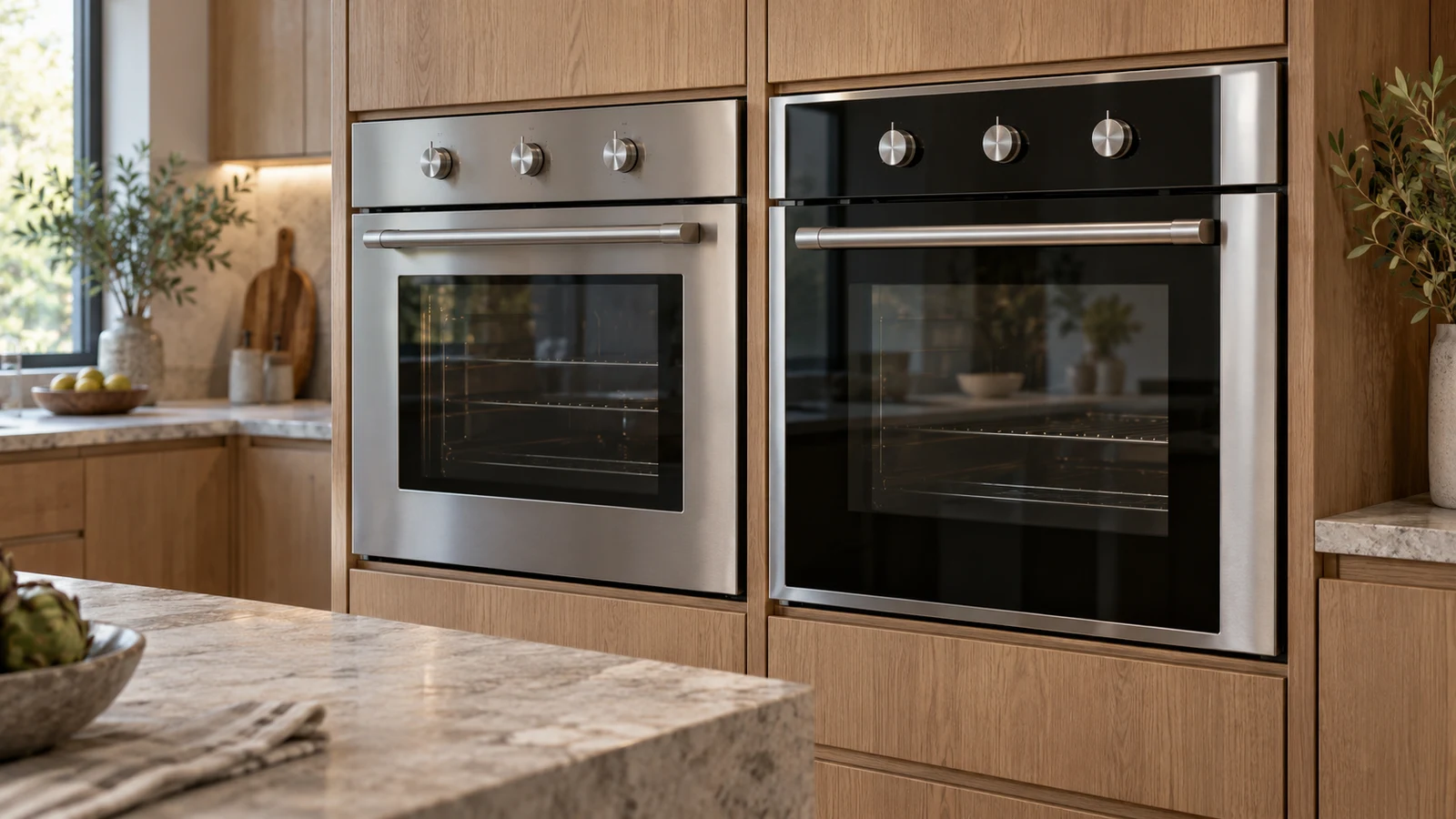
The clearest distinction in BENESKY vs Magic Chef wall ovens is what each description documents about cooking and operation. BENESKY lists 2.5 cubic feet, eight baking modes, 108 preset menus, and touch controls combined with mechanical knobs. Magic Chef lists 2.2 cubic feet, a convection element with a fan, and two racks with five rack positions. Those details support a shortlist, but neither description supplies everything needed to approve an installation or predict cooking results.
This comparison concerns the BENESKY 24-inch single electric built-in oven and the Magic Chef 24-inch built-in wall oven sold through Republeq. Keep those specific listings attached to your notes. A feature advertised for another oven from either brand does not establish a feature on these models, and the shared 24-inch label does not establish that they use the same cabinet opening.
For the BENESKY side of the BENESKY vs Magic Chef wall ovens comparison, the product description supplies both exterior and built-in cutout measurements. The Magic Chef description supplies more explicit rack information but no cutout measurements. Read an omitted detail as an unanswered question. It does not prove that a feature is absent or that one oven is less capable.
Magic Chef Oven Alternative: Capacity And Cooking Modes
BENESKY's stated capacity is 2.5 cubic feet; Magic Chef's is 2.2 cubic feet. That establishes the advertised cavity-volume figures for this pair. It does not establish which oven will accept your particular roasting dish, how much room remains around it, or whether two dishes can cook together. Neither description provides the usable interior measurements needed to settle those questions.
Give the volume figure an appropriate role in your decision. If you want the larger listed capacity, BENESKY meets that preference on paper. If a particular dish is essential, request usable cavity and rack measurements before treating either oven as suitable. Avoid converting the capacity difference into claims about extra portions or additional trays; those outcomes depend on details these descriptions do not resolve.
BENESKY describes eight baking modes and separately names heating/insulation, fermentation, thawing, and disinfection functions. It also advertises 108 intelligent preset menus. The description does not enumerate all eight baking modes or identify every preset, so the menu count cannot tell you whether a specific recipe has a suitable program. Ask for the operating manual if a named function is central to your choice.
The preset claim is most useful as a reason to inspect the program menu. For example, a buyer interested in fermentation could ask which settings are adjustable and what the instructions permit for that function. The description confirms the named capability, but it does not establish its detailed operating sequence. Likewise, a disinfection label should not be expanded into an unsupported claim about sterilization results or suitable items.
Magic Chef explicitly describes a convection element with a fan. Its listed programmable modes include defrost, broil, convection, and fan/grill. The description also says the defrost function circulates air at room temperature. These are specific statements about the Magic Chef oven; they should not migrate into the BENESKY comparison column simply because that oven also lists several cooking functions.
If convection is a purchase requirement, Magic Chef provides an explicit description to investigate further. BENESKY's supplied description does not explicitly establish convection, even though it advertises multiple baking modes. Conversely, Magic Chef's description does not establish an equivalent to BENESKY's 108 preset menus. The available information supports those differences in documentation without supporting a judgment that either oven produces better food.
BENESKY also lists a steaming temperature range of 140 to 230°F and a baking range of 212 to 482°F. Keep those ranges attached to their stated functions. The steaming reference does not explain water handling, required equipment, or preparation steps. If steaming matters to you, request those instructions before assuming how it works. Magic Chef's supplied description gives no corresponding temperature range for comparison.
A useful cooking shortlist can therefore remain quite specific. A buyer seeking documented convection can focus on Magic Chef's named modes. Someone interested in BENESKY's fermentation function or presets can request the relevant manual pages. Neither path requires a claim about faster preheating, more even browning, or temperature accuracy. The supplied material contains no independent side-by-side cooking tests to support such a ranking.
Magic Chef Oven Alternative: Exterior And Cutout Measurements
BENESKY states exterior dimensions of 23.4 × 22.6 × 23.4 inches and a built-in cutout of 22.2 × 22.8 × 23.4 inches. Preserve these as two separate sets of measurements. Exterior dimensions describe the appliance, while the cutout figures describe its stated installation opening. Substituting one set for the other would change the information the listing provides.
The description does not label the individual dimensions as width, height, or depth. Ask for a dimensioned installation drawing that identifies each axis before matching the numbers to your cabinet. Do not silently reorder them or assume a conventional sequence. A drawing should also clarify what the exterior measurements include, such as whether any projecting part is accounted for.
Magic Chef's supplied description contains no exterior or cutout dimensions. Its 24-inch product name is insufficient to fill those blanks. Request the installation drawing for the exact oven under consideration, and retain it alongside the BENESKY drawing if both remain on your shortlist. Applying the BENESKY opening measurements to Magic Chef would create a compatibility claim with no support.
For a replacement installation, give the installer the current opening measurements and the documentation for your preferred oven. Ask them to resolve any required clearances, mounting provisions, and cabinet support. Those details are not established here for either model. BENESKY's published cutout figures are useful starting information, but they do not constitute a complete installation specification.
The electrical information is also incomplete. BENESKY states 3000W, but its supplied description does not specify the required supply voltage or connection method. Magic Chef's supplied description does not provide those electrical details either. Have a qualified installer check the exact model documentation against the existing supply; do not infer compatibility from the oven's size, power figure, or the appliance it would replace.
Magic Chef Oven Alternative: Controls, Racks, And Care
BENESKY explicitly combines touch input with mechanical knobs and lists an integrated timer. That tells you the types of controls described, but it does not show which tasks belong to the touch interface and which belong to the knobs. If you prefer direct adjustment while cooking, request a control-panel diagram or demonstration showing how you select a mode and change its temperature.
Magic Chef lists a digital clock and timer along with programmable cooking modes. Its description does not specify the complete control layout or establish that it uses the same touch-and-knob arrangement as BENESKY. A clock display alone cannot answer how you select a program. Compare the operating instructions if button placement, display readability, or the number of steps involved will affect daily use.
Consider one ordinary task when reviewing those instructions: selecting a cooking mode and then adjusting its temperature. Trace that task on each model's panel without assuming the sequence is identical. For BENESKY, find out how the preset menus relate to manual settings. For Magic Chef, check how the named modes are selected. This gives the control comparison a practical purpose without declaring either interface easier before using it.
Magic Chef explicitly lists two oven racks and five rack positions. The rack count and position count describe different things: the description identifies two racks that can be arranged among the listed positions. It does not establish that five racks are supplied or that every possible rack arrangement is suitable for every mode. Consult the operating instructions for the arrangement appropriate to your intended cooking.
BENESKY's description mentions a baking tray, but it does not specify a rack count or number of rack positions. Ask the seller to confirm the package contents and available positions if those details influence your choice. Do not treat the mention of a tray as a complete accessory inventory, or assume that BENESKY supplies the same rack arrangement as Magic Chef.
Magic Chef also lists an oven light and a cooling fan that turns on when the oven is hot. Its description separately identifies the convection element with a fan. Keep those statements distinct when comparing features: a cooling-fan reference should not become an additional cooking-mode claim. BENESKY's supplied description does not establish matching light or cooling-fan specifications.
For care, BENESKY describes an enamel cavity and a baking tray that can be wiped clean. It also describes double-insulated LOW-E door glass and says the door is designed for disassembly for deeper cleaning. Those statements do not establish a self-cleaning cycle. Obtain the care instructions before choosing cleaning products or attempting any door disassembly, including confirmation of which parts the user may remove.
Magic Chef's supplied description does not state a cleaning cycle, cavity finish, or door-removal procedure. That limits the maintenance comparison; it does not prove that routine cleaning is harder. If access to door glass or cavity surfaces matters to you, ask for the care section of its manual. Compare the documented procedures before assigning an upkeep advantage to either model.
The descriptions also use different certification wording: BENESKY says ETL certified, while Magic Chef states a cETLus approved rating. Keep each designation with its own product. Neither statement supplies the missing electrical or cabinet instructions, and neither supports a claim that one oven is safer than the other. Ask the installer to review the model identification and applicable documentation for the proposed installation.
Empava 24-Inch Vs Rangaire 30-Inch Wall Oven Fit: Further Reading And Final Questions
If your search expands beyond this pair, the Empava 24-inch vs Rangaire 30-inch wall oven fit guide addresses a separate comparison. Keep its product measurements separate from the BENESKY and Magic Chef records. Here, the immediate task is to complete the missing information for these two ovens, particularly Magic Chef's installation dimensions and BENESKY's dimension order.
Before settling on a Magic Chef oven alternative, revisit the Magic Chef oven alternative comparison reference, which opens the Magic Chef product itself. Use that listing to retain the baseline: explicitly described convection, two racks, and five rack positions. Then decide which BENESKY features you actually want, rather than assuming its larger listed capacity or preset count replaces every feature of that baseline.
Your final BENESKY vs Magic Chef wall ovens decision can start with a clear preference while installation remains unresolved. BENESKY documents a broader set of named functions, preset menus, and combined touch-and-knob controls. Magic Chef explicitly documents convection and its rack arrangement. Choose the documented features that serve your cooking, then request the exact model's installation and operating instructions before committing to it.
Send the seller a focused request for the remaining details: a dimensioned drawing, electrical requirements, and any operating or accessory information essential to your choice. For BENESKY, include confirmation of the dimension order and rack provision. For Magic Chef, request the exterior and cutout measurements. Give the resulting documents to your installer so the purchase decision rests on the oven you intend to buy and the cabinet where it will go.