Crypto Commerce
AQSQ countertop dishwasher — Two countertop dishwashers for different water routines
Compare AQSQ countertop dishwasher by water setup, loading, cycles, placement, and daily care.
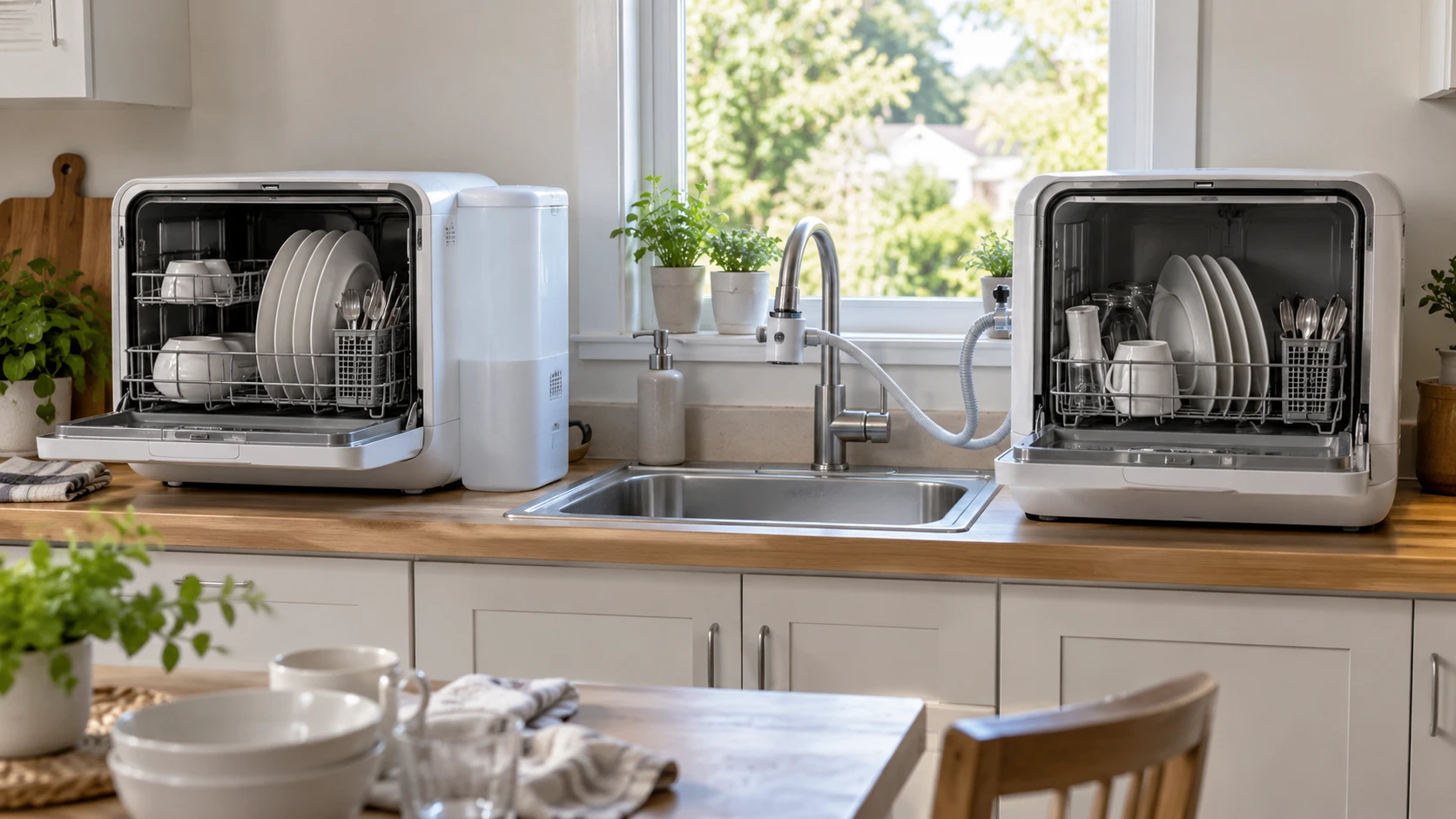
A countertop dishwasher can spare you hand-washing a small daily load, provided it has a workable place to take in water and send used water away. The AQSQ listing names a built-in 5-liter tank plus an inlet hose for a faucet. The Sunpentown SD-2224DWA listing names a universal faucet adapter and a quick-connect fitting. That difference should lead the comparison. If the kitchen faucet is difficult to share with a dishwasher, a tank option may be useful. If a suitable faucet connection is available, quick connection may fit the routine. Neither saved description supplies the complete dimensions, drain route, or faucet measurements needed to approve an installation without further checks.
The AQSQ countertop dishwasher is described as a portable machine with a 5-liter built-in tank, an included faucet inlet hose, two tiers of storage, and five wash programs. The source says an adapter may be needed for a faucet hookup. Sunpentown's page emphasizes a quick-connect faucet arrangement, seven named wash cycles, electronic controls, and water-supply and rinse-aid indicators. These are product-listing claims rather than measurements from a common wash test. Decide first where the machine would sit and how water would reach it, then compare the wash options you would actually use.
Trace both water paths before buying — countertop dishwasher water hookup
A tank-fed run and a faucet-fed run ask different things of the kitchen. For a tank, you need a convenient way to fill the unit and a stable place for it while it runs. For a faucet connection, you need the correct adapter and enough room for the hose without preventing ordinary sink use. In either case, used water needs a safe drain route. The published guide to countertop dishwasher water hookup explains why an inlet choice does not answer the drain question. Trace both routes from the proposed countertop position, including the full path of each hose.
AQSQ states that its 5-liter tank permits use away from a sink for the water-inlet side. The listing also says its included inlet hose can connect to a faucet, although an adapter may be required. That gives two ways to supply clean water, not permission to put the machine where waste water has nowhere to go. The saved excerpt does not state the drain hose length, allowable drain height, or whether a container may safely receive discharge. Ask for exact-model instructions before planning an out-of-sink location. A nearby outlet and an open counter do not by themselves solve drainage.
Sunpentown lists a universal faucet adapter and Quick Connect for connection to most kitchen faucets. The wording still calls for a check of your actual faucet: its threads, aerator, clearance from the backsplash, and whether an existing filter or pull-down sprayer changes what can attach. The saved excerpt does not name every compatible faucet or provide an alternate built-in-tank mode. Do not assume that a missing tank claim proves no tank exists; confirm the exact model's inlet options if that feature would affect your decision. The water-supply warning indicator may help reveal a faucet that was not turned on, but it cannot make an incompatible connection work.
Make a simple route drawing for each unit. Mark the faucet, sink, outlet, counter edge, cabinet doors, and the place the dishwasher door opens. Show where the clean-water hose would pass and where used water would be discharged. Then ask for the manufacturer's minimum clearances and permitted drain arrangement. Both listings are sparse on these installation details. A machine that occupies less counter width can still be unsuitable if its door hits a cabinet or its drain cannot be routed as instructed. Check the exact model's manual before treating portability as a guarantee that every kitchen layout works.
Test the load you wash most often — Sunpentown SD-2224DWA dishwasher
AQSQ's listing describes a two-tier shelf with five positions and capacity for more than 40 pieces of cutlery. It says removing the upper basket makes room for plates up to 11.8 inches. That is a useful detail if large dinner plates are the difficult item in your household, but removing a tier may reduce room for cups or smaller pieces on that run. Do not add the maximum plate claim and the full two-tier arrangement as though they can be used simultaneously. Measure the plates you own, including rims, and check the current loading diagram for the exact basket configuration.
The Sunpentown excerpt does not give a place-setting count, maximum plate diameter, or rack dimensions. Its list of cycles therefore cannot tell you whether a pan, cutting board, or tall glass fits. Request the interior dimensions and a rack image that shows the usable space with the spray path unobstructed. A dishwasher can have the right water connection and still leave you hand-washing the item you most wanted to avoid. Use a normal dirty load as the test: plates, bowls, cups, utensils, and one awkward piece that regularly ends up in the sink.
AQSQ's source describes three spray arms and a range of washing modes. That does not establish how clean a crowded rack comes out or how the spray reaches a bowl nested inside another. Sunpentown's listing does not provide a comparable spray-arm description in the saved excerpt. Follow the loading guidance for the chosen model rather than packing to the highest advertised item count. Before ordering, check whether your everyday dishes are allowed in a dishwasher at all. A wash-cycle label cannot override the care instructions for a wooden board, a delicate finish, or another item that needs different treatment.
Compare controls by the run you would start — Sunpentown SD-2224DWA dishwasher
AQSQ lists heavy, normal, delicate, quick, and fruity programs. The saved source gives 28 minutes for its quick cycle, but it does not state how dry dishes will be afterward or how that mode performs on a particular dirty load. It also mentions an air-refresh function and a delayed start between two and twelve hours. If you would run it after dinner, ask which mode handles food residue you commonly leave on plates and how long its full wash-and-dry sequence takes. A short quick-cycle figure is only one part of that routine.
The Sunpentown SD-2224DWA dishwasher lists heavy, normal, light, mini party, rinse, speed, and soak cycles. It offers delayed starts of two, four, six, or eight hours, and an LED display showing remaining time or the running state. Those options may be helpful if you collect a few dishes before a full wash or want to delay a cycle until later. The listing does not give comparable time, water, and drying figures for every mode. Do not equate one brand's speed mode with the other's quick mode without exact-model documentation.
Sunpentown also names an automatic detergent and rinse-agent dispenser and a rinse-aid refill indicator. The AQSQ excerpt names an automatic water-level indicator and LED touch controls. These signals answer different questions: one concerns washing supplies, another concerns incoming water. Decide which reminders would prevent a mistake in your usual setup. A display can make the current state easier to see, but it does not remove the need to check a hose or load the machine correctly. Look for the control-panel manual if another household member will use the dishwasher without the person who installed it.
Check placement, cleanup, and unresolved claims — Sunpentown SD-2224DWA dishwasher
AQSQ's listing describes double-glazed doors and an internal light so you can see the load. It also refers to an air-refresh function for drying. The saved excerpt does not give a measured drying result or identify which materials can stay in that mode. Sunpentown's excerpt describes an LED display but provides no comparable window or drying result. If you expect to put dishes straight into a cupboard, ask whether the exact cycle you plan to use includes drying and what the manual recommends after it ends. A visibly clean plate can still be wet when the door opens.
The AQSQ source contains an implausible wash-temperature figure alongside its other feature claims. That is a reason to check the manufacturer's current specifications before using temperature to choose it. The Sunpentown excerpt provides no wash-temperature measurement either. Do not infer sanitizing performance from words such as heavy, steam, or rinse. If sanitation of baby bottles or another item is central to the purchase, look for the exact model's documented program and the item's own care instructions. The saved catalog text does not verify a certified sanitation result for either machine.
Keep cleaning the machine in the comparison. Both units need a place to load detergent and a routine for clearing food from the interior according to their instructions. The saved excerpts do not describe filter removal, descaling intervals, hose storage, or replacement parts. Those unknowns matter in a small kitchen where the dishwasher may be moved after every run. Ask how to disconnect and store the inlet, protect the drain end, and access the filter without making a mess. A tank-fed option adds a filling task; a faucet-fed option adds a connection task. Choose the routine that fits the available counter and the number of loads you expect.
The AQSQ gives an explicitly listed tank-or-faucet inlet choice and a stated large-plate adjustment. Sunpentown gives an explicitly listed faucet adapter, supply warning, seven cycles, and dispenser reminders. Neither listing alone completes a safe placement plan. Verify faucet compatibility, drain instructions, door clearance, and usable rack dimensions for the exact unit, then compare the cycles against one real household load. That sequence makes the water decision concrete and keeps a long feature list from hiding a basic setup problem.