Crypto Commerce
AOSU C8E-4H four-camera solar kit vs Xiaomi outdoor cameras for the places a lens can see
Compare AOSU C8E-4H four-camera solar kit by coverage, power, network, night view, alerts, and recording questions.
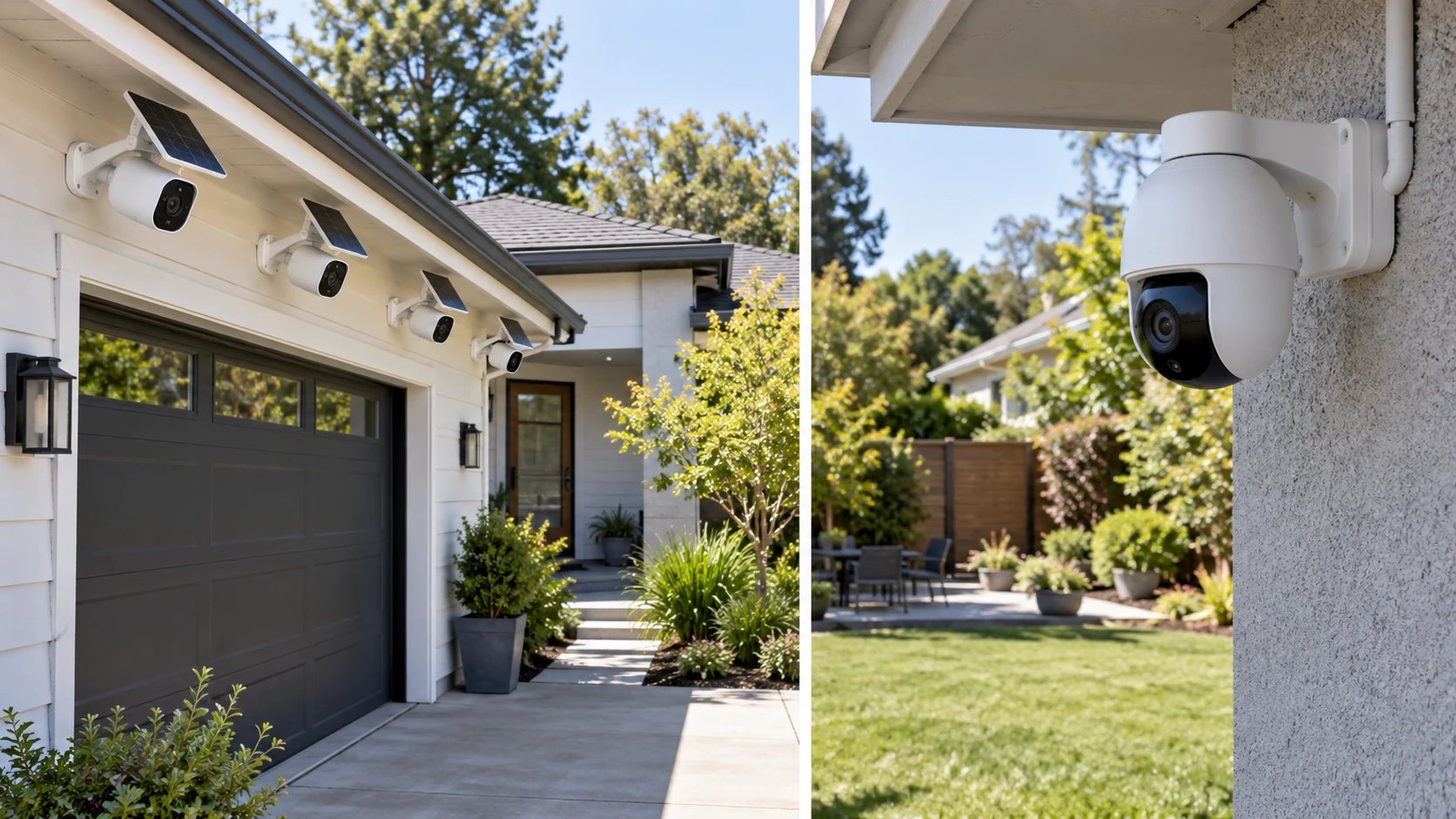
A four-camera kit and one moving camera solve different coverage problems. The AOSU C8E-4H listing offers four solar-assisted outdoor cameras with a HomeBase, aiming to watch several places at once. The Xiaomi CW300 listing describes one outdoor camera with a motorized pan-tilt lens, person detection, and movement tracking. A moving view can inspect more of one area, while cameras at separate positions can watch several approaches simultaneously. Neither approach removes the need to choose mounting spots, provide a working connection, and decide how recordings will be stored.
The AOSU C8E-4H four-camera solar kit is listed as a 2K, 3-megapixel system with spotlights, color night vision, camera-to-camera event tracking, and siren, light, and app alerts. The Xiaomi model is listed at 4 megapixels and 2.5K, with a pan-tilt mechanism, two-way audio, and an IP66 rating. These are saved catalog claims rather than comparable recordings at your doorway. Draw the areas you need to see before deciding that one specification wins.
Put cameras where events happen — outdoor camera coverage planning
Mark the gate, front door, driveway, side path, and any other place where you want a useful recording. Four separate AOSU cameras could be positioned to watch several of those areas at the same time. The saved listing does not give each lens's field of view, mounting angle, or distance for identifying a face or plate. Do not infer those details from the number of cameras. Check current examples from the exact model and position each unit where it can see an approach without pointing into a neighbor's private space.
Xiaomi's CW300 uses two motors to pan and tilt the lens from a smartphone and is described as tracking movement. That can help examine different parts of one yard or porch. It does not prove that the camera records all directions at once. If a delivery reaches the front door while the camera points toward the driveway, ask what its wide view, return position, and tracking behavior allow it to capture. The saved source does not give a horizontal field of view or a record of missed events during a turn.
The published guide on outdoor camera coverage planning compares a moving camera with a larger multi-camera system. Its key exercise applies here: draw sightlines from each proposed location and ask which events need simultaneous coverage. A pan-tilt camera can look around, but separate lenses can be pointed at different entrances continuously. Work out the positions before choosing a kit because power, signal, and mounting access may rule out an otherwise attractive spot.
Four cameras also mean four lenses to keep clean and four installations to inspect after weather or a branch grows into view. A single camera may be simpler to maintain, but it cannot physically see through a building corner. Think about the first week after installation: how will you verify that every entrance appears in the app, the angle stays where you set it, and night lighting does not reflect from a nearby wall? A useful setup includes a test walk through every important path.
AOSU's description says its system synchronizes events across cameras with camera-to-camera tracking. That may make it easier to follow someone moving between covered areas, but the saved text does not explain the time alignment or app workflow. It also says the four-camera kit can show up to two cameras simultaneously in its live view. Do not read that as a limit on the number of supplied cameras or assume it can display all four at once. Check the current app behavior if simultaneous monitoring matters.
Plan power and connection before mounting — Xiaomi CW300 outdoor pan-tilt camera
AOSU is sold as a solar camera kit. Solar assistance can reduce trips to recharge cameras if the panels get suitable light, but the saved excerpt gives no panel dimensions, battery capacity, or expected operating days in shade. Check the current installation manual for orientation, charging needs, and winter conditions. A north-facing wall, deep porch, or heavy tree cover may change the power plan. Do a signal and sunlight check at the actual mounting locations before drilling.
Xiaomi's short description gives no battery or solar claim. Its title mentions Wi-Fi and RJ45 connectivity, but that does not establish whether Ethernet carries power or whether a cable is included. Find the current CW300 power and network diagrams. If an outlet or low-voltage cable is needed near the camera, that may dominate installation effort. A network jack can be valuable for a hard-to-reach wireless location, but only when a safe cable route exists and the exact model supports the mode you expect.
AOSU's title says dual-band Wi-Fi, and the kit includes a HomeBase. The saved description does not specify radio range, whether cameras connect directly to the base, or what happens if the home internet goes down. Xiaomi is described as using the Mi Home or Xiaomi Home app, with Wi-Fi and RJ45 noted in its title. Check the precise connection path for both. A strong router signal inside the house may still be weak at a fence or detached garage. Test the phone or a suitable device at the planned spot, then verify with the camera before fixing mounts permanently.
If you intend to check video remotely, ask how each system handles an internet outage and whether local recording continues. The saved AOSU and Xiaomi excerpts do not give dependable storage capacity, subscription terms, or a full offline-behavior description. A HomeBase is a piece of hardware, not proof that video is stored locally without a fee. Confirm where clips live, how long they stay, and how you export evidence on the current exact package. Decide who in the household can access the account and alerts.
Read the night and detection claims carefully — Xiaomi CW300 outdoor pan-tilt camera
AOSU lists spotlights and color night vision and claims its 2K, 3-megapixel image is about 50 percent sharper than 1080p. The listing also suggests that number lets viewers read license plates. That is promotional language, not a guarantee at the distance and motion in your driveway. Lens angle, lighting, exposure, and compression all matter. Find model-specific night samples recorded at a comparable distance. A bright spotlight can improve a scene while also bothering neighbors or reflecting off a nearby surface.
Xiaomi lists a 4-megapixel sensor, 2.5K recording, and an f/1.6 lens. Its four full-color night-vision LEDs turn on after person detection according to the source. Those figures alone cannot prove that its image is more useful than a camera with fewer pixels. A narrow lens may show more detail in one spot while missing a wider approach. Compare real clips from similar mounting positions and ask what you need to identify: movement, clothing, a face, or a package at the door.
AOSU describes notifications with a preview when people arrive, pass, or stay in a detection zone. It offers siren, spotlight, and app responses. Xiaomi describes on-device human detection, automatic alert clips, phone notifications, movement tracking, and audible alarm and flashing lights. Neither saved description includes a controlled false-alert test. Walk the area at different times of day and adjust zones and sensitivity using the current app instructions. A camera that sends too many alerts may be ignored when an important event occurs.
Xiaomi lists a microphone and speaker for two-way communication with noise cancellation. AOSU's brief excerpt does not mention two-way audio, leaving it unverified for this exact kit. If talking to a visitor or delivery driver matters, check whether AOSU offers that feature and test how quickly either app connects. Two-way audio is less useful if the network delays the conversation or if wind overwhelms the microphone at the chosen mounting spot. The saved text cannot settle those practical details.
Compare complete systems and current offers — Xiaomi CW300 outdoor pan-tilt camera
Xiaomi's source states an IP66 dust- and water-resistance rating. AOSU's short description calls its kit outdoor but gives no specific IP rating. Obtain the current weather and temperature limits for all parts, including the HomeBase and any solar hardware. A rating on the camera does not mean a plug, cable joint, or indoor base can be left exposed. Follow the mounting instructions for drainage and service access so the lens can be cleaned without an unsafe climb.
The September 30 saved catalog marked both products available. It listed the four-camera AOSU kit at $324.99 and the single Xiaomi CW300 at $210. These are historical prices and may reflect different package contents. Confirm the number of cameras, included mounts, power parts, base, current subscription terms, warranty, and returns before comparing totals. If you need four separate views, multiplying a single-camera price is a different purchase from a one-camera setup. If you need only one entrance, buying four units may add work without improving that view.
AOSU deserves a closer look if several entrances need independent sightlines and solar mounting is practical at each location. Verify the power, storage, and weather details that its saved excerpt omits. The Xiaomi CW300 outdoor pan-tilt camera may suit one area where remote positioning, tracking, and two-way audio are useful. Verify the power and network wiring first. Draw the coverage map and test the actual views before assigning the cameras a security job.