Crypto Commerce
AOBOSI ABS-MCD25D car refrigerator vs SetPower RF25: keeping a car fridge running through a trip
Compare AOBOSI ABS-MCD25D car refrigerator by vehicle and campsite power, outage claims, interior capacity evidence, food temperatures, and saved price.
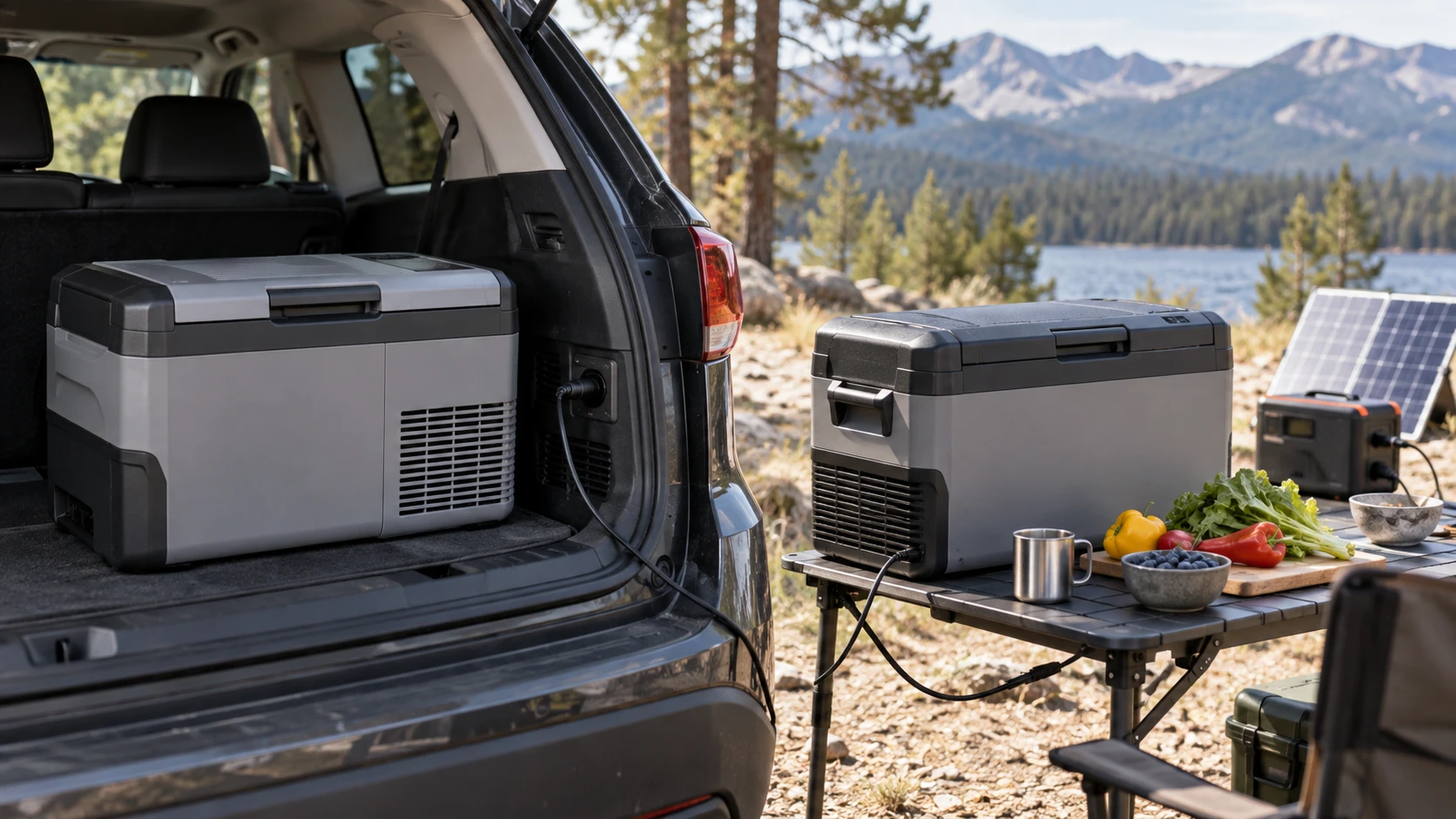
A powered car fridge makes a road trip easier only when its cooling plan matches the vehicle and stops along the way. The AOBOSI ABS-MCD25D lists a compressor, a broad temperature setting range, three-stage vehicle-battery protection, and compatibility with several power sources. The SetPower RF25 lists a built-in ice pack, 12/24-volt DC and household AC connections, and separate ECO and MAX power claims. The useful question is how each unit will be powered and monitored during driving, parked hours, and a power interruption. A capacity label alone cannot answer it.
The AOBOSI ABS-MCD25D car refrigerator is listed at $304 in the September 30 catalog snapshot. Its product title says 26 quarts or 25 liters, while a separate saved size field says 20 quarts. That conflict should be resolved from the current model specification before packing around an assumed capacity. The row gives a temperature range of -4°F to 68°F, a 31 dB operating claim, a 15-minute cooling claim without detailed test conditions, ECO and MAX modes, IPX4 water resistance, 45-degree shock resistance, and AC, DC, and solar compatibility.
The related guide to car-refrigerator camping supplies concerns a different unit but is useful for making a load and power checklist. It does not test either fridge here. The SetPower RF25 12V portable fridge is listed at $359. Its title gives 27 quarts. The row says the box includes a 100–240V AC adapter, a 12/24V DC cord, and a manual. It claims 28 watts in ECO mode, 40 watts in MAX mode, less than 1 kWh per day with its compressor cycling, and an internal ice pack that can keep food cool for up to 50 hours during a sudden power outage. Those figures need a realistic use test before relying on them for perishable food.
Verify the inside size before assigning food — SetPower RF25 12V portable fridge
The AOBOSI capacity conflict matters. A 26-quart title and 20-quart size field cannot both be used as an exact interior-volume promise without more evidence. Ask for the manufacturer's model diagram, interior dimensions, and perhaps a current manual for ABS-MCD25D. Check the usable floor and vertical space after accounting for the compressor hump, if one is present. The saved row does not describe its internal shape. Measure the tallest bottle or food container that will travel, then confirm whether the lid can close without pressing on it.
SetPower's title gives 27 quarts. Its saved description focuses on the ice pack and power modes and leaves interior dimensions unspecified. The ice pack may divide the compartment according to the Republeq's product description. Find out how much space remains with that divider installed and where vegetables, drinks, or chilled meals can sit. An advertised volume is not the same as the number of upright bottles or meal boxes a household can reach without unpacking everything. Ask for a current internal photo or dimensions if the trip depends on a particular cooler loadout.
Make a packing list with actual packages, then leave room for air circulation and for retrieving frequently used items. Ice packs, dividers, and removable baskets can change the useful shape. A family might need a single tall space for bottles; another might want to separate a meal kit from snacks. Neither saved excerpt provides a measured capacity for specific containers. The difference between the two title numbers is only one quart, so layout, power handling, and the capacity discrepancy deserve more weight than the headline gap.
Draw the power path for driving and parking — SetPower RF25 12V portable fridge
AOBOSI says it accepts AC, DC, and solar power sources. The snapshot does not identify the included adapters, required solar controller, input connector, or supported voltage for every source. Confirm all of those for the exact kit. Solar compatibility is not proof that a panel can be connected directly or that a small panel will run the compressor all day. A camping setup needs the panel, battery or power station, cables, and protection specified by the manufacturer. Check each connection with the unit before leaving home.
SetPower's row is clearer about two supplied power paths: a 12/24V DC cord for vehicle use and a 100–240V AC adapter for an appropriate outlet. Confirm the actual plug, cable length, fuse guidance, and whether the vehicle socket remains powered when the engine stops. The 28-watt ECO and 40-watt MAX figures are claims in Republeq's catalog for modes, not a measured whole-trip energy budget. Compressor cycling, ambient heat, food load, and thermostat setting can change daily draw. The phrase less than 1 kWh per day also needs its test conditions before it can be used to size a battery.
Plan the parked period separately from the driving period. A vehicle battery may need to start the engine after several hours of cooling. AOBOSI names three-stage battery protection, which may help prevent excessive discharge, but the snapshot does not give the cutoff voltages or prove compatibility with a specific vehicle. SetPower's excerpt does not state a comparable protection feature. Check both manuals and, for an extended stop, consider an appropriate auxiliary battery or powered campsite. Do not use a claimed low wattage as a substitute for a battery plan.
Separate rapid cooling from food-temperature safety — guide to car-refrigerator camping supplies
AOBOSI advertises cooling in 15 minutes and settings from -4°F to 68°F. The saved row does not say the starting temperature, ambient temperature, empty-versus-loaded condition, or target reached during those 15 minutes. SetPower does not give a cooling-time figure in the excerpt. Neither statement proves that a warm box of groceries reaches a safe temperature quickly. Pre-chill the unit and food where appropriate, follow food-safety guidance for perishables, and use a separate thermometer to observe the actual interior during the trip.
The wide AOBOSI setting range suggests it can be used for chilled or frozen loads according to its controls. That does not mean one compartment can hold freezer food and refrigerator food at separate temperatures at the same time; the row does not describe independent zones. SetPower's ice pack can separate items physically, but the excerpt does not name dual temperature control. Identify whether a trip needs one temperature or genuinely separate zones. A divider alone does not create two independently regulated chambers.
Put the thermometer beside the most temperature-sensitive food. Check it after the car has been parked in heat, after a lid-opening period, and after changing power sources. The saved product rows do not compare temperature stability under those conditions. If the unit fails to stay within the required food-storage range, adjust the power and loading plan or use another safe storage method. A car fridge should be judged by observed temperatures through the whole trip, not by the lowest number printed on its control panel.
What happens if power is interrupted? — SetPower RF25 12V portable fridge
SetPower's internal ice pack is described as keeping food cool for up to 50 hours after a sudden power outage. The row does not state the food load, starting temperature, ambient conditions, lid openings, or threshold used to define cool. Treat the 50 hours as a product claim for a particular test, not as a general safe-food-storage window. A thermometer and a plan for where to move perishables matter more than a single maximum. Ask whether the ice pack must be pre-frozen or placed in a specific position for the claim to apply.
AOBOSI's row does not name a passive ice pack, but it does mention three-stage battery protection and multiple compatible power sources. Those features address a different problem: arranging power before a cutoff occurs. Check whether the unit restarts automatically after power returns and whether it retains its temperature setting. The snapshot does not say. A buyer who expects unattended operation at a campsite should test a safe power-interruption scenario with nonperishable contents before relying on the fridge for medication or food.
Both units still need airflow and appropriate placement during an outage or restart. Do not block ventilation with bags, bedding, or camping gear. Check the manufacturer's clearance requirements and how the lid opens when the cooler is strapped in a vehicle. A sudden loss of power is easier to handle when the thermometer is visible and the alternative cooler or campsite refrigerator is already identified. This is operational planning, not a performance ranking between two untested units.
Noise, movement, and road use — SetPower RF25 12V portable fridge
The AOBOSI row gives 31 dB as an operating claim and mentions 45-degree shock resistance and IPX4 water resistance. Those figures do not establish that the unit will be inaudible beside a bed or safe in driving rain. Ask what the shock and ingress claims cover and keep plugs and adapters dry according to the manual. Secure the fridge against sliding or tipping during braking. Check the lid latch and handle before a rough road; the saved excerpt does not list their design.
SetPower's excerpt does not give a noise figure or ingress rating. That absence prevents a decibel or weather comparison from the saved evidence. A camper sleeping near the cooler should test sound while the compressor cycles. Any electrical fridge needs an appropriate dry, ventilated position. A manufacturer claim of low consumption says little about nighttime noise. If the unit rides in the car and then moves to a tent platform or cabin, consider its weight, grips, and the route to an outlet. Neither row gives a confirmed carrying weight.
A road-use test can combine several checks. Load harmless containers, drive the usual route, and see whether the unit stays secured and cools as expected. Verify that a DC plug does not work loose, the lid opens in the parked space, and cables cannot snag feet. The manufacturer manuals set the installation boundaries. This rehearsal can reveal a practical problem before the cooler is filled with expensive food.
Price, support, and a trip-ready decision — SetPower RF25 12V portable fridge
The saved SetPower price of $359 is $55 above AOBOSI's $304. Current checkout totals may differ. SetPower's listing names three years of technical support for the compressor and one year of maintenance on parts; verify the exact warranty wording, claimant, and service process before assigning value to it. AOBOSI's excerpt does not provide warranty terms. The listed SetPower AC adapter and DC cord may reduce separate purchases, while AOBOSI's solar compatibility needs an exact connection and accessory check.
Choose AOBOSI if its verified interior size fits, the planned power arrangement benefits from its battery-protection stages or compatible solar path, and its wide temperature settings serve the load. Resolve the 26-quart-versus-20-quart discrepancy first. Choose SetPower if the supplied power cables and passive ice-pack feature support the actual travel plan, after checking the ice pack's conditions and measuring real interior temperature. Pack a thermometer, test both driving and parked power, and confirm the food remains safely cooled. Those checks are more useful than a one-quart title difference.