Crypto Commerce
Allegro MU4101 central vacuum vs Ultra Clean SC200 for central vacuum planning
Compare Allegro MU4101 central vacuum by coverage claims, airflow figures, filtration, wiring, mounting, bags, and motor warranties.
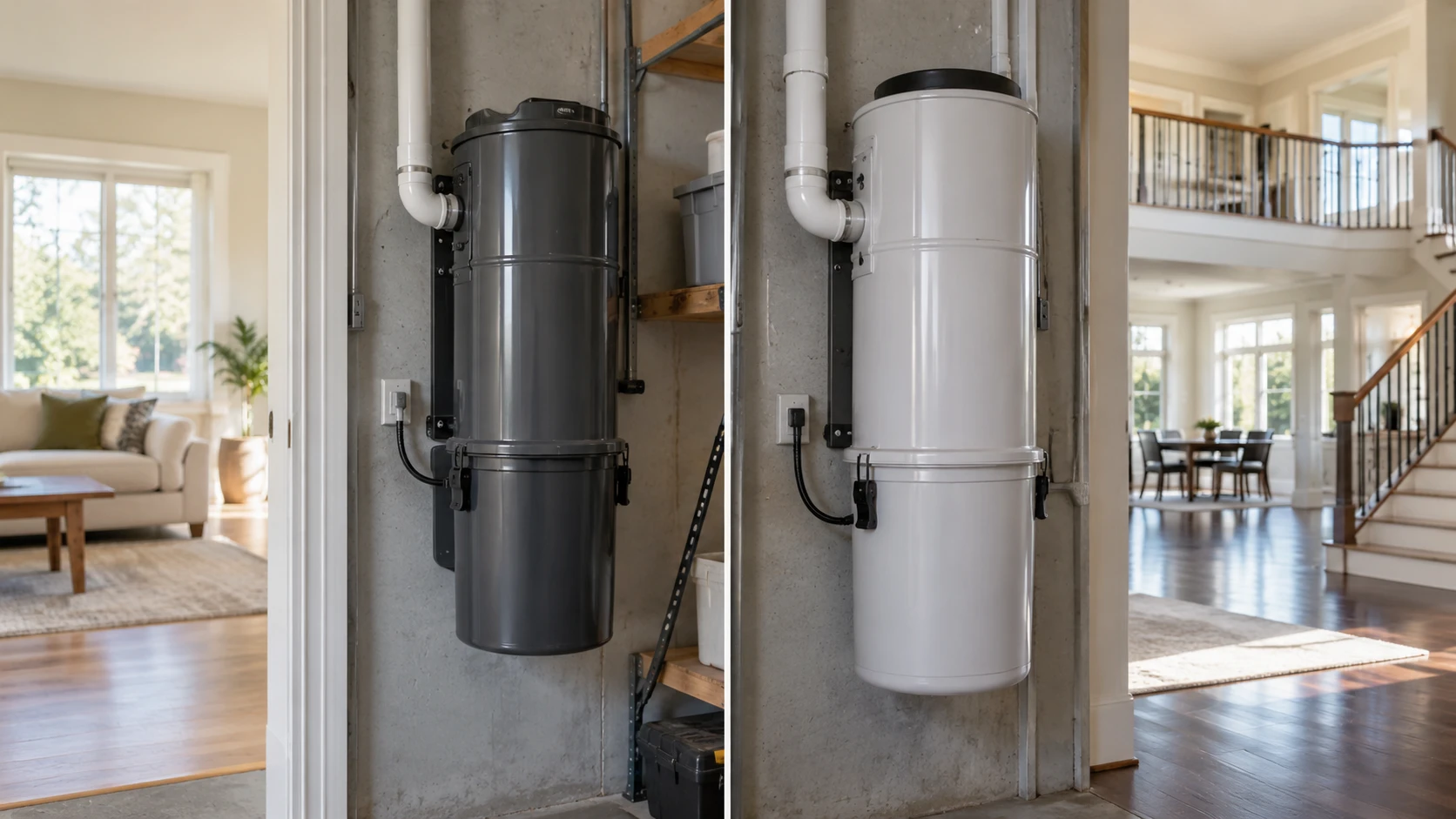
The Allegro MU4101 central vacuum and Ultra Clean SC200 listings make an unusual comparison. Allegro is labeled for spaces up to 3,000 square feet, while Ultra Clean is described for a home around 7,000 square feet, with 7,500 square feet appearing in its title. Yet both listings give the same three performance numbers: 550 air watts, 125 inches of water lift, and 121 cubic feet per minute of airflow. Those repeated figures do not prove the two units perform identically in a real home's piping. They make the different coverage labels a question to investigate before buying.
A central vacuum power unit is one part of a fixed system. The length and layout of the pipes, the number and condition of wall inlets, the hose and cleaning head, electrical supply, exhaust path, and filtration all affect daily use. A bigger square-footage claim cannot settle whether a replacement fits an existing system. Start by identifying the power unit you have, measuring its installation area, and tracing how the wall inlets activate it. If this is a new installation, plan the pipe and inlet network before selecting a motor cabinet.
Treat coverage as a planning claim — Ultra Clean SC200 central vacuum
Allegro's saved description calls the MU4101 suitable for up to 3,000 square feet. Ultra Clean's body text says 7,000 square feet while its product title says 7,500. Neither excerpt explains the assumptions behind those areas: number of inlets, pipe diameter, longest run, bends, hose length, or cleaning-head load. The conflicting Ultra Clean figures are a reason to request a current model specification, not to choose the larger number. A house's floor area alone does not describe the resistance between the unit and a distant attachment.
A good replacement question is whether the manufacturer recommends the exact power unit for your longest pipe route. Draw the unit location and the farthest inlet, then count bends and measure the hose needed to reach the room. Ask an installer or manufacturer to account for those details. The square footage printed on a box is a shorthand for some assumed installation, and the saved excerpts do not state that assumption. A smaller home with a long, complicated run can be harder to serve than a larger home with a short, simple layout.
Do not infer that Ultra Clean is automatically stronger because its coverage label is more than double Allegro's. Conversely, identical performance figures may come from similar marketing specifications rather than independent side-by-side testing. Confirm the model number and current technical sheet for each unit. If a Republeq's available product details do not explain how the coverage claim relates to the airflow and suction numbers, choose based on verifiable installation compatibility and support rather than the largest area on the page.
Read airflow and lift together — compare vacuum suction claims
Both saved listings state 125 inches of water lift and 121 CFM airflow. Allegro also lists 550 air watts; Ultra Clean repeats that value. Water lift describes a suction-pressure capability under a specific restriction. Airflow describes volume movement under its own test condition. Neither single number tells you the flow through a particular hose, brush, bag, and pipe network while cleaning. An air-watt figure combines pressure and flow at a measurement point, but the listings do not supply comparable curves across restrictions.
The related guide on how to compare vacuum suction claims explains why headline pressure, airflow, and wattage cannot be read as one universal strength score. Apply that discipline here. Ask where each figure was measured and under what setup. For a central system, performance at the farthest wall inlet and at the cleaning head matters more than an isolated motor figure. If a current system disappoints, check for clogs, leaks, a full collection bag, or a worn brush before deciding that the power unit is undersized.
Allegro lists a 13.8-amp current draw. Ultra Clean describes approximately 1,675 watts at 120 volts and says it works on a non-dedicated 15-amp breaker. These are not enough to approve an electrical installation. A motor's starting demand, the existing circuit load, outlet type, and applicable electrical rules still matter. Have the circuit and receptacle checked against the manufacturer's exact installation instructions. Do not treat a Republeq's catalog mention of a 15-amp breaker as permission to overload a shared circuit.
Motor design and cooling — Ultra Clean SC200 central vacuum
Both listings describe a two-stage, 5.7-inch, single-speed tangential-bypass motor with a 10 mm shaft and bearing arrangement. Allegro names an Ametek Lamb blower and a separate fresh-air cooling fan. Ultra Clean also describes a dedicated cooling fan that keeps heated or dirty exhaust away from the motor chamber. The descriptions are similar, but they do not prove the same motor part number, replacement availability, or service procedure. Ask for the exact service part and warranty terms if long-term repairability is important.
Allegro's page includes an extended explanation of why it favors tangential-bypass motors over through-flow designs. That is a Republeq's catalog comparison, not a test of every portable or central vacuum motor. For these two units, the relevant question is how each installed motor receives cooling air and where its exhaust goes. A power unit mounted in a tight closet or next to stored items may need clearances and an exhaust arrangement the product page does not spell out. Read the current manual before drilling mounting holes or enclosing the cabinet.
Neither excerpt describes an adjustable suction setting. Single-speed operation can be fine for routine floor cleaning, but delicate upholstery or curtains may need a suitable tool or a hose with airflow control. Check the accessories you already own. The power unit listings do not necessarily include a hose, wand, motorized floor head, or wall inlets. Buying a cabinet without the missing parts could leave the house with a mounted motor and no practical way to clean.
Bags, filters, and emptying — Ultra Clean SC200 central vacuum
Allegro calls its MU4101 a hybrid unit that can work with or without collection bags. The saved text describes a permanent self-cleaning filter, a HEPA system claim, and optional triple-layer bags intended to trap fine dust. Ultra Clean also calls its SC200 hybrid: it can collect in a filtration bag or a metal pail and includes a permanent microfiber filter. It says one compatible disposable bag is included and instructs buyers to use Ultra Clean triple-layer bags. Both descriptions suggest different ways to maintain the unit, but they do not give comparable independent particle-emission tests.
Ask how the filter and bag fit together on each model. A bag can make emptying less dusty but creates a recurring supply cost. Bagless emptying avoids that purchase and may expose more dust when the pail is opened. Confirm the current bag part number, price, and availability, especially if the unit will be mounted in a garage or basement where you want a predictable maintenance routine. Do not substitute a bag that merely appears similar if the manufacturer requires a specific fit.
Allegro's text claims capture of up to 99.97 percent of allergens. That phrasing leaves out the particle size, test method, and whether it refers to the filter alone or the entire installed machine. Ultra Clean calls available paper bags HEPA bags but does not establish an equivalent whole-system rating. If fine-dust control is a primary reason for installing a central vacuum, ask where exhaust air is discharged and request test evidence for the complete arrangement. Leaks around a poorly seated bag or filter can undermine a filter-material claim.
Plan access for emptying before choosing the mounting location. A cabinet may fit against a wall yet leave too little room below to remove its canister or bag. Ask for actual cabinet dimensions, collection capacity, and the clearance required to lift or drop the pail. The saved descriptions do not give a complete dimension drawing for either unit. Mark nearby pipes, shelves, cars, and doors on the installation sketch so routine service does not require dismantling the room.
Controls and existing-system fit — Ultra Clean SC200 central vacuum
Ultra Clean explicitly says a low-voltage connection turns the unit on when a hose is plugged into a wall inlet. It lists a mounting bracket and a six-foot, three-prong North American power cord. Allegro's excerpt does not give the same installation detail, so verify its low-voltage terminal arrangement, bracket contents, cord length, and physical dimensions separately. Existing houses can have different inlet switches and wiring. Confirm compatibility before removing a working old unit, and label the connections so they can be restored if necessary.
A replacement unit also needs to connect to the existing pipe diameter and exhaust plan. Measure pipe size and the position of the intake on the old cabinet. Check whether an adapter is permitted and whether the new unit can sit where the old one stood without a sharp bend. A tight bend at the unit can add resistance to the farthest cleaning run. If a system is new, choose inlet locations so the hose reaches the whole room without crossing unsafe stairs or leaving corners unreachable.
Installation questions extend to noise. Ultra Clean lists an exhaust muffler; Allegro describes steel housing and separate motor cooling. Neither saved excerpt gives a measured sound level under comparable conditions. A central unit mounted beside a bedroom or shared wall may sound different from one in a detached garage. Ask for a meaningful noise figure if that location matters, and consider vibration isolation and mounting instructions. Do not infer quiet operation from the absence of a decibel claim.
Warranty and final choice — Ultra Clean SC200 central vacuum
Allegro claims a lifetime warranty against corrosion perforation and a seven-year manufacturer's motor warranty. Ultra Clean lists a lifetime corrosion-perforation guarantee and a five-year motor warranty. These terms cover different components and may have registration, labor, shipping, or proof-of-purchase conditions. Obtain the written warranty for the exact model and Republeq's catalog before treating two extra motor years as a decisive benefit. Ask where replacement bags, filters, and motor parts can be sourced during the expected life of the installation.
The Ultra Clean SC200 central vacuum has more explicit information about its mounting bracket, low-voltage switching, cord, and collection bag in the saved listing. Allegro supplies more detail about motor branding and its longer stated motor-warranty period. The repeated 550-air-watt, 125-inch, and 121-CFM figures make it especially important to test the coverage claims against a real pipe plan. Choose the unit that fits the existing system or a documented new design, then verify airflow at the farthest inlet after installation. That practical check can reveal a leak or blockage that no product-page area estimate would catch.