Heating, Cooling & Air Quality
Choosing an air purifier replacement filter: match the exact model
Check the purifier model, replacement part and physical fit before relying on a HEPA label or pack count.
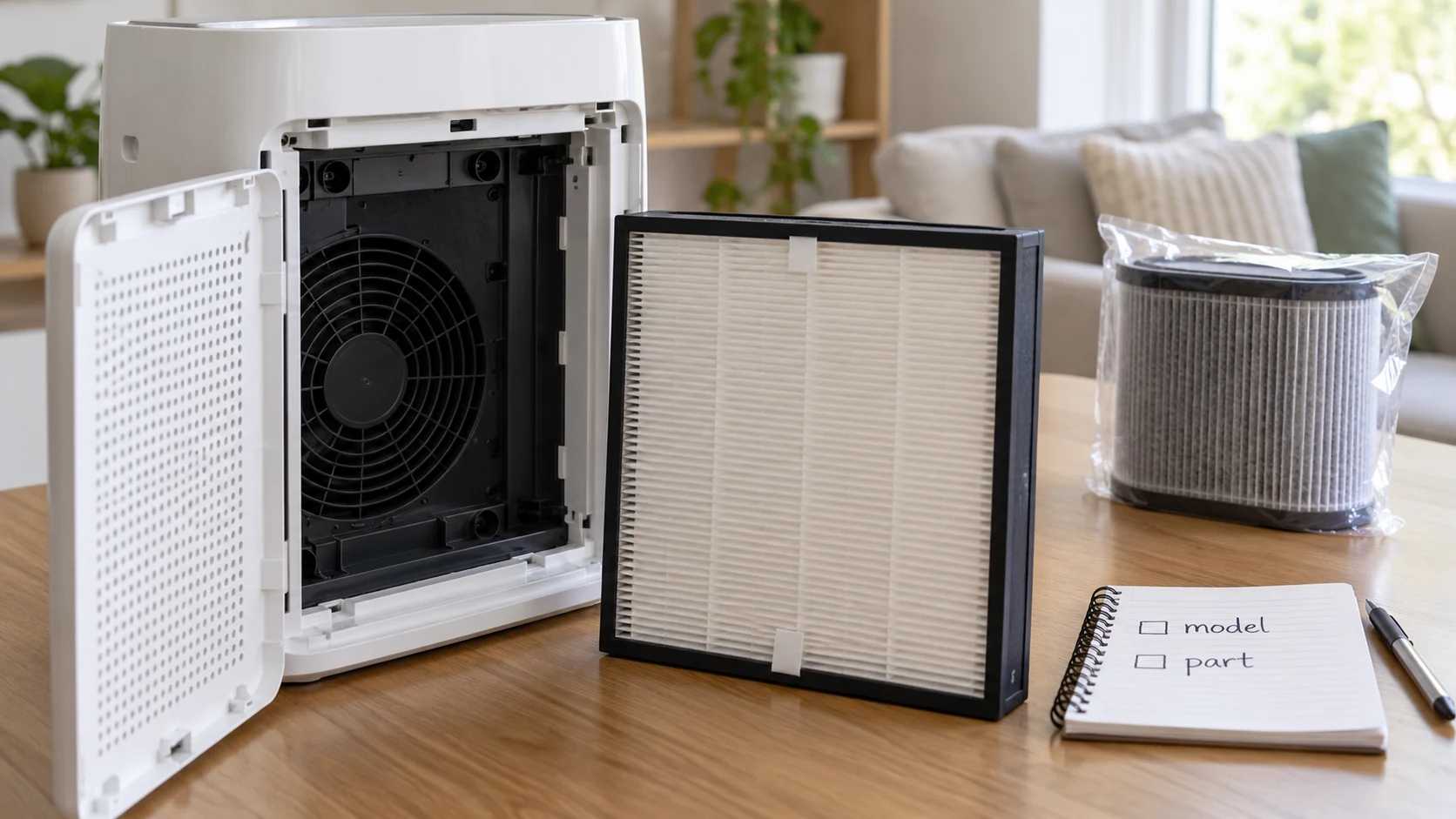
An air purifier replacement filter needs to fit a particular purifier, not merely share the words “HEPA” or “activated carbon” with the old part. Begin with the model printed on the purifier and the identifier on its current filter, if either can be read. This guide compares two current replacement-filter offers that name different Levoit models. It helps you make a compatibility decision before ordering; it does not certify either third-party filter as manufacturer-approved or promise a measured cleaning result.
Copy the purifier model from the machine
Read the model label on the purifier itself. Photograph it before searching. A product name remembered from a shopping order can differ from the label on a machine, especially when a brand sells several units with similar names. Copy letters, numbers, hyphens, and suffixes exactly. If the label is inaccessible, use the machine's own paperwork or a support record that identifies the same physical unit. Do not decide from its color or a product photograph alone.
Next identify the filter you are replacing. Record any printed part number, the direction it installs, and which pieces came out together. Keep the used filter available until the new part has been checked against the manual. The word “filter” can refer to a pre-filter, a carbon layer, a HEPA element, or an assembly containing several layers. A listing that names one of these functions does not establish the size or shape needed by your housing.
Write a two-column match: purifier model on one side, filter offer's explicit compatible model on the other. A complete match of model text is the starting point. Then check the maker's instructions for any variant, generation, or part-number requirement. If the listing leaves a suffix open, treat that as an unanswered question rather than trimming it away. A name containing “100” does not make it the same machine as one containing “126.”
Read the LV-H126 replacement-filter offer narrowly
The H126 replacement-filter listing names compatibility with Levoit LV-H126 and includes the label LV-H126-RF in its visible title. That is the offer's compatibility claim. The catalog brand is Unbranded, so the title alone does not make this a Levoit-manufactured filter. Confirm the exact model and part identifier against the purifier's documentation before relying on the claim.
That same title advertises two HEPA filters and eight activated-carbon pre-filters. Its short structured description is only “1,” which supplies no useful dimensions, installation instructions, or independent explanation of the pack. Ask what physical pieces the order includes if the count affects your plan. Do not infer that every pre-filter can be used with every HEPA element, or that eight pre-filters means eight full replacement cycles.
The product photograph shows a rectangular filter form, but a photograph is not a dimensioned drawing. An old filter might have similar color or pleats while its edge, seal, or orientation differs. Before buying, compare the part number and the size and shape required by the LV-H126 documentation. After delivery, compare the unopened or clean new part with the old one and the manual. Never force a tight element into a housing merely because the listing uses the right model text.
Read the Vital 100 offer and its conflicting pack count
The EESK replacement-filter listing names Levoit Vital 100 and Vital 100-RF in its description. It describes a three-stage assembly with a removable washable pre-filter, activated carbon, and a HEPA layer. These are claims about that exact offer. They do not show that the assembly fits LV-H126 or any other purifier whose model is absent from the description.
There is a quantity conflict worth resolving before checkout: the current catalog name calls it a four-pack, while the description also calls it a two-pack and “pack 2.” Do not choose a replacement schedule from either number without confirming the actual box contents with the seller. The listing also says its carbon and HEPA layers are attached and are not washable, while the pre-filter is described as washable. Follow the exact supplied instructions for each layer; do not wash the whole assembly because one component can be cleaned.
The EESK text advertises H13 material and filtration efficiency, but those statements do not replace a fit check or provide a controlled comparison with the H126 offer. A filter's claimed media grade and a housing's physical compatibility answer different questions. A HEPA label does not describe the frame seal, tabs, airflow direction, or installed clearance. Confirm those details through the intended model and its instructions before installing a substitute part.
Check air purifier filter fit after delivery
Open the purifier only as its own manual instructs, with the unit safely disconnected if the manual calls for it. Note the old filter's orientation before removing it. Compare the new part's frame, edges, handle, tabs, and markings with the old part and the manufacturer's replacement diagram. Avoid touching or damaging the filter medium while checking. If the supplied assembly cannot sit in the intended position without pressure, stop and resolve the mismatch with the seller or maker.
Look for a complete, ordinary closure of the filter compartment according to the purifier's instructions. A cover that will not close is evidence of a fit question, not a cue to trim the replacement or compress its frame. The same applies if a seal appears folded or a locating tab is left outside its slot. Record a photograph of the part and its package label if you need support. That preserves the exact offer identity without guessing from the media color.
If the filter package includes multiple layers, identify which pieces the purifier's instructions expect at each position. The H126 title advertises separate carbon pre-filters alongside HEPA filters. The Vital 100 listing describes a pre-filter plus attached carbon and HEPA layers. Their wording does not establish that these assemblies have the same service sequence. Do not transfer an installation order from one machine to the other. Let the correct model documentation settle the sequence.
Keep room ratings separate from filter compatibility
A replacement filter's fit does not tell you what room size an air purifier can serve. Our air-purifier room-rating guide explains why several area figures can appear on one product page. Those figures concern purifier performance claims and test conditions. This article's task is narrower: identify a replacement part for the purifier you already own. Do not treat a third-party filter title as a new room-coverage certification for that machine.
Likewise, measuring the room is a different job from checking the filter frame. If you need a reliable room footprint for a separate appliance decision, our room-measurement sketch guide shows how to retain saved dimensions and make a usable plan. It does not turn an LV-H126 filter into a Vital 100 filter. Keep the machine label and filter identifier with your compatibility notes even when you also measure the room.
Resolve missing or inconsistent compatibility information
A listing may name the purifier model but omit physical dimensions. In that case, the model claim is useful evidence, yet you still need the purifier manual or seller's clarification if the unit has variants. Ask for the exact filter part number, dimensions, frame details, and included-piece count. Send the seller the model photograph and the listing URL. A reply tied to those identifiers is more useful than a broad promise that the part is “universal.” Save the reply with the order record.
For the H126 offer, ask the seller to confirm how the two HEPA filters and eight carbon pre-filters are packaged if that ratio matters. For the EESK offer, ask whether the listing is selling two or four assemblies. These questions come directly from the current page text. Do not quietly pick the larger count or assume that one line is an outdated typo. The answer affects what arrives, storage space, and when you will need another order.
Check the seller's return terms before opening every item in a multi-pack. Keep packaging and the exact model labels until one clean part has been compared successfully with the machine. If the offer is wrong, an untouched remainder and a clear photograph of the mismatch can make the issue easier to explain. This is a purchasing workflow, not a claim about a specific retailer's policy. The exact return terms must come from the order and seller.
Make the replacement decision from identity and fit
Choose an offer only when the purifier model, stated compatible filter identity, included parts, and installation fit are clear enough for the actual machine. The H126 page names LV-H126 and LV-H126-RF; the EESK page names Vital 100 and Vital 100-RF. Those are separate claimed matches. Neither page is evidence that the two filter forms are interchangeable. If your purifier bears another model, look for a part that names it explicitly and check the corresponding manual.
After installation, keep the model and filter-package record for the next replacement. Note the date and the exact part installed, without inventing a service interval from a different machine's listing. The EESK page suggests a replacement period for its offer, but the interval appropriate to your machine depends on its own instructions and use conditions. A future purchase is faster when the first fit check has been recorded precisely.
Keep the compatibility record usable
A short compatibility record can prevent the same uncertainty at the next order. Write the purifier's full model from its own label, the replacement filter's advertised part number, the seller and product URL, the number of physical assemblies received, and the date one was installed. Keep a photograph of the package side that carries the model claim. If you had to ask the seller whether a variant fits, save the exact reply. A generic note such as “HEPA filter, four-pack” leaves out the one fact that matters most next time: which machine accepted it.
Record what the fit check actually established. “Frame entered without force and compartment closed as the manual describes” is an observation. “Compatible with every Levoit purifier” would be an unsupported conclusion from one installation. Do not turn an individual fit into an approval for a different model or a later production revision. If the filter was rejected, record the mismatch just as plainly: which tab, edge, or included piece differed from the unit's instructions. That description will help the seller resolve the order and help you avoid repeating it.
Keep performance claims in their own column. The H126 title names HEPA and carbon pieces; the EESK description names H13 media and three stages. Neither statement by itself tells you whether a different machine's motor, housing, and seal will work with that part. Media marketing, package quantity, and mechanical fit are three separate facts to verify. A filter that looks similar to the original can still be the wrong replacement. The model label, part identity, and physical check should lead the decision.