Crypto Commerce
Accucold FFUF234IM upright freezer vs Element EHUF21CECW for bulk storage
Compare Accucold FFUF234IM upright freezer: upright freezer capacity claims, door access, ice making, convertible operation, controls, and source discrepancies.
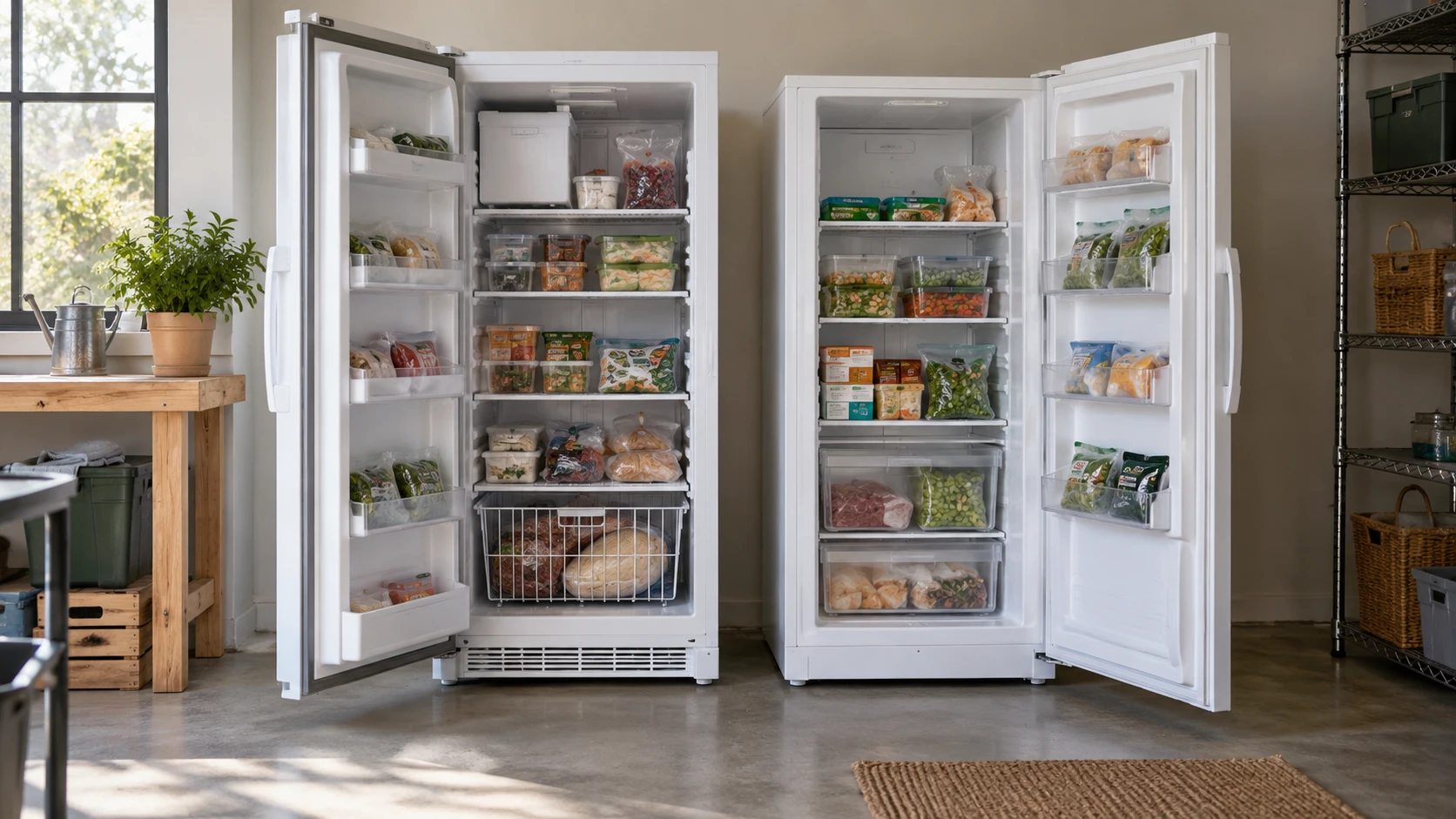
Accucold and Element advertise upright freezers in a similar size class, but their saved descriptions leave different questions open. Accucold lists 22 cubic feet overall and 21 cubic feet of interior space, with shelves, door bins, a lower basket, and an installed icemaker. Element lists a 21.2 cubic foot unit that can switch between freezer and refrigerator operation. Accucold specifies a nonreversible door; Element's excerpt does not give its hinge side and contains a stray 13.8 cubic foot reference. Resolve those measurements and the door arrangement before deciding where either cabinet could fit.
The Accucold FFUF234IM upright freezer has digital controls on top of the cabinet and a factory-installed icemaker rated by the listing for up to eight pounds of crescent-shaped ice. Its description names four adjustable wire shelves, four door shelves, a lower wire basket, and a light that turns on with the door. The Element EHUF21CECW uses an exterior electronic control to switch operating mode and change temperature without opening the door. It has LED lighting and a storage basket. Its saved excerpt does not describe shelf count, door bins, or an icemaker. These omissions need current model documents before a storage plan can be precise.
Reconcile volume with the space you can use — Element EHUF21CECW upright freezer
The cubic-foot figure leaves out the shelf layout and space taken by installed equipment. Accucold's description uses two numbers, 22 cubic feet in the model summary and 21 cubic feet for interior space. Ask what each figure measures, then request inside shelf dimensions and usable clearance around the icemaker. Element's title gives 21.2 cubic feet, while a no-frost paragraph refers to a 13.8 cubic foot freezer when discussing LED lighting. That looks like mixed source copy, but the saved record does not establish which sentence is incorrect. Confirm the EHUF21CECW model label, manual, and manufacturer capacity before relying on either figure.
The published freezer capacity planning guide shows why capacity labels and physical fit deserve separate checks. List what you actually freeze: wide trays, tall containers, boxed meals, and irregular packages. Measure a few representative items and compare them with shelf width, depth, and vertical spacing from the manuals. A 21-cubic-foot interior may still be awkward if a favorite pan will not pass the shelf supports.
Leave space for air to move around stored food as the manual directs. A fully packed shelf may block airflow, so sketch where a bulk purchase would go before loading the cabinet. Check the shelf's weight rating as well. Neither saved excerpt provides a shelf-load limit, and heavy boxes may need a lower position even when their dimensions fit above.
Accucold's four adjustable wire shelves and lower basket offer several ways to divide the space. Door shelves may suit small, frequently used packages, while heavy or bulky goods are more stable on interior shelves. The icemaker also occupies space and needs a path for water and ice collection. Find out whether its bucket reduces storage where you would otherwise place large packages. Element's source only mentions a basket. Request a current interior photograph or parts diagram before assuming it has the same number of shelves or the same flexibility. Comparing total volume without that layout could lead to a poor fit for your inventory.
Plan the door and installation footprint — Element EHUF21CECW upright freezer
Accucold is described as a freestanding white cabinet with a nonreversible right-hand door, a magnetic gasket, sealed back, and right-angle plug. The nonreversible hinge is a hard planning constraint. Stand where the freezer will sit and imagine loading a wide box while the door is fully open. Check whether a wall, counter edge, parked car, or adjacent appliance blocks access. Confirm the hinge orientation from the current installation drawing before purchase. Element's saved excerpt does not state its hinge side or whether it can be reversed, so the same check is necessary there.
Measure the route into the room as carefully as the final location. Doorways, turns, stair landings, and cabinet openings can restrict a full-size upright freezer. The saved excerpts do not give exterior dimensions, shipping dimensions, weights, ventilation clearances, or cord lengths for both units. Request those figures from the current manuals and shipping sheets. Mark the required ventilation zone on the floor or wall and verify an appropriate outlet is available without an unsafe extension-cord arrangement. Neither a low running cost nor a convenient basket matters if the cabinet cannot be installed as instructed.
Accucold's sealed-back construction and right-angle plug might help in some layouts, but neither proves the unit can be pushed flush against a wall. Follow the stated rear and side clearance requirements. Likewise, Element's exterior control panel needs a spot where you can see and use it without obstruction. Look at how high each control sits, how far the door extends into the aisle, and whether the light reaches the bottom basket. These physical details affect daily use more than a small difference between the headline capacity figures.
Decide whether ice making or conversion earns its place — Element EHUF21CECW upright freezer
Accucold's factory-installed icemaker is the standout feature if your household regularly needs ice. The source says it can make up to eight pounds of crescent-shaped ice, but it does not state the measurement period, the first-batch wait, or the water connection details. Ask for installation instructions, filtration requirements if any, and the bucket's usable capacity. A household that uses ice mainly for occasional gatherings should compare this setup with its existing ice source and the space the built-in mechanism consumes.
Element's distinctive feature is mode conversion. Its description says pressing and holding the exterior electronic control button changes between freezer and refrigerator operation. That could be useful when storage needs shift, but the excerpt does not state the temperature ranges in each mode, how long the cabinet takes to change, or what precautions apply to stored food during a change. Check the manual before treating the feature as a quick switch. You need a plan to relocate food and verify safe temperatures before and after the mode change.
The Element description also states ENERGY STAR certification and says the unit exceeds the minimum federal efficiency standard. That is a useful listing claim, although the saved excerpt lacks a kWh-per-year figure or an energy label. Accucold's excerpt does not provide a comparable energy-use figure. Request current EnergyGuide or model-specific energy data for both and compare them under the same assumptions. The installed icemaker may change energy and water needs, while using Element as a refrigerator changes the job entirely. A single label is not enough to calculate your household's operating cost.
Review temperature control and maintenance — Element EHUF21CECW upright freezer
Accucold places digital controls on top of the cabinet. Element describes an exterior panel that adjusts temperature without opening the door. Exterior access can avoid a brief warm-air exchange when changing settings, though the practical difference depends on how often you adjust them. Neither excerpt specifies an alarm for an open door, a power failure, or an out-of-range temperature. Ask whether each model has those alerts, whether they work during an outage, and how to read a temperature history if food safety is a concern. An independent thermometer can help verify the cabinet after installation.
Both descriptions claim a defrost convenience: Accucold calls its operation frost-free, and Element says no-frost. That does not mean there is no cleaning or maintenance. Check how to remove shelves and baskets, clean the gasket, and clear any drain or air passages identified by the manufacturer. Inspect the door seal periodically, especially after a heavily loaded shopping trip. A package holding the door slightly open can lead to warming and frost even when the cooling system normally controls ice buildup. Keep an inventory so food at the back does not disappear behind newer purchases.
For Element, the 13.8-cubic-foot wording in the no-frost section is another reason to ask for the actual EHUF21CECW manual. Do not borrow a maintenance procedure from a model that happens to be mentioned in a copied paragraph. Accucold's description is more specific about shelves and hinge, but it still leaves service details open. Check who supplies replacement shelves, baskets, gaskets, and icemaker parts for the exact serial or model family. A long-lived freezer is easier to own when small replaceable pieces remain available.
Match the freezer to your routine — freezer capacity planning
Choose Accucold for further inspection if fixed freezer use, a built-in icemaker, a known right-hand door, and its described shelf layout fit your room. Verify the difference between the 22- and 21-cubic-foot figures and the water and clearance requirements. Consider Element if the ability to convert between refrigerator and freezer matches a real seasonal need. Resolve its 21.2 versus 13.8 cubic foot text conflict and obtain the missing interior and door details first.
Before ordering either, compare the exact model labels, installation drawings, internal shelf dimensions, energy documentation, and service terms. Sketch where the door opens and what will sit on each shelf. The sketch will show whether bulky items clear the shelves and whether the door can open in the room. The Element EHUF21CECW upright freezer and the Accucold model can then be judged by the space and features you will actually use, with the source discrepancies resolved before delivery.