Crypto Commerce
Abangdun 3500W induction cooktop vs Ramblewood EC2-30 Two Burner Cooktops
Compare Abangdun 3500W induction cooktop by power, cookware, counter cutout, wiring, controls, and cleanup.
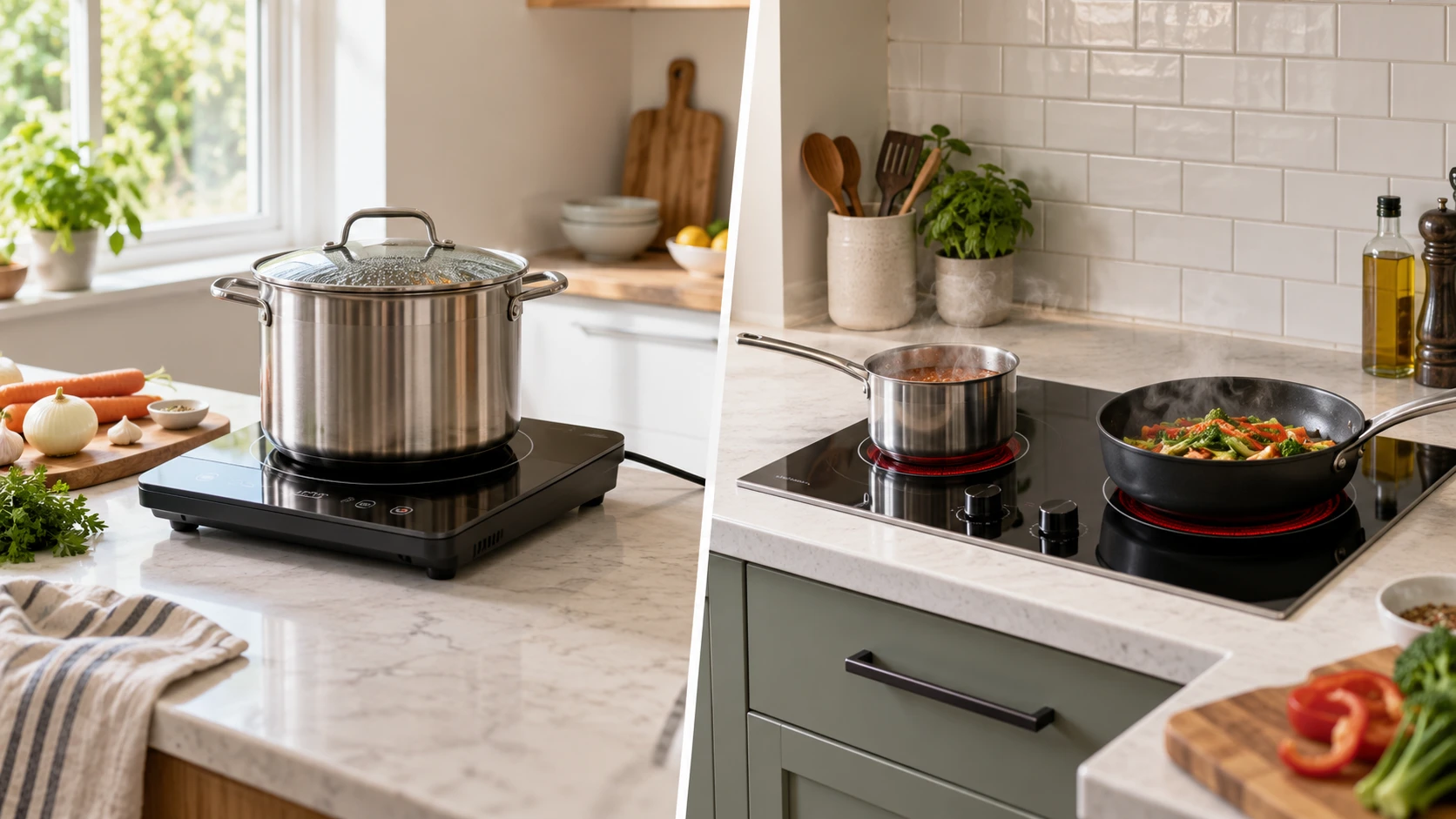
The Abangdun 3500W induction cooktop and Ramblewood EC2-30 solve different cooking-space problems. Abangdun is listed as a portable, single cooking zone with a 9.25-inch heating coil and a high power rating. Ramblewood is a two-burner electric cooktop with a specified countertop cutout. One may be brought out for a large pot; the other commits a section of counter to two pans. The first decision is whether a temporary cooking station or a permanent two-zone installation suits the kitchen, followed by a check of the available electrical service.
The published guide to cooktop power sharing checks explains why the number on a cooking-zone label should be read alongside the supply and the other appliances on a circuit. Abangdun advertises up to 3,500 watts at 240 volts and 15 amps in its description. Ramblewood states a 220-to-240-volt, 60-hertz input, but its pinned excerpt does not give a total wattage or individual burner ratings. A qualified electrician can match the exact model labels to a suitable outlet or connection. Do not assume an ordinary nearby receptacle meets either listing's needs.
The Ramblewood EC2-30 electric cooktop page identifies German EGO burners and an EGO energy regulator. It gives the glass-panel dimensions as 12 by 20 inches and a cutout of 10.6 by 19.3 inches. Abangdun's excerpt describes induction heating and a stainless-steel housing with raised controls and cooling fans, but no exterior dimensions. These differences affect both the pans that can be used and the place the cooktop can go. Ask for the exact manual, top view, and clearance requirements before buying cookware or cutting a counter.
Decide how many pans must cook at once — Ramblewood EC2-30 electric cooktop
Ramblewood's two burners permit two pots on the same installed appliance. The pinned excerpt does not give their diameters, spacing, or whether both can run at their highest setting simultaneously. Draw circles for the pans used most often on a paper outline of the 12-by-20-inch glass top. Include handles and a safe route to turn the controls. Two zones are less useful if the favorite skillet crowds a saucepan off-center. Request a scaled burner diagram and the regulator settings, then check whether the arrangement works for the meals cooked together.
Abangdun has one stated 9.25-inch heating coil. The listing says the effective heating area depends on that coil diameter and describes a structure that keeps heavy pots from pressing directly on the ceramic-glass panel. Ask for the minimum and maximum supported pan-base diameters and the rated weight. A wide stockpot may overhang the active heating area even when it physically rests on the unit. One zone can be enough for batch boiling or a stir-fry station, but a sauce or side dish will need another appliance or a different time slot.
Induction also requires cookware that works with the unit's magnetic field. Check the exact pan base against the manufacturer's guidance rather than assuming every metal pot will heat. Ramblewood's excerpt calls its burners electric EGO units but does not describe an induction mechanism. Ask what pan material and base shape it accepts, especially if the household already owns specialty cookware. A flat, stable pan that matches a burner often matters more to daily cooking than the highest power figure printed on the box.
Check power and controls as installed — cooktop power sharing checks
Abangdun's title says 190 to 275 volts, while its caution says to connect to a 220-volt AC supply. The description also gives a 3,500-watt maximum at 240 volts and 15 amps. Those statements need reconciliation with the model's nameplate and manual before an outlet is selected. Its listing warns against running other high-power appliances on an overloaded circuit and mentions a suitable 6-20P plug. Have a qualified professional inspect the site if a new receptacle or circuit is needed. A plug style in product copy does not verify the wiring behind a wall.
Ramblewood gives 220-to-240-volt, 60-hertz input and a 5.2-foot power cord. The listing does not specify the cord's plug, breaker requirement, installation method, or combined burner wattage. Request the installation drawing and electrical table before the counter is modified. The cord length may allow a planned outlet position, but a cord should not be stretched across a drawer or hot area. Leave access for service according to the manual. A two-burner surface that looks simple from above can still require a carefully placed electrical connection below.
Abangdun describes a high-power stage for fast heating and a lower-power stage for keeping food warm. Its source mentions a temperature range from 194 to 464 degrees Fahrenheit, yet the excerpt does not show the control increments or how the unit senses temperature. Ask whether the displayed number is a pan setting, a sensor reading, or an estimate. Try a familiar task such as holding a small sauce at a gentle heat and note whether the unit cycles noticeably. A maximum-power claim does not establish how finely it can control the low end.
Ramblewood's EGO energy regulator is named without a photograph of its control markings in the pinned excerpt. Ask to see the dial or manual. A cooktop used for simmering needs settings that can be repeated, even if its interface is simple. Test a small pan and a larger pan after installation, following the manual. The ability to run two pans at once should also be checked under the home's actual electrical setup. Avoid treating a two-burner label as a guarantee of full power at both positions when the total rating is unknown.
Plan the counter and ventilation space — Ramblewood EC2-30 electric cooktop
Ramblewood specifies a 3.5-inch depth clearance beneath the counter surface. Confirm whether that is a minimum empty space or the appliance's own depth, and read the installation drawing for side and rear clearances. Measure the existing countertop cutout in more than one place. A glass panel measuring 12 by 20 inches cannot make an incorrectly shaped 10.6-by-19.3-inch opening safe. Check the remaining counter material around the hole, drawer movement below, and room to lift pans without hitting a wall shelf.
Abangdun is portable in the listing, but its pinned description omits outer width, depth, weight, and cord length. It has two fans and rear air ducts for heat dissipation. Ask how much space the vents need and where the hot pan can be set down after cooking. A portable appliance still needs a stable, level, heat-appropriate surface and an outlet that matches its load. Its cylindrical legs raise the body off the counter according to the source, but their height and grip are not given. Check whether a heavy pot makes the whole unit rock or slide.
If the kitchen is small, think about storage after use. Abangdun may free counter space between meals once it has cooled, but only if there is a cabinet wide enough for the appliance and a safe way to carry it. Ramblewood preserves a permanent cooking place and will remain visible on the counter. Check the cleaning access around both models. A cutout installation cannot be moved to another room on a whim, while a portable high-power unit cannot be plugged into just any convenient outlet. The electrical plan and daily routine should agree.
Read safety and care claims precisely — Ramblewood EC2-30 electric cooktop
Abangdun's product description says heating stops when a pan is removed or an over-temperature condition occurs, although the pinned text does not provide a complete shutdown specification. It claims FCC certification. Ramblewood says its EGO burner and regulator have UL safety approval. Verify the exact model and relevant listing or documentation for the property. These statements concern different parts and standards, so neither can be summarized as a general safety ranking. Follow each manual's procedures for hot surfaces, cooling, ventilation, and cleaning.
Abangdun says its stainless-steel housing and glass area can be wiped with a damp towel, and that its rear ducts and fans dissipate heat. Ask how to keep those ducts clear of grease and dust. Induction heats the pan rather than an exposed coil, but the cooking surface can still become hot from a hot pan. Let it cool as the manual directs before cleaning or storing it. Ramblewood's pinned excerpt offers no cleaning instructions for its glass panel. Request its approved cleaner and scraper guidance before a spill burns onto the surface.
Warranty and service also differ in what is stated. Abangdun lists a one-year limited manufacturer's warranty, while Ramblewood lists a two-year warranty and a free exchange for an installation defect. Read the full written terms, including any conditions for commercial use or installation. Ask about replacement controls, glass, fans, and burners for the exact SKU. A built-in cooktop may be harder to take out for service than a portable one, and shipping a heavy appliance can carry costs even when a component is covered.
Make the choice from a meal and an outlet — Ramblewood EC2-30 electric cooktop
Choose Abangdun for a single-pot induction station only after confirming pan compatibility, exterior size, the conflicting voltage language, and a suitable circuit. Choose Ramblewood for a permanent two-pan area if its 10.6-by-19.3-inch cutout, 3.5-inch below-counter clearance, and electrical requirements fit the kitchen. Neither excerpt supplies a comparable boiling test, total Ramblewood power rating, or complete installation diagram. A useful pre-purchase check puts the most-used pans on a scale drawing and the model labels in front of the electrician. That settles practical fit more reliably than comparing one high wattage with an unstated two-burner total.