Problem-Solving Articles
Abacus counting mismatch: identify the selected group
Resolve a disagreement between selected-bead totals and a whole-frame inventory through an original counting convention and definite partition examples.
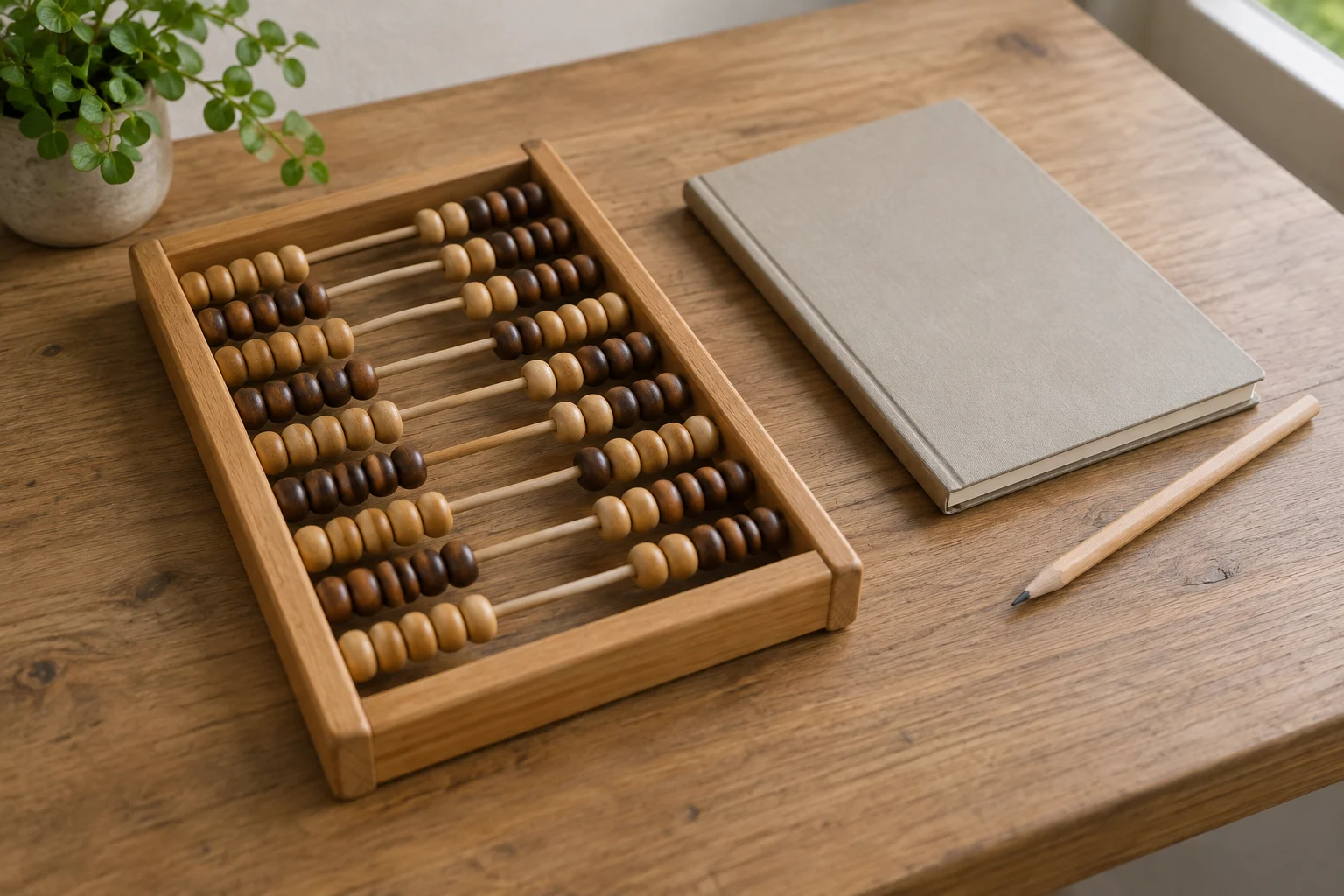
An abacus counting mismatch can begin with two people answering different questions. One reports the beads selected for a task; another counts every bead installed in the frame. Before changing the arrangement, ask each person to identify the group they counted. The disagreement may concern the group rather than the arithmetic.
The example below uses an original convention: each selected bead represents one unit, and every other bead is spare for that task. Rows have no assigned place values. This is a deliberately simple counting activity, not a manufacturer method or soroban lesson. A definite partition shows how twelve selected beads can coexist with a much larger installed inventory.
Ask what the reported number describes
When two totals differ, leave the arrangement available long enough to identify what each person included. Ask the first person to point out their counted group, then ask the second person to do the same. Do not immediately ask either person to recount from memory. A correct recount of a different group would preserve the disagreement.
Write each answer with its subject. Twelve selected beads and one hundred and twenty installed beads are complete descriptions in the example developed below. Writing only the two numbers makes them look like competing answers to one question. Naming the groups makes it possible to check whether the answers actually conflict.
Keep the original task wording as well. A request to represent a quantity is different from a request to inventory the frame. If the wording said only count the beads, the people involved may reasonably have chosen different groups. Clarify the task before deciding that somebody made a counting mistake.
For an invented shared activity, Mina asks Jules to show twelve units under the selected-bead convention. Later, another person asks how many beads are on the frame. Those are two different requests. The first needs a selected group of twelve; the second needs the complete physical inventory. This scene illustrates the ambiguity without reporting an observed test.
Keep the actual abacus inventories distinct
The Eisco Labs PH0105A abacus offer describes a wooden frame on a finished wooden base, with six steel wires and twenty beads per wire. Those stated quantities support a calculated installed inventory of 120 beads. They do not assign a numerical place value to any wire.
The Digital Zakka wooden abacus offer identifies a multicolor wooden item but supplies no explicit wire count or beads-per-wire inventory. Its learning and developmental claims are not measured results here. The Eisco quantities cannot be transferred to that separate offer.
For the numerical example, retain the stated Eisco inventory as the capacity being partitioned. The arithmetic assumes a complete frame matching that description. If an actual frame has a different confirmed inventory, write its actual counts and recalculate the example. Do not preserve the example's total while replacing the equipment information underneath it.
An unfamiliar frame also needs its own applicable instructions before use. This article gives no repair, removal or alteration procedure. If a physical feature prevents an intended grouping, resolve that issue through the item's own guidance. A counting convention does not establish that every bead layout supports the same physical arrangement.
Define selected beads and spare beads once
For selected beads and spare beads, use two mutually exclusive groups. A bead belongs to the selected group or to the spare group for the current task. It must not belong to both. Each installed bead still exists in the complete inventory regardless of which group it occupies.
Agree how the two people will identify the selected group on the actual frame. Use an arrangement both can distinguish clearly, following that item's instructions. State the identification rule before asking for a total. A remembered color preference is insufficient if the other person has not been told that color determines membership.
The original numerical example does not need a special color assignment. Call two wires A and B in the written explanation. Select seven beads from A and five from B; select none from the other four wires. The letters are local names for this example, not labels claimed to appear on the product.
Under the declared one-unit rule, the selected count is seven plus five, which equals twelve. No row is worth ten merely because of its position, and no bead acquires a different value from its color. Keep that rule explicit while checking the answer. Introducing a place-value rule halfway through would create another activity.
The keyboard percentage and key-count guide keeps a layout percentage separate from an explicitly named key group. Its keyboard details do not describe a counting frame. The useful connection is keeping the label with the number: a count of selected objects needs the selected group named, just as a hardware count needs its stated group.
If another reader has learned a place-value convention, ask them to describe the rule they are using. Do not combine its values with this activity's one-unit rule. Agree which task is intended and use its applicable instruction from the beginning. A person can apply a different convention consistently and still answer a different question from the one posed here. Naming that difference avoids correcting arithmetic that was never performed under the agreed rule.
Also allow a selected group of zero when that is the actual task state. Every installed bead then belongs to the spare group under this convention. Zero selected does not mean that the physical frame contains no beads.
Reconciling selected-bead totals with the whole frame
For reconciling selected-bead totals, account for the remaining inventory as well. Wire A starts with twenty installed beads, so selecting seven leaves thirteen spare there. Wire B also starts with twenty; selecting five leaves fifteen spare. The four unused wires retain their eighty beads entirely in the spare group.
The spare count is therefore thirteen plus fifteen plus eighty, which equals 108. Add the twelve selected beads to those 108 spare beads and the complete inventory returns to 120. The partition accounts for every installed bead once. It explains why twelve and 120 can both be correct when their group labels differ.
That agreement resolves the group question, but it should still be checked against the actual arrangement. Arithmetic alone cannot prove that someone selected the intended beads. Compare the selected membership with the written example and count that group. Then account for the complement without moving a bead into both groups in the explanation.
If the written selected and spare totals add to more than the installed inventory, look for double inclusion or an incorrect subtotal. If they add to less, look for a bead left outside both groups or an incorrect subtotal. These are diagnostic possibilities. Find the actual membership or arithmetic difference before claiming its cause is established.
Keep the two checks separate. A partition can account for every bead while selecting the wrong quantity for the task. For example, a selected group of eleven with 109 spare beads still accounts for 120 installed beads. Its inventory reconciliation passes, but it does not meet the request to select twelve units.
Check a changed arrangement without changing the rule
Now consider a second original arrangement using the same stated inventory and the same one-unit convention. Select nine beads on A and three on B, leaving all other wires outside the selected group. Nine plus three still equals twelve. The distribution changed, while the selected total did not.
The corresponding spare groups are eleven on A, seventeen on B and eighty on the other wires. Those also total 108. This check makes the unchanged total concrete without claiming that a particular color, wire or visual shape must always represent twelve. The membership rule and the arithmetic determine the result in this activity.
Ask a second reader to describe the selected group using the agreed rule before giving the total. If they identify nine and three but report thirteen, the group description now agrees and the arithmetic needs checking. If they report every installed bead, return to the task definition. Those observations identify different next actions.
The crochet stitch-and-row gauge comparison preserves the direction and measurement attached to each count. Its fabric measurements and tool discussion belong to crochet. Here there is no gauge interval: the comparison concerns membership in a declared bead group. Keep the particular subject beside each result instead of transferring a measurement method between the activities.
Separate a group disagreement from an actual recount
Once both people identify the same group, a remaining difference deserves a recount of that group. Keep the arrangement stable during the comparison so neither person is counting a group changed after the other person's answer. Say when the count begins and let the first reader finish before discussing the result.
For the paper example, count A's selected beads and B's selected beads separately, then add the two subtotals. This makes a disagreement traceable to a particular group. If both readers agree on A but differ on B, examine B's selected membership together. Recounting every installed bead would not locate that particular difference.
If a bead's membership is unclear, settle that before assigning a final number. The task has an unresolved boundary until both people can identify the same group. Do not force an agreed answer by choosing whichever total appears more often. First establish the objects included; then check the count of those objects.
Write any change that occurs during the check. If a selected bead is moved to the spare group under the activity's actual arrangement, the selected count changes. Compare both answers with the same state. A result from before a change and a result from after it are different observations, even when the two counts were spoken close together.
Give the next reader a complete counting question
A useful handoff describes the convention, the selected group and the requested result. For the second example, write that each selected bead is one unit, A contains nine selected beads and B contains three, with none selected elsewhere. Ask for the selected total. The reader can then reproduce the intended answer of twelve.
If the next question concerns the installed inventory, label it separately. Keep the supplied wire and bead counts with that calculation. Someone can check the complete inventory without interpreting the selected group as a new product specification. Likewise, changing the activity's selected total does not change how many beads the complete frame is stated to contain.
Resolve an abacus counting mismatch by establishing what was counted before judging the number. In this example, selected membership, spare membership and the complete inventory each have a definite role. A clear group definition resolves the ambiguous question; a stable arrangement and matching subtotals then let the readers check any actual counting disagreement.