Vehicle Care & Accessories
5-in-1 snow tool: read the shared-handle layout
Read detachable snow-tool arrangements without treating repeated assembled pictures as additional complete implements.
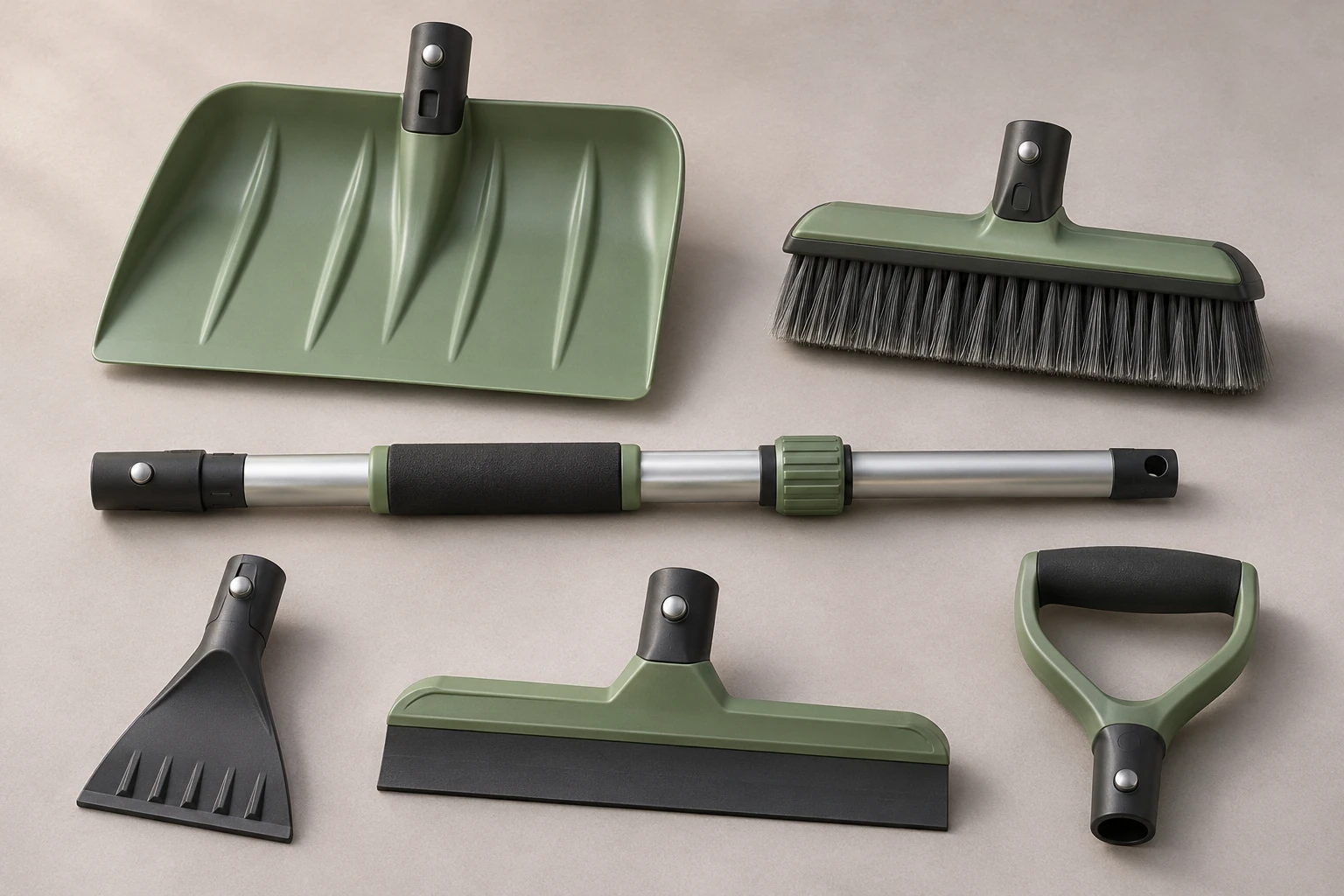
Read a 5-in-1 snow tool by following the handle through the pictured arrangements. The useful question is what changes when a different head is fitted, rather than how many impressive-looking tools appear across the page. A long assembled view, a short view and a parts layout can explain different aspects of an offer without establishing that each view represents another complete implement in the parcel.
This explainer concerns that reading task. It supplies no snow-clearing, assembly or disassembly procedure. The two retail examples have not been operated or checked against a vehicle here. Their actual descriptions and galleries also contain limitations that remain attached to the references below. Understanding a proposed arrangement is one task; obtaining the applicable instructions for a real item is another.
Give component, configuration and function different jobs
For this explanation, call a separate physical piece a component. Call an arrangement of pieces a configuration. Use function for the job being advertised. These are working definitions for reading the pictures together. They let you ask a specific question without assuming that a short marketing label is also a complete packing list or a set of instructions.
The distinction is useful when several pictures look complete in their own right. You might be looking at different arrangements of shared hardware. You might instead be looking at separate supplied implements. Establish which account the offer actually gives. The appearance of another assembled picture does not, on its own, choose between those interpretations. Keep the pictured arrangement and the supplied-item statement in view together.
Do not settle the question by inventing a universal meaning for an in-one label. In this reading exercise, the label is a reason to inspect the relationship between the pictures and the contents account. You want to understand this offer, with its actual parts and unresolved details. Another product can use similar wording while presenting a different arrangement.
Read the two actual offers within their limits
The bristled snow-tool listing identifies SKU18688174524 and UPC763471305295. Its gallery names brush, rod, D-grip, scraper and shovel and shows alternative assemblies. Its own description contains unrelated sleeping-bag prose, not adopted here. The catalogue says Unbranded; its source title names Vivicreate. Maker identity, pictured bag supply and actual parcel contents remain unverified. No operating result is demonstrated.
The flat-head snow-tool listing identifies SKU18268053685 and UPC739396418204. Its gallery shows a flat snow-squeegee head, shovel, rod sections, D-grip and one scraper advertised with three modes. Those are not three separate scraper tools. Zone Tech title wording, Unbranded brand data and White metadata versus orange-and-black images remain distinct. Maker, delivered colour and bag supply are unverified; no clearing test is reported.
Keep an unanswered question attached to the offer that raised it. If you replace one candidate with another, read the new candidate afresh. A clear answer about one package cannot complete the other package’s missing information. You can understand the comparison while leaving a purchase undecided, rather than borrowing a reassuring detail from the neighbouring column.
Follow a shared handle through the pictured arrangements
Begin with one assembled view and describe the arrangement you are trying to understand. Then look for the accompanying parts view. Ask which physical piece connects the head to the rest of that depicted arrangement. Keep your answer limited to the picture and its labels. If the connection is obscured or the inventory is incomplete, record the question instead of silently supplying a familiar mechanism.
When another picture shows a different arrangement, consider what it is explaining. Is it another view of the same proposed setup, a different configuration, or an explicitly additional supplied implement? Look for the offer’s own account rather than selecting whichever interpretation would make the package more attractive. A repeated illustration is useful information about appearance, but it is not automatically an extra order quantity.
You do not need to handle an actual tool to formulate that enquiry. Point to the relevant picture and ask which supplied components belong to the pictured configuration. If your question concerns changing the arrangement, request the applicable instructions for the exact item. This article does not turn a visible connector, button or hole into an instruction to press, twist, release or force anything.
Keep a proposed configuration separate from a replacement-parts request too. Knowing which connection you mean can make the question clearer, while leaving its exact specification unanswered. A similar silhouette is not a part number. If you need a replacement, the supplier must identify what applies to that particular item rather than infer it from another illustration that happens to look convenient.
Read the whole configuration before judging a detail
A close view can help you locate the feature under discussion while omitting the rest of an arrangement. Return to the complete view before describing how that feature relates to the whole. The detail and the wider picture can both be useful; they answer different questions. Neither needs to be discarded merely because the other contains information outside its frame.
The same restraint applies to an attractive finished-looking picture. It may explain how an arrangement is intended to appear without confirming everything that would matter to a purchase. Leave colour, maker, supplied contents and applicable instructions attached to their actual evidence. Do not ask one persuasive view to settle all of those questions at once.
The conceptual cover for this article uses generic inactive parts around a shared handle. It illustrates the distinction being discussed. It is not a retail photograph, a packing list, a compatibility demonstration or a record of equipment assembled and used. No exact product, supplied quantity or successful connection should be inferred from that illustration.
Keep the next question about the arrangement you mean
A useful enquiry can be short: identify the exact offer, point to the pictured arrangement and ask what the supplied package contains for that arrangement. Add the particular uncertainty that could change your decision. That gives the supplier something concrete to answer. A general request to explain every feature may produce a long reply while leaving your original connection question untouched.
Read the answer against that question. A response about the package may still leave the applicable changing instructions unanswered. A response about a pictured head may leave its connection to the handle unspecified. Preserve what was actually answered. There is no need to turn one helpful reply into a complete approval of an arrangement the reply never addressed.
If the reply concerns a different model or package, resolve that difference before carrying its details into your comparison. Keep both references visible while clarifying which one the answer describes. This is ordinary communication about an actual item, not a test in which every field must be filled immediately. An accurately named open question is more useful than an invented completion.
Follow one explicitly invented household handoff
Imagine that Noah is preparing a message for another household member, Ren. Noah has saved a complete assembled picture and a close view from an imaginary offer. He initially captions the message “the tools,” although Ren needs to know which pictured arrangement he means. The example is invented; it reports no order, supplier response, physical inspection or trial of either linked product.
Ren asks Noah to identify the complete arrangement he wants explained. Noah points to that view and keeps the close picture as a detail of his question. He removes wording that implied an additional complete implement without an explicit contents statement. His message now asks how the pictured configuration relates to the supplied package, rather than announcing an inventory he has not established.
Suppose their next conversation concerns a different arrangement. Noah can keep the earlier message and identify the new picture separately. He need not pretend the first question was about both. Ren can then see what changed in the enquiry and which answer remains outstanding. They have improved their communication without claiming that an actual handle has been reconfigured or that any connection is safe to use.
Leave winter preparation with the guides that address it
The before-first-snow planning guide addresses household clearing responsibility, available equipment and the wider preparation arrangement. It does not determine the contents or configuration of these two offers. Understanding a retail illustration leaves that separate household planning task in place.
The winter car preparation guide concerns vehicle visibility, system checks and travel preparation. It supplies no approval for a pictured head to touch a particular vehicle surface. Keep its actual preparation questions separate from this explanation of component and configuration language.
Keep an optional order attached to the actual offer
If you decide to consider equipment or another item on republeq.com, review the exact current offer and checkout for that order. A preference for cryptocurrency does not establish that new supplies are needed or that a particular payment method is available. If you prefer USDT, first confirm that the actual transaction offers it. Obtain the applicable asset, network, amount and receiving destination from the responsible service for that specific order. Do not copy instructions from another purchase, a product image or an unrelated message. Check the seller, selected item, variant, supplied package, delivery details, displayed total and terms. Leave any unclear field unresolved while you seek clarification. Review an applicable fee or conversion term from the current transaction instead of inserting an estimate. Keep the real order reference and the instructions that were confirmed. If an acknowledgement arrives, retain what it actually confirms instead of treating it as proof that equipment will suit the proposed task. If payment status becomes uncertain, reconcile that status before considering another transfer; uncertainty does not establish that nothing happened. This article supplies no wallet address, transfer guarantee or recovery procedure. A completed payment cannot authenticate an uncertain maker or establish a pictured configuration’s suitability. You can leave an order unplaced while a relevant product question is answered. If somebody orders on your behalf, provide the exact selected reference and any remaining limitation, so an unresolved supply assumption is not carried silently into the transaction. Retain the confirmed transaction information with the actual order, and keep a later product enquiry attached to the item that was selected.
Keep a complete view with any detail you send. A cropped connector can be hard for another person to locate, especially when several pictures use similar grips or colours. Identify which end and which assembled view your question concerns. This gives the reply a clear reference without supplying the connector specification yourself.
Finish with a description of the arrangement you actually mean. Keep snow tool components attached to the correct offer, and distinguish them from the detachable tool configurations shown in separate pictures. The result should be a clear account of what you understand and a precise question about what remains unanswered, without turning an illustrated possibility into extra supplied equipment.
Different arrangements can share the same handle.