Programming & Compilers
How static single assignment joins value versions
Static single assignment gives definitions distinct identities and selects values by incoming control-flow edges. Follow branches, loop-carried values and transfers that preserve them.
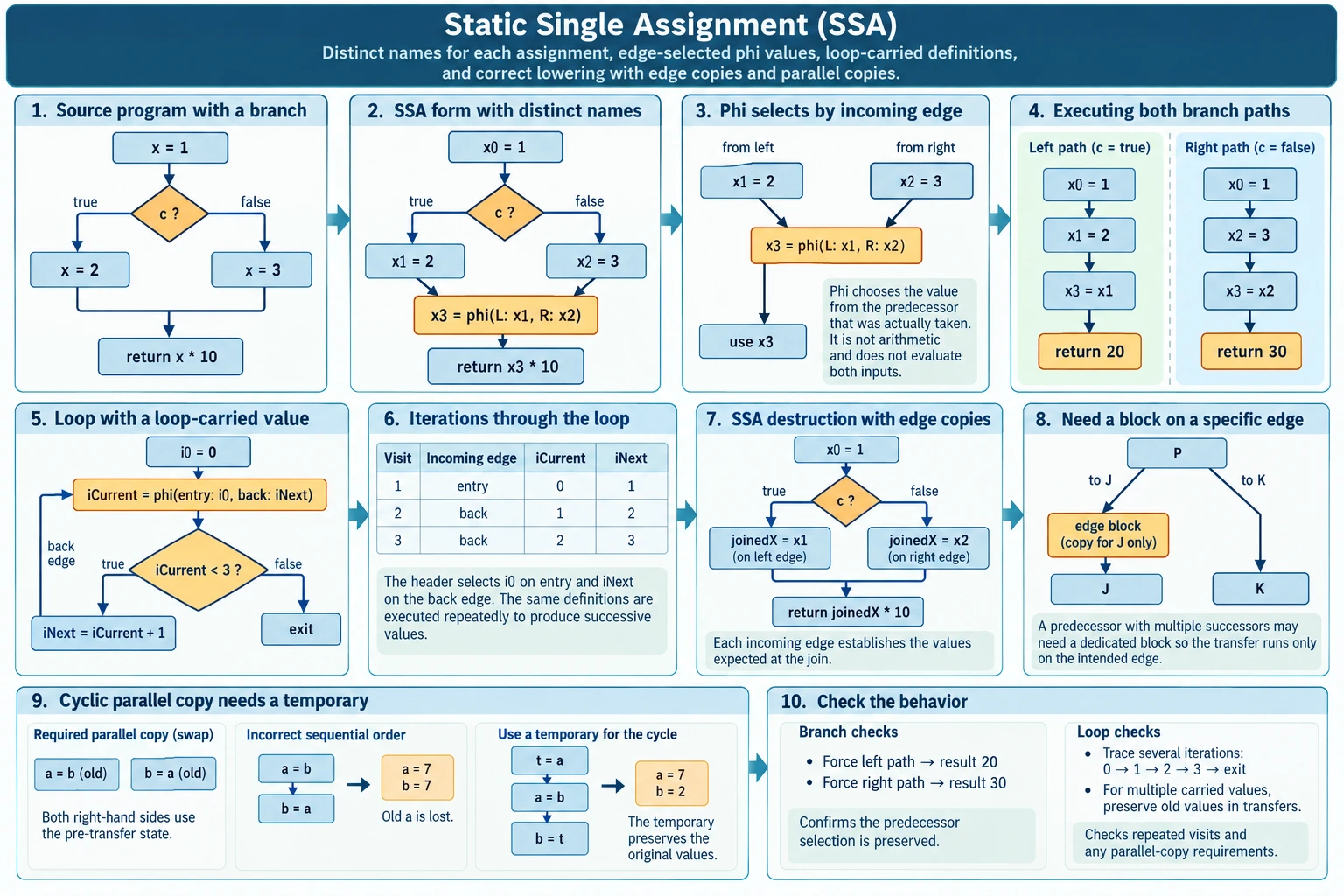
A source program can assign the same variable in several places. One branch may set a value to two, another may set it to three, and a loop may update it repeatedly. A compiler needs to keep track of which definition a later use depends on without confusing assignments that share a source-level name.
static single assignment, usually abbreviated SSA, gives each computed definition its own identity. A later use can refer to a particular definition instead of asking which of several assignments to the same name most recently executed. At a point where control-flow paths meet, the representation must also express which incoming definition supplies the value on the path actually taken.
Those path-dependent selections are useful inside a compiler's representation. Executable code still needs ordinary instructions and correctly placed transfers. Branch and loop examples make those requirements concrete: translated transfers must supply the right incoming values without overwriting values still needed.
Give each assignment a distinct value name
Consider a small program that begins by assigning one to x. It then tests a condition. On the left path it assigns two to x; on the right path it assigns three to x. After the paths join, it multiplies x by ten and returns the result.
Rename the definitions according to where they occur. The initial assignment defines x0. The left assignment defines x1, and the right assignment defines x2. The names distinguish three definitions even though the source program used x for all of them. A use that belongs entirely inside the left path can refer to x1 without ambiguity.
After the join, the multiplication needs a value selected according to the incoming path. If control arrived from the left, its input must be the value defined by x1. If control arrived from the right, its input must come from x2. Replacing every later use with whichever definition appeared last in a textual listing would ignore that control-flow distinction.
The representation therefore introduces a new value identity at the join, say x3. It defines x3 by selecting x1 on the left incoming edge and x2 on the right incoming edge. The multiplication can then use x3. Each of its possible inputs has a defined relationship to the path that reaches it.
Renaming has changed the way the compiler describes the computation. It has not changed the required answers: the left path still needs to return twenty and the right path thirty. These two outcomes provide simple checks on any later translation of the example.
How phi functions select an incoming definition
Write the selection as x3 = phi(left: x1, right: x2). The incoming edge labels matter. The representation records that reaching the join from the left selects x1 and reaching it from the right selects x2.
phi functions should not be read as ordinary calls that eagerly evaluate every listed input. In the branch example, only one branch executes. A value defined solely on the unchosen branch need not be computed in order to obtain the selected result.
The operation also does not choose whichever input seems preferable to a compiler. Its selection follows the predecessor edge used by the actual execution. If the left edge was taken, choosing x2 would change the program's result even if both values have the same numerical category.
A join can raise separate questions about value identity and compatible execution states. Comparing phi functions with bytecode verification separates the question of which definition supplies a value from the question of whether an instruction receives a permitted execution state. The related verification topic propagates stack and local-state descriptions; it does not make a runtime choice between these branch definitions.
Several selected values can appear at one join. Each selection needs incoming arguments associated with the correct predecessor. Handling one value correctly does not justify silently dropping another selection or rearranging its edge associations.
A loop carries a value back to its header
Now consider a loop that starts i at zero, continues while i is less than three, and adds one on each trip through its body. The header can be reached from the entry path or from the body's back edge. Those predecessors bring different definitions of the loop's current value.
Let i0 be the initial zero. At the header, let iCurrent select i0 when the entry edge is taken and iNext when the back edge is taken. The body defines iNext as iCurrent plus one. The condition uses iCurrent to decide whether to execute another iteration.
On the first visit to the header, execution arrived from the entry edge, so iCurrent is zero. The body produces one. On the next visit, the back edge supplies that result as the current value. The body then produces two, and a further iteration produces three. When the header sees three, the stipulated condition ends the loop.
The circular relationship in the description connects one iteration to the next. It does not request that the compiler evaluate both header inputs recursively before the loop can begin. The entry edge supplies the first value, and completed body executions supply later values.
A static definition can be executed more than once when its instruction belongs to a loop. Its identity denotes the defining position in the representation; executions at that position produce the successive dynamic instances used by the loop. The compiler does not need to invent an unbounded sequence of textual variable names for every possible runtime iteration.
SSA destruction turns selections into transfers
To execute the branch example using ordinary reusable locations, a compiler can arrange for the left path to transfer its selected value into the location used after the join. It can arrange an equivalent transfer from the right path's definition on the right incoming edge.
This translation is often discussed as SSA destruction. Every incoming edge must establish the values expected at the join. The left edge must provide the left values, and the right edge the right values, while paths that do not reach this join retain their intended behavior.
For the example, imagine a location named joinedX. The left incoming edge stores the value of x1 into joinedX, and the right incoming edge stores x2. The multiplication reads joinedX. With the left condition selected it reads two and returns twenty; with the right selected it reads three and returns thirty.
Location assignment adds another set of constraints. The discussion of SSA destruction alongside register allocation helps separate preserving incoming selections from deciding where live values can be stored. The related allocation topic concerns overlapping value lifetimes and a finite supply of machine registers. Correct value selection must survive those storage decisions.
No particular performance improvement follows from writing the program in SSA form. The representation exposes definitions and dependencies for compiler reasoning. The generated code's cost depends on subsequent decisions, including which transfers remain and how the target executes them.
Why some incoming edges need their own block
A predecessor with several successors can make copy placement ambiguous. Suppose predecessor P can branch either to join J or to another block K. Join J can also receive control from predecessor Q. A transfer intended only for the edge from P to J must not run when P takes its other edge to K.
Placing that transfer unconditionally at the end of P would execute it on both outgoing paths. If the destination location matters to K, the copied value could alter that path's behavior. The fact that the transfer is correct for arrival at J does not authorize it on the route to K.
Placing the P-specific transfer unconditionally at the start of J has a different problem. Execution can arrive there from Q, in which case J needs Q's selected inputs. Running P's transfer on that arrival would associate a value with the wrong predecessor.
One solution is to introduce a small block on the P-to-J edge. P branches to that block when it chooses the route to J. The block performs the required transfers and then enters J. The route from P to K bypasses it, while the route from Q to J supplies its own correctly associated transfers.
The new block executes the transfers only on the chosen edge. Its placement preserves the distinction that the selection operation previously represented. The branch predicate still determines which incoming value reaches the join.
Preserve simultaneous copies when sources overlap
A join can require several transfers that conceptually use the values present before any transfer begins. When selected values are assigned to reusable storage, a destination of one transfer can overlap a source needed by another. Executing the transfers in a careless sequence can then destroy an input.
Suppose two locations, a and b, initially hold two and seven. The required edge transfers are a receives b's old value and b receives a's old value. The intended result is therefore a holding seven and b holding two. The pair is a parallel-copy requirement: both right-hand sides refer to the pre-transfer state.
If ordinary instructions first copy b into a and then copy a into b, the first instruction overwrites the old two. The second instruction reads the new seven from a. Both locations end up holding seven, which fails to implement the required swap.
A temporary location preserves the needed input. First copy the old a into the temporary, then copy b into a, and finally copy the temporary into b. The final pair is seven and two. This sequence performs ordinary transfers while preserving the original simultaneous-copy meaning.
The temporary is necessary for this illustrated ordering because the transfers form a cycle. Other sets of transfers may have an order that preserves all remaining sources without temporary storage. A safe transfer order depends on which sources each remaining copy still needs.
Check both branch paths and repeated loop visits
Check the translated branch example along both paths. Force the condition down the left path and follow the value supplied to the multiplication. It should return twenty. Force the right path and repeat the trace; the result should be thirty. These checks exercise the predecessor association that the join selection was intended to preserve.
The loop needs several visits, not just its first entry. On entry, the current location must receive zero. After one body execution it must receive one on the back edge, then two after the next, and then three before the exit condition takes effect. Checking only initialization would miss an incorrect back-edge transfer.
For a loop with several carried values, repeat the state trace for the entire transfer group. If an iteration needs the old values to produce the next values, sequential overwrites must not substitute newly transferred values where old ones were required. A cyclic copy problem can be invisible on a first iteration whose values happen to coincide, so the chosen example values need to expose the difference.
The checks establish the illustrated behavior only for the stipulated examples. They do not prove every translation performed by a compiler. A wrong predecessor choice, misplaced transfer, or destructive copy order changes the traced result and can therefore be detected.
Keep the representation separate from its host computer
Compiler representations can be studied on ordinary computing equipment. The Lenovo IdeaPad 15.6-inch FHD touch laptop appears in a listing with 16GB DDR4 memory and a 512GB SSD. Those host specifications do not establish how an installed compiler represents definitions or where it places edge transfers.
A different listing, for the ASUS Vivobook 14 FHD laptop, identifies an Intel Core 5 120U processor. The processor label supplies no evidence that a particular lowering preserved the old values of a parallel-copy cycle. That question belongs to the compiler transformation and its generated execution behavior.
static single assignment makes each definition and each predecessor-dependent selection explicit. A correct translation carries those choices into executable control flow, placing transfers on the right edges and retaining any sources that later transfers still need. The branch results and loop-state sequence should remain the same after the representation's selection operations have been removed.