Cost & Savings Articles
SodaStream cylinder exchange cost: spares and return commitments
Read SodaStream cylinder exchange cost alongside spare-cylinder licensing and US return terms, keeping Art and Terra bundle contents and rated output conditional.
SodaStream cylinder exchange cost starts with a question about what you are ordering: a refill exchange supported by an empty cylinder, or an additional spare cylinder. The two transactions can have different prices because they include different commitments. Comparing only the first figure on a page can leave an empty-cylinder return obligation outside the budget.
This guide uses the US SodaStream program as a documented example and two actual Republeq sparkling-water-maker descriptions as equipment contexts. The manufacturer's refill service is a separate transaction from buying a machine through Republeq. Its terms do not automatically become the terms of the retailer's checkout or a service in another country.
An exchange starts with an empty cylinder to return
SodaStream's US spare-cylinder page distinguishes an exchange from a spare. An exchange involves returning an empty cylinder and paying for the gas in the replacement. A spare includes the cylinder-use licence and the gas. The same page says the cylinders remain SodaStream property and are provided under licence. Do not describe the spare price as a refundable deposit without an applicable term establishing that.
These are different starting positions. Someone with an eligible empty cylinder has something to exchange. Someone seeking an additional full cylinder without an empty to return is asking for extra supply. A lower refill figure does not remove that distinction. Establish which transaction describes your situation before comparing the total.
The physical cylinder you already have also needs to belong to the applicable program and equipment context. This article supplies no universal cylinder interchangeability rule. Identify the actual type and current service requirements rather than assuming every cylinder with a similar shape can be returned or used in the same way.
Read the actual Art bundle before counting cylinders
The SodaStream Art White bundle identifies model 1103113010, SKU 2050557450 and UPC 810055454723. Its description lists an Art machine kit, an additional CO2 cylinder, an additional carbonating bottle and a Pepsi Blue 440Ml flavour mix. Keep the word additional attached to those items without inventing a complete inventory for the underlying machine kit.
Before budgeting a separate spare, confirm the actual bundle contents and what you already have. The retail wording does not independently enumerate every cylinder inside the base kit. It would be premature to decide that another purchase is necessary, or unnecessary, from an assumed total that the selected description never states.
The Art description says a cylinder carbonates up to sixty litres of water. That is an upper-limit claim, not a promise that every cylinder will supply exactly sixty litres in your routine. It also says the machine works with SodaStream flavours and BPA-free carbonation bottles except the glass carafe. This article gives no bottle-fitting or carbonation procedure.
The selected Art wording says to press a button. That retail sentence is not an operating sequence for a verified unit. Use the applicable model instructions for actual operation. The cost question here concerns the supply transaction and what its price includes, rather than how to activate the machine.
Keep the Terra account separate from the Art kit
The Supersale SodaStream Terra bundle offer describes manual carbonation with no batteries or electricity required. It names Pink Quick Connect CO2 cylinders and repeats an up-to-sixty-litre claim, also expressed as 126 bottles. That wording does not establish your actual bottle size, consumption or number of days between exchanges.
The Terra description calls its carbonating bottles dishwasher safe and BPA-free. It supplies no complete counted bundle inventory in the text used here. Keep the actual offer's contents question open when deciding whether you need more supplies. Do not transfer the Art bundle's additional-cylinder wording into the Terra package.
No electricity required does not mean no continuing supply expenditure. The selected Terra account still describes a CO2-cylinder system. A household can distinguish an appliance's stated power arrangement from the separate cost of replenishing the material it uses, without inventing an electricity saving or a gas-use figure.
Spare cylinder versus exchange price needs the whole transaction
For spare cylinder versus exchange price, compare like starting positions. Imagine two fictional choices with invented prices in currency units: twenty for an eligible exchange and thirty-five for a spare. The fifteen-unit difference describes those invented prices only. It is not a current quote from SodaStream or Republeq.
If the imaginary buyer has one eligible empty and wants one full replacement, the exchange can be evaluated with that return obligation included. If the same buyer wants to add another cylinder to the household's supply, the spare describes a different purpose. Calling the extra cylinder another exchange would not produce another empty cylinder to return.
Now give both fictional transactions a six-unit delivery charge and leave taxes outside this simple example. The exchange's initial outlay becomes twenty-six and the spare's becomes forty-one. The arithmetic does not establish a real shipping rate. It shows why the final payable amount and the underlying return commitment both belong in the comparison.
Do not convert the fifteen-unit difference into a universal saving. The buyer must be eligible for the exchange, fulfil its return terms and assess the actual transaction. A spare may also serve a different supply purpose. The two prices alone cannot decide which purchase a particular household needs.
Cylinder return requirements belong in the US budget
For cylinder return requirements, the US refill page requires one empty cylinder for each refill cylinder ordered. At the time reviewed, its one-time exchange window is sixty days; subscription returns use the delivery frequency plus thirty days. It states an additional fifteen US dollars plus tax for each unreturned or damaged cylinder, including where the customer has no empty to return.
Those are program-specific terms, not a universal return rule for every cylinder order. Check the current offer, region and order type before relying on a deadline. A subscription and a one-time exchange may share a product name while creating different continuing commitments. The selected transaction needs to be clear before its price is treated as the whole cost.
Consider a fictional household ordering two refill cylinders while identifying only one eligible empty for return. Counting the two incoming cylinders is insufficient. The household also needs to resolve the second return requirement. This is a transaction question to settle with the provider before ordering; the article does not promise that an unmatched exchange will receive a waiver.
A return commitment can remain relevant after the initial payment. Keep the order's applicable deadline and the provider's confirmation of the return available. Paying the refill price does not itself establish that the empty has been received. This guide supplies no cylinder packing, transport or handling procedure; use the applicable service instructions for those tasks.
A household supply count is different from an exchange count
Imagine a household with two cylinders, one in use and one already empty. It wants a full replacement for the empty one while retaining the cylinder still in use. That describes one available exchange in this example. Counting both household cylinders as empty would overstate what can presently be returned.
Now imagine the household wants a third cylinder as an additional spare. That is a change to its supply arrangement. It should be priced as that intended transaction, with the applicable licence and gas information, rather than hidden inside a refill comparison. The example does not recommend keeping three cylinders or establish how many a household needs.
Decide what would change after the proposed order. Are you replacing an empty, adding a spare or entering a recurring service? Those purposes can lead to different commitments even when a page displays the same cylinder size. Keep the purpose explicit while assessing the current charges.
If the actual bundle inventory is still unresolved, settle that first. A planned extra supply purchase should not depend on guessing which items the original machine kit contains. You can ask a precise contents question without making an exchange or subscription order in the meantime.
Rated output does not set your exchange calendar
The manufacturer's spare-cylinder page says replacement frequency depends on the level of carbonation used. That supports keeping the up-to-sixty-litre figure conditional. It does not provide a measured yield for your household or determine a fixed number of exchanges per month.
A proposed annual budget therefore needs its own clearly identified usage assumptions. If you have actual relevant records, distinguish those from a catalogue maximum. If you do not, leave the frequency estimate provisional. Dividing a hypothetical gas price by sixty would not turn that maximum into an observed cost per litre.
Keep flavour purchases and any additional bottles separate as well. The Art offer's named flavour mix does not specify the quantities your household will use over a year. The Terra description's general flavour instruction is not a recipe or a consumption forecast. Neither supplies a complete ongoing drinks budget.
A household that wants only to understand the next supply purchase can keep the comparison at that scale. Identify whether an empty is available, what the selected transaction includes and its actual final charges. You do not need an invented yearly saving to make the immediate difference between an exchange and a spare understandable.
Use other cost examples for their actual questions
The yarn unit-cost and project-outlay guide uses actual Sensy Candy and CAKE package quantities to distinguish a normalized length price from buying enough whole packs. Its fictional project example has no cylinder-return commitment. It is useful here as a reminder that a displayed unit figure and the transaction you must complete can answer different questions.
Keep the yarn example's quantities with the yarn. The cylinder question requires the current gas-program terms and an actual empty-cylinder starting position. A pack calculation cannot establish exchange eligibility or a return deadline, and a lower normalized price cannot resolve those obligations.
The appliance electricity-use guide separates listed watts from energy consumed over an assumed operating interval, using an actual heater and a Veeboto washer example. Its discussion of changing operating states limits what a nameplate figure can establish. Those electrical calculations do not measure CO2 use or create an energy bill for the manually operated Terra description.
The relevant distinction is the cost being estimated. A supply replenishment and an appliance's electricity use need different evidence. Keep each actual product's power and material descriptions with it rather than using a zero-electricity claim to remove every running cost from the household plan.
Finish with the purchase you actually need
Before treating SodaStream cylinder exchange cost as a settled number, identify the current program, cylinder type, available eligible empties and selected order. Read the final charges and the return commitment together. Keep the Republeq machine purchase separate from the manufacturer's refill arrangement.
An additional spare and an empty-cylinder exchange can both be understandable purchases when their purposes are clear. Confirm the actual bundle first, retain the applicable service terms and leave an unverified yield or saving open. This comparison ends with a defined transaction, without promising a particular drink output or a universal cheapest option.
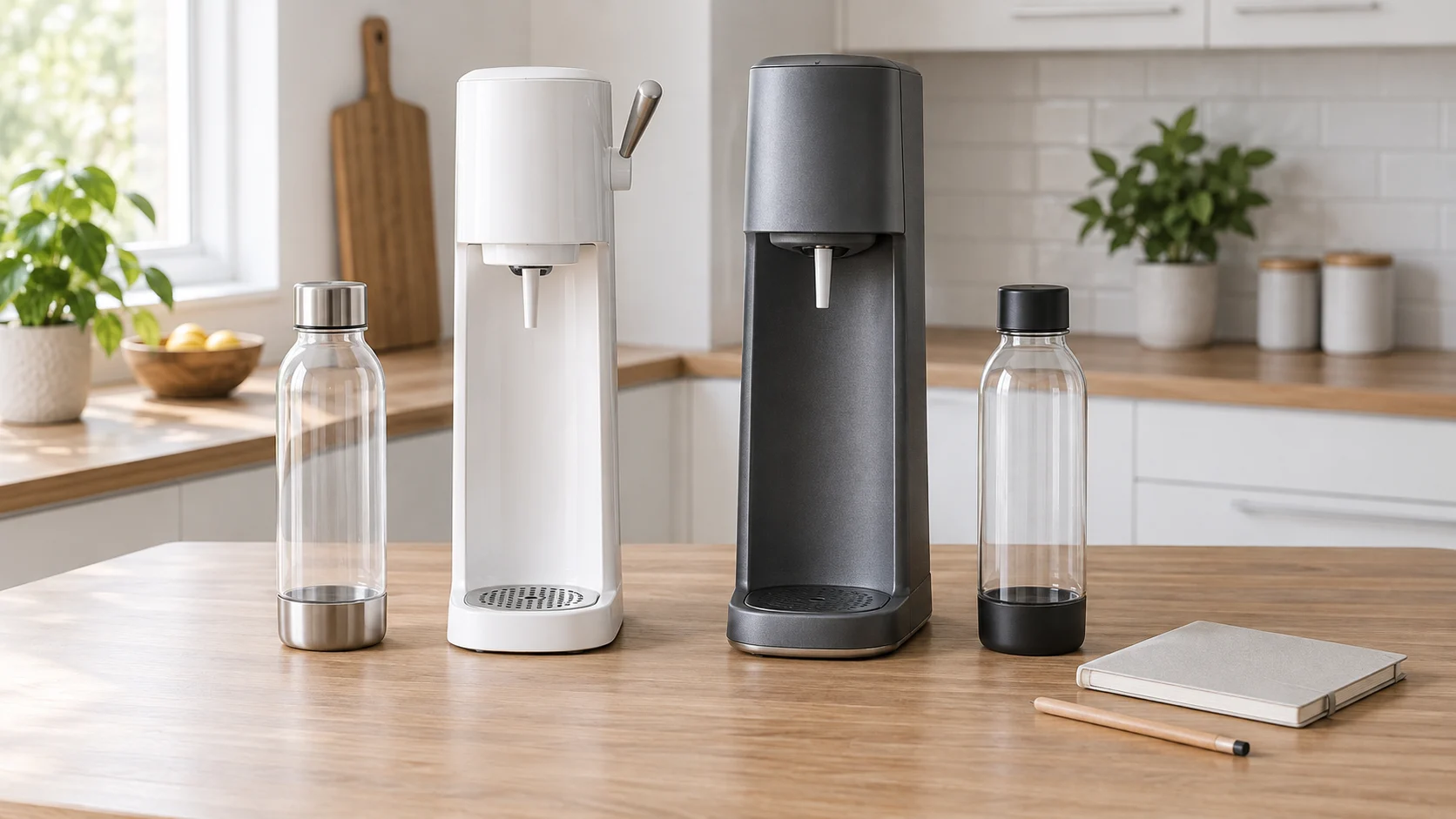
Conceptual SodaStream cylinder exchange cost scene with two whole generic inactive sparkling-water makers and separate empty bottles; no exact retail bundle, cylinder handling or operating method is depicted.