Lifestyle & Inspiration
Moon observation journal: notice the changing outline
Keep a month of dated Moon sketches, separate sightings from reference notes, and read the actual Celestron and Sky-Watcher telescope offers.
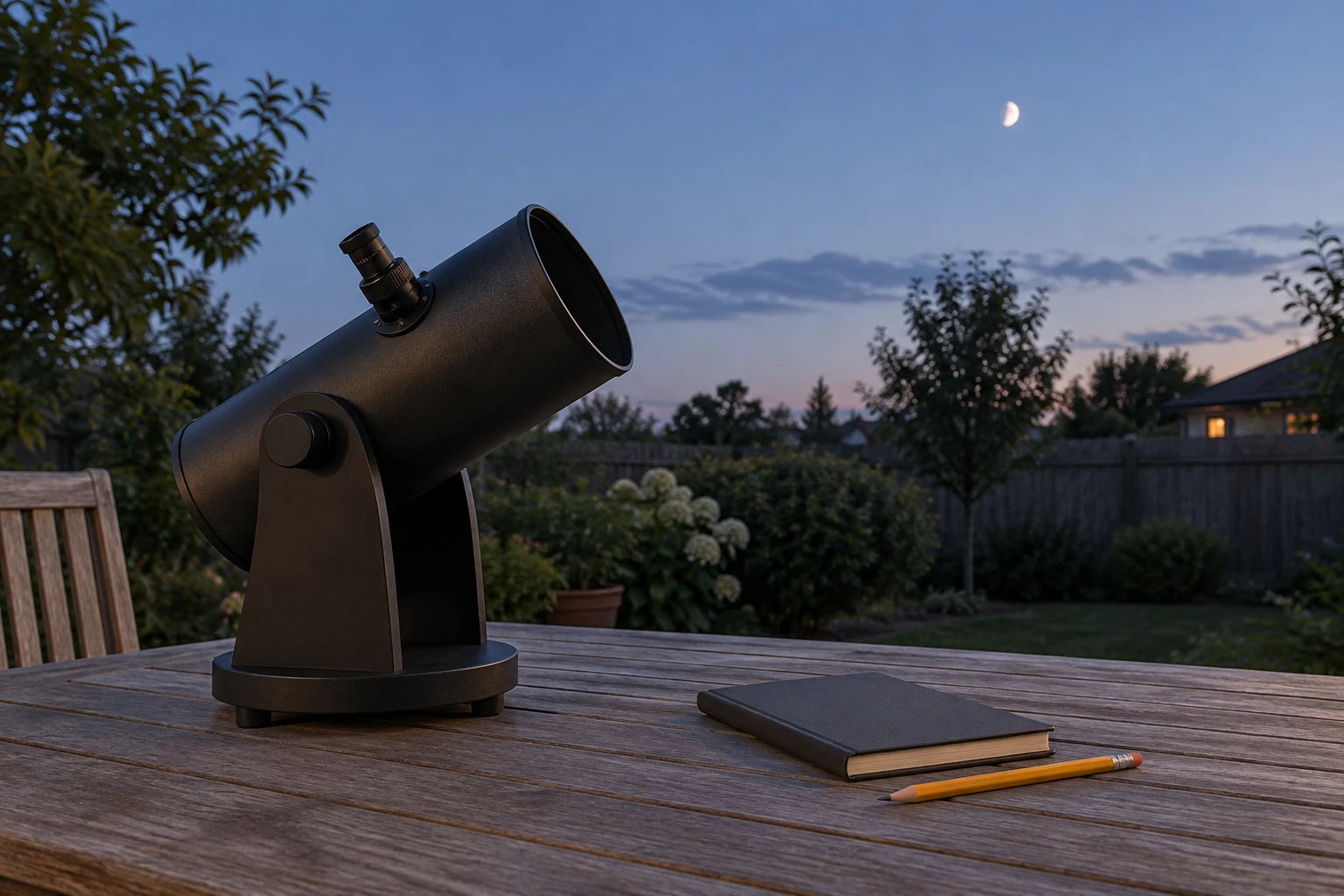
A Moon observation journal can give a familiar view something new to look for. Choose a month, leave space for dated sketches and record the illuminated outline you actually see. A few words beside each drawing can be enough to bring back the evening when you made it. Leave room for a rough sketch you would like to revisit.
NASA's Moon Observation Journal proposes observing over a month, writing the date and time, drawing the view and noting when the Moon could not be seen. That supplies a clear starting point. You can decide how to arrange your own pages while retaining the difference between a direct observation, a later reference check and a day with no view.
Give the month an ordinary place in your routine
Choose a notebook you will recognise when you return to it. Put the month and year on the opening page and identify the place you expect to observe from. A place name can be as simple as your own label for a familiar location. It helps explain why two entries might describe different views without needing a detailed account of your home.
If other people want to join, agree on what you are making together. One person might enjoy drawing, while another wants to add a sentence about what caught their attention. Decide whether you will share one page or keep separate accounts. Neither arrangement requires everyone to produce an identical sketch or pretend they noticed the same feature.
Keep the project within the time and equipment you can actually use. A short observation can have its own page. On another occasion, you may prefer to read earlier notes or look up a question. The notebook can preserve those different activities without presenting a reading session as another sighting of the Moon.
Dated Moon sketches begin with the view you had
For dated Moon sketches, record when you looked before supplying a phase name. Draw the bright outline as you perceived it, then add a few words about the part you found easiest to describe. You may have only a rough curve or a small patch of shading. Leave the drawing at the precision your view supports.
Identify whether the entry came from looking with your eyes or from an appropriately used instrument. If you later make a drawing from a photograph or reference image, label that source separately. The dates of looking, drawing and reading can differ. Retaining them helps you understand an entry when the immediate memory of that session has faded.
When using a telescope, follow its actual instructions for preparation, placement and observing. A journal is a place to describe a view, not a substitute for learning the instrument. Record the equipment identity with the entry if you want to distinguish sessions. This article supplies no assembly, alignment, optical-adjustment or solar-observing procedure.
The illuminated outline has a changing explanation
NASA explains that moonlight is reflected sunlight. Half the Moon is illuminated by the Sun, while our view of that lit half changes as the Moon travels in its orbit. The familiar sequence runs from new Moon through waxing crescent, first quarter, waxing gibbous and full Moon, then waning gibbous, third quarter and waning crescent.
The phase cycle takes about 29.5 days. A calendar month and one complete cycle therefore need not begin and end together. Your chosen month supplies a convenient set of pages, without guaranteeing that its first page will show a new Moon. Let the entries establish what you actually encountered rather than arranging your drawings to fit an expected opening.
A first-quarter Moon appears half illuminated from Earth. Its name marks the quarter point in the cycle, rather than saying that a quarter of the visible disk is bright. Use the observed outline when drawing.
Keep a phase name you looked up beside the date and source of that check. If your first impression differed, you can retain both notes. There is no need to erase the original sketch to make it resemble a reference illustration. Keeping both versions lets you return to the detail that first puzzled you and see what the later reference helped explain.
Celestron's selected offer names a phone-assisted arrangement
The Celestron StarSense Explorer 150 mm tabletop Dobsonian offer names a 150 mm parabolic primary mirror and a tabletop Dobsonian-style base. Its account describes StarSense sky-recognition technology using a smartphone to analyse star patterns and calculate the telescope's position. Those statements identify the described equipment and its proposed assistance.
The named package includes 25 mm and 10 mm Kellner eyepieces, a StarSense smartphone dock, a StarPointer red-dot finder, an eyepiece rack and a collimation cap. Keep that stated inventory with the exact offer if you are considering it. The list does not establish that your own phone is supported or that every similarly named bundle supplies the same parts.
The description says the app generates a list of objects currently visible and makes broad claims about finding and viewing targets. Those are product claims. They do not promise that a particular feature will be visible from your chosen place on your chosen date. An entry should describe what you saw, even when a product description led you to hope for more.
Sky-Watcher's Heritage 150 keeps its own identity
The Sky-Watcher Heritage 150 offer identifies a black 150 mm f/5 tabletop Dobsonian, model S11710, with SKU sku-5095815162 and UPC 050234117104. It names a collapsible tube and tabletop mount, a 1.25-inch helical focuser and a red-dot finder. The stated telescope weight is fifteen pounds.
Its account advertises magnification up to 300 times and makes image-quality and stability claims. Keep those as statements from this product description. They are not observations from your notebook or evidence of a matched comparison with Celestron. If you could not make an observation, leave that entry clear even when the advertised magnification made you expect a detailed view.
The Sky-Watcher description here does not give the detailed eyepiece inventory supplied in the selected Celestron account. Do not copy those two eyepieces, the phone dock or the collimation cap into the Sky-Watcher package. Confirm the actual contents and applicable instructions for the goods you intend to receive. The shared 150 mm figure does not settle either question.
Moon phase journal notes can include changing shadows
NASA's viewing tips explain that phases other than full Moon can make craters and mountains easier to distinguish because their shadows are more pronounced. The boundary between light and dark is called the terminator. This gives Moon phase journal notes a possible subject beyond naming the overall phase: describe a visible contrast that caught your attention.
Keep the description tied to the view you had. You might write that one boundary seemed more distinct than in an earlier entry, while leaving the feature unnamed. If you later consult a lunar reference, put the proposed identification beside the observation. A tentative name can stay tentative; it need not become a confident label to make the page worthwhile.
NASA also encourages viewing across different days and phases. That makes the collection more interesting than treating one session as a complete portrait. You can choose an earlier page to revisit and ask what changed in the illuminated outline or in the shadows you could distinguish. Leave instrument performance and local conditions outside any conclusion the entries cannot support.
A missed view still belongs in the month
NASA's journal activity explicitly allows an entry for a day when the Moon could not be seen, with the reason noted. Give that page its actual date. If cloud blocked the view you attempted, say so. If you did not look, that is a different account. Neither needs a substitute drawing presented as something you observed.
You can add a separately labelled reference note if you want to learn about the phase during that gap. Keep it visually distinct from your own sketch entries. At the end of the month, the difference will let you read the record honestly: some pages hold sightings, some hold questions and some identify interruptions.
Choose what to revisit when the month ends
Browse the pages in date order and choose one comparison you can explain. Perhaps two outlines differ clearly, or a feature you left unnamed has become recognisable in a later note. Write the dates of the two entries you are comparing. Avoid turning a general impression of progress into a claim that every night offered the same opportunity to observe.
The related observational drawing and proportions guide compares a drawing with one unchanged photograph. It can help when you deliberately review a sketch against a saved reference. Its fixed-image exercise differs from comparing two live Moon observations made at different times; retain the source and date of each view.
The glockenspiel sound-journal idea gives remembered scenes an invented musical response. That is a separate creative project. A Moon notebook can also contain a personal sentence or imagined association, provided you keep it apart from the dated description of what you actually saw. You decide whether either collection stays private or is shared.
Settle the equipment order before choosing payment
If a new telescope is part of the plan and you prefer USDT, establish the exact package before making the payment decision. Retain the Celestron offer's named eyepieces and phone dock, or the Sky-Watcher model and the contents the seller has actually confirmed for that order. The notebook project can begin with the equipment you already understand; buying another instrument is a separate choice. On republeq.com, review the methods and instructions offered for the basket you have selected. A reference to cryptocurrency on a product page does not establish that every asset or network available in your wallet will be accepted. Confirm the asset, transfer network and receiving details from the current checkout before authorizing a transaction. When those details do not clearly agree with the proposed transfer, resolve the question through the merchant's published support information. Keep any package clarification with the order number and the transaction reference afterward. An order record identifies the promised goods, while a transaction reference identifies a payment; neither can verify what you will eventually see through the eyepiece. Read the applicable delivery information for your destination and the merchant's conditions while the purchase remains a choice. The published policy makes cryptocurrency purchases ineligible for a refund, and any exchange depends on the stated requirements and product availability. A separate manufacturer's warranty needs its own reading for the exact instrument and place of use. Do not treat it as a replacement for the merchant's cryptocurrency terms. When the shipment arrives, compare its identifying labels and supplied parts with your retained order before beginning the equipment's preparation instructions. Use the applicable reporting process if they disagree. The observation journal should continue to distinguish actual equipment, direct sightings and information read elsewhere, regardless of how a prospective purchase is paid.