Troubleshooting & Repairs
Kuru Toga Metal lead jam: refill and clear the matching pencil
Match the Kuru Toga Metal instructions for rear refilling and jam clearing, keeping lead feeding separate from rotation and a Tamisio twist pencil.
A Kuru Toga Metal lead jam and uncertain lead rotation are different observations. Match the actual pencil to its instructions before choosing a remedy.
The selected retail account names the Metal M5KH1P.24 with a 0.5-millimetre point. Its actual catalogue brand is Unbranded. The other selected account names a Tamisio twist pencil using 0.7-millimetre lead and has TeviRoom as its catalogue brand. Keep those identities honest; familiar names inside their descriptions do not replace their actual brand fields.
Identify what stopped happening
Describe the immediate problem before taking anything apart. Does no usable lead emerge, has a visible piece broken, or does the pencil still write while you wonder about its rotating mechanism? A statement that the pencil does not work can conceal those different observations. Name the part of the behaviour you actually noticed.
If someone else used the pencil last, ask what they changed. They may identify a refill tube or explain which pencil they meant. Their account helps you locate the relevant information; it does not independently diagnose an obstruction. Adding a refill is a known event; its role in the present problem may remain unestablished.
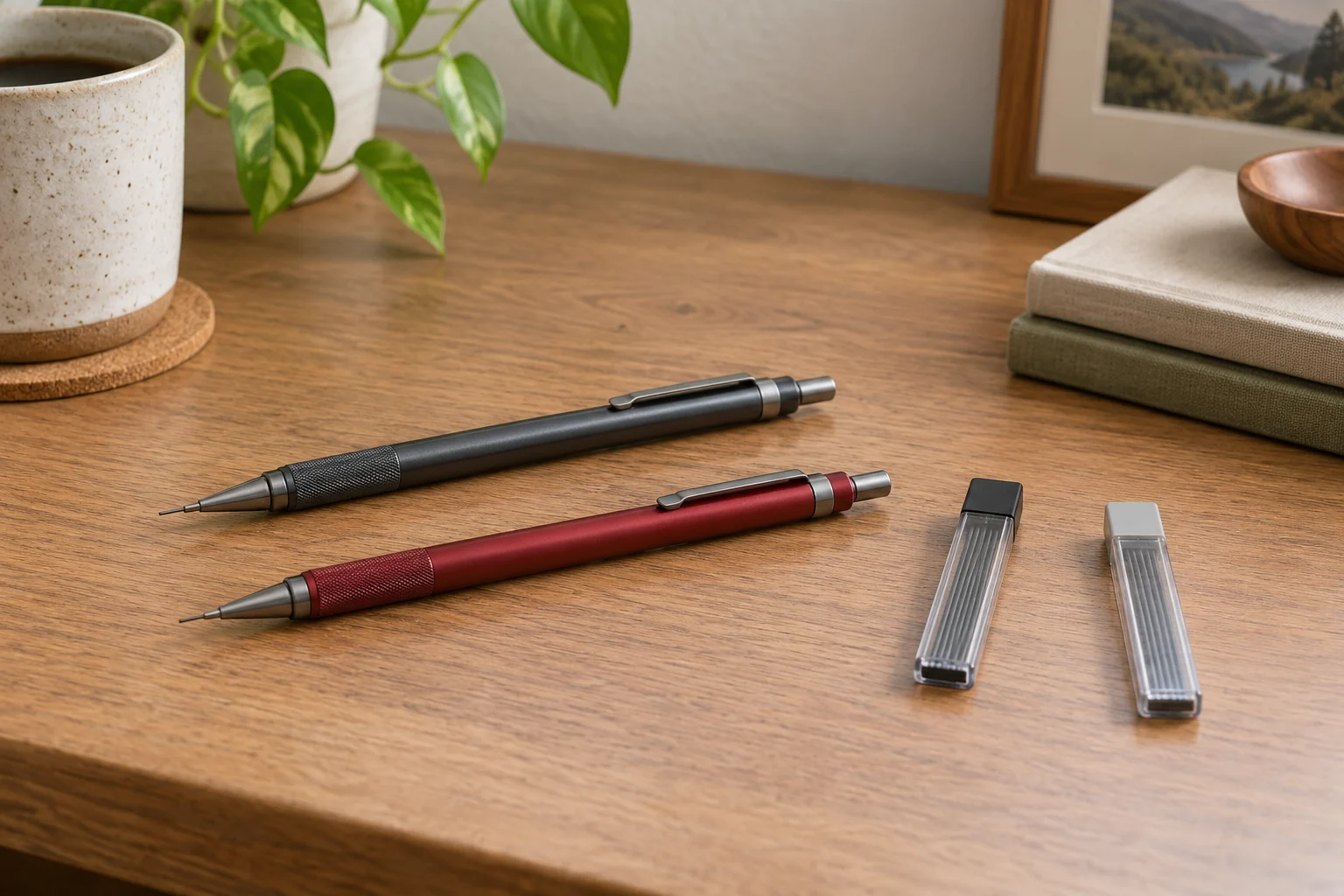
Also distinguish the pencil from the loose supplies beside it. A refill container can belong to another writing instrument in the same case. Find the actual diameter marking before treating nearby lead as the refill already inside this pencil. A shared stationery pouch is an ordinary reason to check identity, without assuming anybody deliberately loaded the wrong material.
Keep the actual Metal offer with the matching instructions
The Unbranded-listed Kuru Toga Metal offer identifies SKU 18789411929 and UPC 757047258139. Its body names M5KH1P.24, a metal body, Nocturne Black finish and a 0.5-millimetre point. Use that full reference when asking about the actual supplied item.
The same description attributes fine, uniform lines to its rotating Kuru Toga Engine. It describes a grip combining blast processing with fine lines and a resin nib damper intended to absorb impact and reduce noticeable tip movement. These are retail feature claims, without a writing or durability comparison performed here.
The manufacturer's sheet is headed KURU TOGA Metal and identifies Mitsubishi Pencil Co., Ltd. Read its part diagrams beside your actual pencil before using the illustrated procedure. If the actual components or applicable instructions differ, leave the procedure unapplied until that mismatch is resolved. A general Kuru Toga family name does not identify every model's service arrangement.
Keep the complete sheet available while working. Its illustration distinguishes the outer grip, a white pipe and a silver slider. Use the sheet's own part names. It does not replace an unclear diagram with a guess about which other piece should turn or separate.
Refilling a Kuru Toga Metal
For refilling a Kuru Toga Metal, remove the rear cover and eraser. Insert at most three matching 0.5-millimetre Mitsubishi Pencil leads there, never through the tip, following the sheet.
Check the selected pencil's stated diameter against the actual refill package. The 0.5-millimetre Metal account and the 0.7-millimetre Tamisio account name different diameters. They are not interchangeable descriptions of one refill requirement. If the refill marking is missing, resolve that supply question before using an anonymous loose stick.
A refill amount is also different from the number of pencils in a purchase. Keep the quantity in the instruction with its refill task. A package of replacement lead can contain more pieces than belong inside the pencil at one time. The packet's remaining contents can stay separate without becoming a required load.
If you have already added something and cannot identify it, report that uncertainty when seeking help. Do not improve the story afterward by naming a diameter you never established. Knowing that the refill is uncertain is more useful than a confident account attached to the wrong supply.
Clear the matching Metal
For a matching jam, unscrew and remove the front grip; hold the white pipe and unscrew the illustrated silver slider. Remove jammed lead or debris, firmly screw slider and grip back into position, then click the eraser cover once. Keep small parts out of your mouth; the tip is sharp.
Pause if you cannot identify one of those components on the actual pencil. The diagram gives the relationship between parts, not a general permission to dismantle every writing instrument with a metal body. Keep the matching-sheet requirement throughout the task rather than checking the model only after something has separated.
Make room for the actual components before beginning an applicable procedure. A clear part of the desk lets you keep a removed piece associated with this pencil. Avoid combining loose components from another pencil into the same small group. Return each component to the pencil it came from.
The stated procedure concerns the obstruction shown in that sheet. It does not certify a damaged component, supply a replacement part or guarantee that every pencil which fails to feed has the same cause. If the expected parts or result do not match, retain the unresolved condition for the appropriate support enquiry.
Lead rotation versus lead feeding
For lead rotation versus lead feeding, the sheet says light pressure, minimal movement or a shallow angle can limit rotation without preventing ordinary writing.
A pencil that leaves a line while its owner questions rotation presents a different observation from one with no usable writing point. State which observation remains after any applicable action. A line on the page does not independently prove that every mechanism operated as expected, while an uncertain rotating effect does not itself establish a physical obstruction.
Describe any change you noticed in the line itself. A different page, refill or writing task would need its own identity before it became a controlled comparison. This article reports no test of line uniformity, tip movement or the selected retail pencil. It gives no prescribed writing pressure or angle for a particular person's hand.
If the question is specifically about the advertised rotating feature, identify that feature in the enquiry. Asking only whether a pencil can write could receive a correct answer to a narrower question. Explain whether the unresolved concern is usable writing, refill behaviour or the mechanism the product account describes.
Keep the Tamisio twist pencil's refill account separate
The TeviRoom-listed Tamisio 131586 offer names the Graf von Faber-Castell Tamisio mechanical pencil in India Red. Its native catalogue brand is TeviRoom. The body describes a twist mechanism and 0.7-millimetre lead, also written as 0.03 inches with 0.7 millimetres in parentheses.
Retain that paired source wording without rewriting it as an exact numerical conversion. The relevant refill identity here is the actual 0.7-millimetre statement. The description gives no Kuru Toga Engine, rear-cover procedure or matching grip-and-slider service diagram for this pencil.
If you own the Tamisio-described item, obtain its applicable instructions for advancing, refilling or servicing it. The Metal sheet does not become its manual because both products hold replaceable lead. A twist mechanism and a named rotating-lead engine describe different product features, with no shared repair arrangement established by these two accounts.
When choosing supplies for a household with both pencils, identify the pencil on the refill question. A request for lead for the red pencil can lose meaning if another red instrument is added later. Keep the actual product reference and diameter available to the person arranging the refill.
Check the result without turning it into a complete repair claim
After an applicable action, describe the result you actually obtained. If the pencil produces a usable line, you can report that observation. If the original feeding problem remains, say so. Neither outcome requires inventing a cause you did not establish or declaring another untested feature restored.
A problem that returns also remains relevant. Keep the actual model and the repeated symptom in the support request, along with any identified refill supply and applicable action already taken. A later brief improvement does not erase the earlier event or prove that every component is sound.
This guide supplies no substitute cleaning chemical, compressed-air technique, improvised wire or unlisted replacement component. Use the actual documented procedure for the matching pencil and stop at the limits of the information available. An unresolved writing tool can remain out of use while its actual support or replacement question is settled.
Keep the loose supplies with the pencil they serve
After identifying the actual refill, keep unused sticks in their labelled container while you work with the matching pencil. A loose stick on the desk loses the printed diameter that helped identify it. Retain the original package until the supply question is settled, particularly when more than one mechanical pencil shares the workspace.
Use separate places for the two pencils' supplies. Someone handing over a refill should be able to name the pencil it is for without relying on which side of the desk it happened to occupy yesterday. A closed container with its actual marking keeps that information available when the desk is cleared or the stationery case moves.
If you find anonymous pieces already mixed together, separate them from the identified supply. Their appearance does not recreate a missing package label. You can continue using an identified refill without deciding that every loose piece must be used too. Ask for the actual supply information when its identity affects an applicable maintenance task.
Keep removed pencil parts associated with the actual instrument as well. A cap from another pencil can look familiar while leaving its suitability unestablished. Returning a loose component to the wrong stationery case would make the next enquiry harder. Finish identifying and returning the matching parts before clearing that work area.
A refill choice can remain separate from replacing the pencil
If the identified pencil and its applicable instructions are available, investigate the actual refill or feeding question before assuming the entire writing instrument needs replacement. A missing supply is a different purchase from a new pencil. The offers identify pencils; they do not quote every compatible replacement part.
If support instead identifies an unsupported or damaged part, retain that finding with the particular pencil. Do not expand it into a conclusion that every Metal or every twist pencil has the same fault. Choose a replacement for the item you own, keeping the actual finding and any missing supply in view.
Use related guides for their own observation questions
The actual M210 stud-finder indication guide distinguishes an observed display from an unsupported fault diagnosis. Its detector-specific information stays with the actual M210 and JGJJUGN accounts. The relevant connection is naming the behaviour that failed before choosing a remedy; it supplies no pencil components or service instructions.
The actual quartz clock dial explanation separates a timekeeping method from the face a person reads. Its JUNCHI and MELINLOY descriptions do not establish pencil features. It illustrates why a product's named mechanism and the result a user observes need their own questions.
For a Kuru Toga Metal lead jam, retain the actual pencil identity, matched instructions and the symptom that remains. Refill and service only under the applicable account, then describe the result honestly. A feeding question and a rotation question can be handled clearly when neither is silently substituted for the other.
Conceptual Kuru Toga Metal lead jam cover with whole generic inactive pencils and closed refills; no exact model or repair shown.