Cleaning & Vacuums
Dyson V15 vs Miele Blizzard CX1 vacuum: follow the floor route and supplied heads
Compare Dyson V15 and Miele Blizzard CX1 by the actual floor route, supplied heads, controls, runtime questions, care and the current $63.75 offer gap.
Walk through the rooms you normally clean before comparing Dyson V15 vs Miele Blizzard CX1 vacuum. Mark the hard floor, low-pile rug, furniture gap and upholstery job that interrupt the route. The current Dyson V15 Detect Absolute description centers on cordless use, a Digital Motorbar head, hair-handling features and a runtime display. Miele's Blizzard CX1 Pure Suction description names a bagless canister, two specific floorheads and four suction settings. Check the supplied tools and how you would move each cleaner between those rooms. Neither source reports a matched pickup test in your home.
The current Dyson V15 Detect Absolute Iron/Gold offer is $785. The Miele Blizzard CX1 Pure Suction Graphite Grey offer is $848.75, a listed difference of $63.75 before applicable checkout or delivery charges. Both sit in Vacuums, Steamers & Floor Care. Keep these exact products with the comparison: a different Dyson bundle or Blizzard variant may change the supplied head, accessories and questions that matter on your floors.
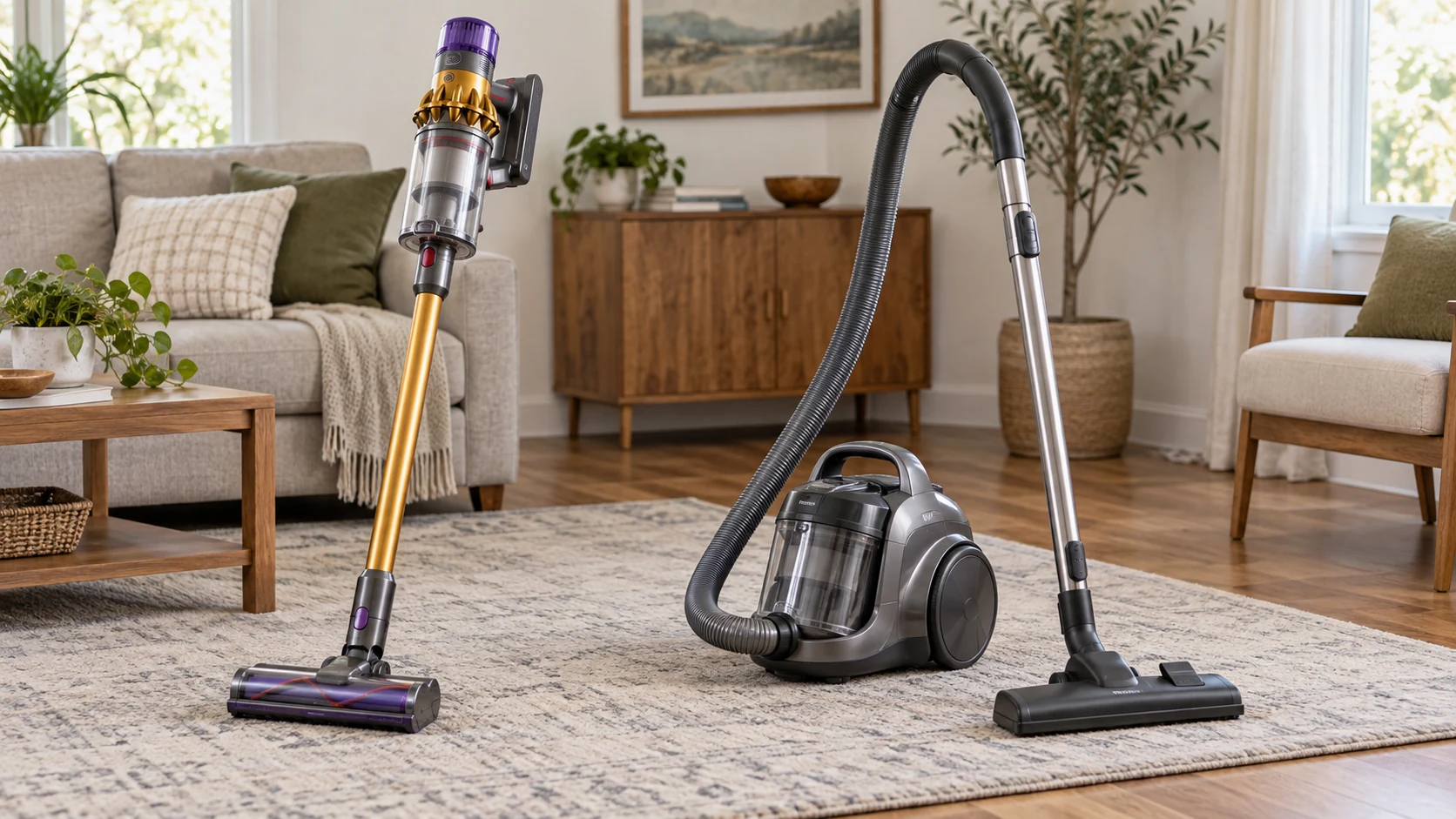
Conceptual editorial cover for Dyson V15 vs Miele Blizzard CX1 vacuum: generic cordless stick and bagless canister cleaners in a living room, not actual retail models or evidence of their supplied tools, cleaning results or filtration.
Vacuum floorhead and surface checks
Begin vacuum floorhead and surface checks with the floor manufacturer's care directions. Miele describes the Pure Suction Combination Floorhead as intended for low-pile carpets and hard floors. Its named inventory includes the SBD 285-3 combination head and SBB 300-3 Parquet Twister. The latter is described with soft bristles for delicate hard floors. Those statements give you particular tools to investigate, but do not approve every carpet or floor finish. Ask which of the supplied heads is permitted on each actual surface.
Miele's source also lists a dusting brush, upholstery tool and crevice tool. Note the places where those small tools would be used: the sofa seam, shelf edge or space beside a cabinet. The inventory does not give their dimensions or a complete attachment and reach diagram. A tool called crevice may still be too wide or short for a particular gap. Measure the awkward space and ask about the actual accessory instead of counting it as a solved task merely because it appears in the package list.
Dyson's description names the Digital Motorbar cleaner head and says its DLS system monitors brush-bar resistance 360 times a second to adapt power across floor types. It also describes hair-removal vanes, an anti-tangle conical brush bar for small spaces and soft nylon with antistatic carbon-fiber filaments for hard-floor dust. Keep those as the product's documented feature descriptions. The short source is not a complete parts inventory and does not identify every accessory by exact supplied part number.
The actual Shark NV752 and Eureka NEN185 mixed-floor comparison develops a purchasing decision from carpet instructions, supplied brush controls, small tools and furniture access. Use those surface and handling questions when checking the actual Dyson and Miele heads against your floors. Its Shark Lift-Away system, Eureka nozzle controls and those products' accessory details belong to that separate comparison. They cannot establish a mode or attachment on the Dyson or Miele offers here.
Divide the route by surface before deciding how many changes you can tolerate. A hard-floor room followed by a low-pile rug may require checking a setting or exchanging a permitted head. The sources do not give a common demonstration of those transitions. Ask how each exact machine should be configured for your surfaces, including any restriction from the rug or floor maker. Neither a broad “all floors” claim nor a soft-bristle description can replace a specific floor-care permission.
Cordless and canister cleaning route
For cordless and canister cleaning route planning, mark where the cleaner must turn, be lifted or reach underneath furniture. Dyson describes cordless versatility across floors, mattresses and hard-to-reach places. Miele describes a canister arrangement, but its short text does not supply an operating radius or cord length. Confirm the electrical setup, cord and hose measurements for the actual Miele unit. Do not import a reach figure from another Miele model simply because both have a canister body.
The actual Miele Guard L1 and LG CordZero A9 route comparison distinguishes moving a corded body and hose from cleaning with a charged cordless unit. It asks buyers to follow the real rooms and account for interruptions, tool changes and storage. Those decisions support this comparison without transferring Guard L1's cord radius, dustbags or filter specification, or LG's battery and charging arrangement. Blizzard CX1 and V15 need their own measurements and supplied-component confirmation.
A canister body following the head can behave differently around chair legs from a stick's assembled body. That is a handling distinction to examine, not proof that one format always turns more easily. Request Miele's actual hose, tube and body dimensions and Dyson's assembled dimensions. Measure the narrowest turn along the route. If the vacuum will be carried to another floor, ask for its relevant weight and carrying guidance rather than assuming the stick is easier to lift from a description calling its materials lightweight.
Check the working position under a sofa or bed. Dyson's description mentions a low profile for reaching farther under furniture, but does not provide a measured head height or guarantee a fit. Miele's actual head and tube likewise need dimensions for that gap. Record the clearance and the room available to turn the nozzle. A generic product photograph on an open floor does not answer whether the head can enter, change direction and be withdrawn comfortably beneath your furniture.
Understand the display and suction controls
Dyson lists three cleaning modes and a digital display showing a runtime countdown and maintenance alerts. The source does not give a fixed runtime for each mode, battery count, charging duration or complete charger inventory. A countdown display is information to investigate, rather than a promise that a particular session finishes on one charge. Ask how the chosen floorhead and setting affect runtime, and confirm what battery and charging equipment is included in the selected Iron/Gold offer.
Miele describes four suction settings selected through a rotary dial. That is a documented interface with a different question: which setting and head should be used on each permitted surface? The number four does not establish four measured pickup results or a performance advantage over Dyson's three mode labels. Ask to see the exact control and read its instructions. A mode count cannot tell you how strongly a head seals against a rug or how comfortable it is to push along your route.
The DLS description concerns Dyson's monitored brush-bar resistance and adaptive power feature. It does not supply a side-by-side measurement of pickup, battery use or user effort against Miele. Similarly, Miele's Vortex wording and claim of deep cleaning do not establish a test result on your rug. Keep the documented controls with the surfaces you intend to clean. A permitted demonstration on a representative floor can help answer handling questions, while this guide provides no result from such a demonstration.
For a long cleaning session, ask how the actual Dyson is charged and whether a compatible spare is included or available separately if you need one. The short description does not settle that inventory. For Miele, check the route between appropriate outlets and how the actual cord is stored; its current excerpt does not document a rewind system. Neither question should be answered with a specification copied from the related Guard L1 or LG article.
Examine hair handling without promising no maintenance
Dyson says its hair-removal vanes clear the brush bar and its conical anti-tangle bar moves hair into the bin. Those are intended design functions, with no common pet-hair pickup trial against the Miele in these sources. They do not establish that every hair length, carpet or upholstered surface will need the same number of passes, or that cleaning the head is unnecessary. If hair is the main obstacle in your home, ask which actual supplied tool the manufacturer intends for that surface.
Miele's source names its floorheads and upholstery tool but does not give a matching anti-tangle mechanism or hair-handling test. Missing language is an unanswered product question, rather than proof that it cannot collect hair. Inspect the head permitted on your rug and obtain its care instructions. If a powered upholstery tool is necessary for your routine, verify exact compatibility, availability and package contents before including it in the purchase. The name Pure Suction does not itself identify an additional powered accessory.
Write down where hair accumulates instead of treating pet use as one uniform task. A narrow floor edge, rug and sofa seam can call for different access and tools. Confirm the expected head change and the instructions for inspecting collected hair afterward. The sources do not supply a complete brush-maintenance procedure for either appliance. Ask how the exact head is safely inspected and cleaned before assuming that a feature name removes the work that frustrated you with a prior cleaner.
Keep filtration claims separate from emptying and health
Dyson claims fully sealed HEPA filtration trapping 99.99 percent of microscopic particles as small as 0.1 microns. That is the listing's system claim, without an independent whole-appliance test presented here. Miele's current excerpt supplies no directly comparable particle-size or capture result. These descriptions do not support ranking the two machines by a matched filtration result. Neither statement establishes a clinical benefit or the amount of dust a particular person will encounter during their actual cleaning and emptying routine.
Miele's selected offer names a bagless canister, while Dyson's description refers to hair going into a bin. Those statements do not give a bin capacity, removal sequence or filter-care table. Ask how the actual collected debris is removed and where the instructions require that work to happen. The related Guard L1 guide describes a bagged machine, so its dustbag replacement routine cannot be assigned to Blizzard CX1. The selected sources do not establish that these two containers open or clean in the same way.
Obtain the exact component care directions for the filters, bin, head and any removable tools. A washable-looking part should not be put in water or a dishwasher without its own approval. Confirm any required drying and replacement guidance in the actual manual, then keep the identified filter and wear-part references with the order. These sources do not give replacement intervals or running costs. A filtration claim during operation leaves those ownership questions unanswered.
Check storage and what the offer includes
Place the complete expected equipment on the storage plan. Miele's named two floorheads and small tools need a place alongside the body, hose and tube. Dyson's actual confirmed charging equipment and attachments will create their own requirements. Ask for the stored and assembled dimensions and the maker's storage guidance. Neither source establishes that a stand, wall mount or particular attachment organizer is included, so do not allocate a product photograph's display arrangement as a guaranteed part of the box.
On delivery, compare the model designation and inventory with the confirmed offer before choosing a head or charging arrangement. For Miele, retain SBD 285-3 and SBB 300-3 alongside the selected Blizzard CX1 Pure Suction model. For Dyson, retain V15 Detect Absolute and the Iron/Gold package identity with the promised component list. Ask how the seller handles an inventory discrepancy. Keeping the exact order evidence is more useful than accepting a replacement tool on the assumption that a similar name establishes compatibility.
Assess the price after the route is clear
The present $63.75 gap places this Miele offer above this Dyson offer. It does not establish which product usually costs more, cleans faster or lasts longer. Confirm applicable delivery charges and any separately necessary, verified compatible tool before comparing your total. For Dyson, resolve the charging and runtime questions that affect the route. For Miele, resolve head suitability, cord and hose reach. A lower listed amount has limited value if a necessary unanswered component or handling issue prevents the intended clean.
Miele's short description ends with “3 year Limited,” without a complete warranty statement. Ask for the full applicable terms and the identity of the coverage before treating that fragment as an entitlement. Dyson's source also supplies no complete warranty plan here. Read each selected offer's current return and service conditions and ask about replacement filters, heads and batteries where relevant. This comparison cannot promise eligibility, repair cost or a specific return outcome from the product descriptions alone.
For Dyson V15 vs Miele Blizzard CX1 vacuum, keep the floor sketch with the confirmed inventory: permitted head for each surface, comfortable furniture access, supported controls, charging or cord arrangements, and the maintenance required afterward. Choose the configuration that answers your actual route with instructions and parts you can identify. Leave missing reach, runtime, care or package information unresolved until the seller or manufacturer answers for the selected model, rather than declaring a cleaning winner from feature labels.