Seasonal & Holiday Content
Christmas snow globe placement: keep direct sunlight in mind
Winter fire reports give a practical reason to consider daylight before displaying an ornament, with two distinct musical decorations kept identifiable.
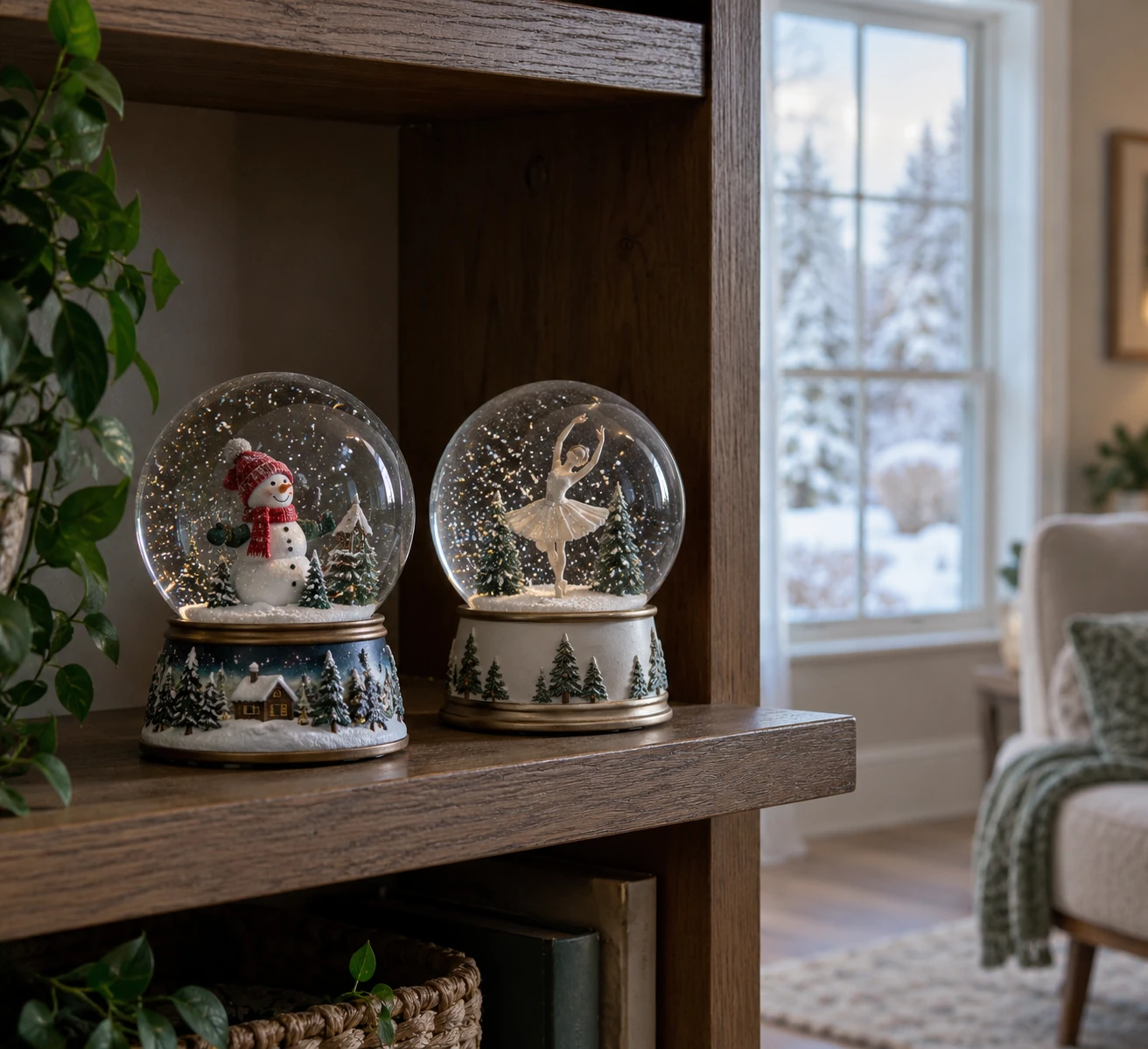
Christmas snow globe placement needs attention during daylight as well as during an evening display. Fire services have documented winter incidents involving sunlight and glass ornaments, including a snow globe on a windowsill. Keep that concern in your seasonal plan before choosing a place because it looks festive. The two products below also have different stated materials and music arrangements. Identify the actual ornament and follow its applicable instructions while choosing where it will live.
Take winter sunlight fire risk seriously
Dorset & Wiltshire Fire and Rescue Service reported a January 2017 incident in which a resident smelled burning and firefighters found a snow globe on a windowsill focusing winter sunlight onto a woollen throw. The throw had scorch marks and was still smouldering. The service warned that curved glass objects can concentrate sunlight onto nearby flammable material. Its advice was to move glass ornaments away from windows and remain aware of where sunlight falls inside the home. Cold weather did not prevent the incident.
That example gives winter sunlight fire risk a specific place in holiday decorating. It does not establish a tested position for an unidentified ornament in another room. Keep the advice attached to the concern it addresses: sunlight reaching glass objects and nearby material. An attractive windowsill arrangement is still a location to reconsider. You do not need to reproduce a reported incident or experiment with a globe to decide to keep it away from direct sunlight.
Check the room before treating an evening arrangement as finished
Imagine Leila unpacking a holiday ornament after work in December. Her fictional room is dark outside, and she likes the empty windowsill beside a chair. She leaves that location out of her proposed display when considering the fire service's advice. Instead, she looks for a place in the room that keeps the ornament out of direct sunlight. The pleasant evening view has not answered the daylight question. This example supplies no safe distance from a window or approval of a particular shelf.
You may unpack decorations at a time when the room looks quite different from its daytime use. Treat that as a reason to consider the setting again, with the actual objects present. Explain the intended location to anyone helping with the display. Someone who did not hear the original discussion may otherwise move an ornament to the very window you decided against. Keep the reason understandable in ordinary words, rather than depending on one person's memory of a decorating plan.
A glass-globe fire report is different from a product test
Essex County Fire and Rescue Service described a January 2025 bedroom fire caused by sunlight reflecting off a decorative glass globe on a windowsill. Curtains were burning when firefighters entered. Its warning concerned glass, crystal and reflective objects in direct sunlight, including objects on windowsills or bedside tables. The report also described a mirror in another bedroom that was already becoming very hot. These are reported household incidents. They do not identify either of the two retail products selected for this article.
Keep that distinction when reading a product description. A stated material helps identify the offered object; it does not provide a model-specific fire assessment. A photograph of a decorative object near a window cannot supply that assessment either. Use the relevant safety advice and actual product requirements when planning the display. Neither a different base colour nor an alternative decorative scene establishes that an ornament can safely be left in direct sunlight.
Read the glass ballerina globe with its mechanical music account
The BestPysanky ballerina water globe description names a glass globe, resin base and built-in mechanical music box playing Swan Lake upon windup. It lists a height of 5.75 inches and a base diameter of 4 inches, and says the item is hand painted and gift boxed. Its photograph shows a pink ballerina within a round clear globe above a pink decorated base. Those stated dimensions and features identify the offer, without establishing a handling, winding or storage procedure here.
The material statement matters more to this placement question than the pictured ballerina's costume. Keep the glass identity with the item when considering the fire services' guidance. If the ornament is being given as a present, pass along its actual supplied instructions and product reference. A recipient should be able to identify what they have received. The music feature is a separate operating question, to be answered from the applicable instructions for the actual mechanism.
Keep the PC-and-resin lighted decoration distinct
The Menolana Santa Claus music-box decoration lists PC and resin, water, swirling glitter, music and a light function. Its specified size is 23.5 by 7.3 by 14.5 centimetres. The package account lists one Christmas snow globe and one USB cable. The single photograph shows a broad clear-fronted scene containing Santa and reindeer; it also includes surrounding staged decorations. Those background objects are not established as supplied. No power-adapter specification or operating procedure is provided by this article.
Its PC-and-resin description should remain visible in the comparison with the glass ballerina offer. Do not rename the Menolana material as glass because both listings use snow globe. Equally, a different material name supplies no independent safety certification for its particular construction or location. Keep the actual model information and instructions with it. The USB-cable account also differs from a mechanical windup description; neither gives you permission to transfer the other product's operating directions.
Keep the sunlight concern after the holidays
London Fire Brigade's account of a May 2022 house fire in Marble Arch described sunlight reflecting from a mirror on a side table and a fire in a timber window. A station officer warned that fires involving reflected sunlight can happen throughout the year, and advised keeping mirrors, crystals and glass ornaments out of direct sunlight. That report concerns a mirror, rather than a test of a snow globe. Its year-round warning matters when a seasonal decoration remains on display after the celebration ends.
Leila's fictional household decides to keep one ornament out after the holiday boxes have gone away. They retain the same sunlight concern instead of treating the end of December as the end of the placement decision. A seasonal object can become an everyday possession without changing its identity. Keep its actual instructions available and reconsider the setting when moving it. The change from a holiday display to a year-round shelf does not itself establish a suitable location.
Do not make a temporary photo location an unconsidered display place
In the invented example, Leila wants to send her sister a picture of the ornament. She considers the old windowsill because she likes its plain background, then remembers why the household rejected that location. She chooses a different photographic arrangement that retains the display's sunlight constraint. The photograph is a separate activity, but it still involves the actual object. A temporary arrangement can be discussed before anyone moves the decoration into it.
If another person helps photograph or tidy the display, explain which object is being moved and the concern that belongs with it. They may be concentrating on the picture or on clearing a surface. Giving that context can keep the original reason for the location from disappearing during an ordinary household task. This is a suggestion for keeping a decision understandable; it is not a substitute for the actual product's handling requirements or a fire-safety assessment of a room.
Keep window decorations and free-standing ornaments separate
The window art afternoon guide considers a proposed visual scene while leaving the actual window materials and their application requirements unresolved. Its cling and decoration listings have their own identity questions. That composition exercise does not establish a location for a free-standing glass globe. A decoration intended for a window and an ornament placed on a windowsill are different product questions, even when both appear in a seasonal room.
Decide what you are actually adding to the room before borrowing an idea from another display. You might already have a paper drawing of a window scene, an unopened packet of decorative shapes and a separate boxed ornament. Keep each identified with its own applicable information. A proposed scene on paper can change while you obtain the details needed for a real product. The products need not all occupy the same surface simply because they arrived for the same holiday.
Keep seasonal ornament storage tied to the actual item
For seasonal ornament storage, retain the specific product reference and its supplied instructions when the display comes down. These two descriptions do not provide a complete packing or storage method. A gift-boxed statement does not establish that an original box is suitable for every later storage arrangement. Obtain the requirements for the actual ornament and its components. Keep any music or powered feature identified so that its applicable instructions can be found when you next take the item out.
The holiday decoration box-label guide concentrates on words that another household member will recognise when retrieving decorations. It distinguishes a useful group name from an assumed inventory, and explicitly leaves fragile-object packing to the actual item and container requirements. That is a relevant boundary here. A clear label can help identify a stored decoration, while the label itself supplies no packing protection, handling instruction or permission to stack a container.
In Leila's example, the person unpacking next season may be her partner. They want that person to recognise the ornament and find the information retained with it. They choose an ordinary identifying phrase together, while leaving the physical packing decision with the actual requirements. The next year's display can be different. Keeping the product identifiable allows the household to revisit its instructions and the sunlight concern without pretending that last year's location settled every later arrangement.
Keep an optional crypto order tied to the right ornament
Consider another part of Leila's fictional choice: she is browsing republeq.com and would like to explore paying with USDT. Before reaching a payment decision, she wants the ornament's identity and unanswered product questions clear. Her preference for cryptocurrency will not establish the material of an ornament or provide instructions that the listing does not contain. She checks the current order's available payment methods instead of assuming that a broad crypto reference specifies her eventual transaction. This guide identifies no receiving address or network and asks nobody to send funds through a route described here. Any decision to proceed belongs with the actual checkout and the instructions provided for the selected method. The availability of USDT or any other asset for a future order remains unpromised. Leila can retain the product reference while deciding whether the offer answers her questions. If someone suggests an alternative decoration, she would examine that item's own description rather than carrying over the first ornament's material or supplied-cable account. She would also review the delivery and return information applicable to the purchase she is actually considering. A preferred payment method creates no commitment about arrival, returns or a particular refund arrangement. In this example, she can leave the basket undecided while asking for the missing details; her holiday room does not depend on completing the purchase immediately. Should she later place an order, the order confirmation and selected product reference can remain together for comparison with what arrives. These ordinary checks belong to the item being purchased, whether she ultimately chooses a cryptocurrency option or another method presented to her. The display's practical requirements remain part of her decision throughout. They cannot be settled by a payment label, a festive product photograph or the wish to finish decorating today.
Choose the display with the real ornament in mind
Christmas snow globe placement should keep the actual materials, applicable instructions and daylight setting together. The glass ballerina globe and the PC-and-resin Santa decoration have different stated construction and music accounts. Enjoy the scene you choose while retaining those distinctions. Keep glass ornaments out of direct sunlight in line with the fire services' advice, including when the holiday has ended or the object is moved for another purpose. A decorative photograph can remain an idea while you resolve the actual display requirements.