Crypto Commerce
Create Sony ZV-1 II photo riddles with a reveal image
A good object riddle lets someone make a reasoned guess from a photograph, then see exactly how the clue belonged to the answer. Start with an item you own or have permission to photograph. Decide what answer you will accept, take a picture that leaves out some identifying information, and take a second picture that shows the same visible feature on the whole item. Show the clue first. If the reveal cannot point back to something the player actually saw, the pair needs another photograph.
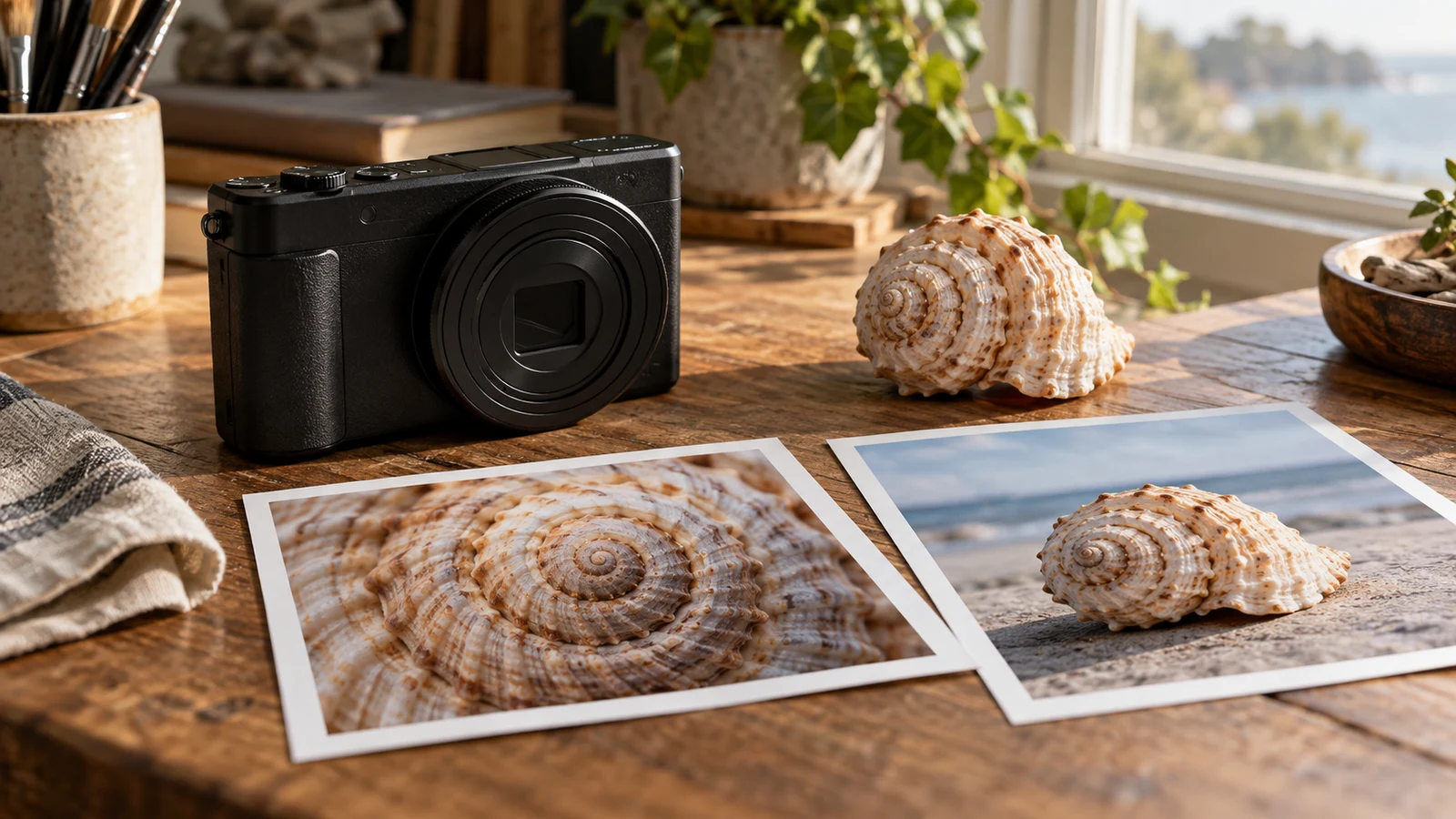
A good object riddle lets someone make a reasoned guess from a photograph, then see exactly how the clue belonged to the answer. Start with an item you own or have permission to photograph. Decide what answer you will accept, take a picture that leaves out some identifying information, and take a second picture that shows the same visible feature on the whole item. Show the clue first. If the reveal cannot point back to something the player actually saw, the pair needs another photograph.
The interesting choice is how much to withhold. A full view gives away an object too quickly; a shapeless sliver could belong to almost anything. You can make a riddle from a curve, a partial marking, or the meeting point of two visible features without pretending that blur makes the puzzle clever. The steps below keep the game fair while leaving room for a surprising answer.
Choose An Answer Before The Product Photo Shot List
Write the intended answer in ordinary language before raising the camera. It could be an animal represented by a decoration, a kind of household object, or one particular item the player already knows. Those are different tasks. A photograph might support “dog decoration” without supplying enough evidence for a manufacturer, a model number, or the exact name on a store listing. Set the answer at the level the clue can reasonably support. If several names describe what is visibly there, decide in advance which ones count.
Imagine a player who has never seen your object in person. What could that person identify from shape or markings alone? Familiarity can make the answer feel obvious to the person taking the picture. Someone else may see a different but equally plausible object. If your intended answer depends on knowing where you bought the subject or remembering a conversation about it, change the answer or choose a different detail. The photograph has to carry the relevant evidence itself.
Keep a private note with the intended answer, the visible clue you expect someone to use, and one alternative you would accept. This is a fairness check rather than text to display with the clue. If the answer is “beagle decoration,” for instance, “dog decoration” may be a reasonable partial answer if the image does not establish a breed. The note gives you a way to judge the guess consistently after you hear it, instead of moving the goalposts to defend your first picture.
Use A Product Photo Shot List To Plan Sony ZV-1 II Photo Riddles
The listed Sony ZV-1 II is a compact camera that takes still photographs. For Sony ZV-1 II photo riddles, its job is straightforward: capture a clue image and a fuller image of the same physical subject. The plan does not require a particular camera setting, attachment, focusing distance, or editing feature. Look at the object first and choose a feature you can record clearly from a position that works with the camera you have.
Try identifying a boundary between recognizable parts rather than isolating a tiny patch of color. A curve beside another shape gives the player a relationship to reason about. A patch of red on its own might describe a hat, a toy, or a dozen unrelated objects. If the selected detail is too small to photograph clearly, choose a larger portion of the item; the puzzle can remain interesting because the surrounding identifying features stay out of view. Sharpness helps the player inspect a clue, while omission makes them guess.
Check the clue as a stranger would. Does the photograph show at least one discernible contour, pattern, or junction? Have you accidentally included the whole subject, a readable label, or another giveaway that bypasses the clue? You can make a second candidate showing a little more of the same feature, then compare which photograph invites an inference. This is an editorial choice about what the player sees, not a test of a camera specification.
For Sony ZV-1 II photo riddles, keep the object unchanged between the clue and reveal whenever practical. That lets a viewer trace a feature across the two pictures. If the subject shifts or a piece is hidden in one view, the answer can feel like it came from information supplied after the guess. You do not have to show every part of the object in the clue. You do need to preserve the identifying evidence you plan to explain later.
Inspect Hyjoy Multicolor 2 Pack Dogs As Possible Subjects
The listing for Hyjoy Multicolor 2 Pack Dogs describes a pair of pre-lit beagle figures wearing Christmas suits and hats, each holding a candy cane and an apple. Those descriptions suggest several possible categories of answer, but they do not tell you which details will be legible in your photographs. If you have the figures or can photograph them with permission, inspect one actual figure before choosing a clue. Do not assume the two figures look identical in every visible respect.
Suppose you want the player to guess “dog decoration.” Find a visible part of one figure that could plausibly lead there without displaying its entire outline. You might test a portion where an ear appears beside the head, if that relationship is clear on the particular item. If it reads as an unrelated curve in the photograph, try another feature. A hat or candy cane alone may instead suggest a holiday decoration without pointing to a dog. That can work if “holiday decoration” is the answer you meant to invite.
There is no need to turn an unseen difference between the two figures into the solution. A player cannot infer that one item differs from its partner if the partner was never shown. Likewise, a specific product name printed on a listing should not be the required response to a partial photograph unless the photograph itself supplies the relevant words. Let the item give you clues you can see, and let the intended answer follow what those clues warrant.
Choose One Hyjoy Multicolor 2 Pack Dogs Detail To Test
Look at the chosen figure from the viewpoint you expect to photograph and describe the feature without naming the answer. “A curved shape beside a pointed shape” may reveal that the composition is too ambiguous; “a hanging ear beside a visible section of a face” gives a player more to work with. These are hypothetical descriptions, not promises about how the actual figures appear in your hands. If you cannot see a useful relationship on the item, pick another permitted object rather than forcing the product into the game.
Use A Product Photo Shot List To Make The Reveal Explain The Clue
A reveal should settle the question by making the clue easy to locate on the same subject. Photograph enough of the object to establish the intended answer, while keeping the clue feature visible. A separate product photo shot list guide discusses how detail and overall views relate when documenting an item's visible condition. Borrow only that relation here: the second image should let a player find the first image's detail. This riddle is about what a viewer can infer, not assessing wear or cataloging surfaces.
Compare the pair side by side before inviting anyone to play. Point to the exact contour or marking in the clue, then find that same contour or marking in the reveal. If you have to explain that it was on the reverse side or behind something the reveal does not show, take a more useful reveal. A photograph of the whole object from a viewpoint that hides the clue can identify the answer while failing to explain the game. The connection between the two images is the payoff.
Let the reveal answer at the promised level. If the clue supports “dog decoration” and the reveal clearly shows a dog figure, the pair holds together. If your planned answer is a specific brand, the reveal of an unmarked figure still does not prove it. You can tell a player the listing name afterward as background, but score the guess from the visible evidence. Keeping those two roles separate prevents an obscure catalog detail from becoming a surprise requirement.
Test Hyjoy Multicolor 2 Pack Dogs Clues Before Sharing
Show only the clue to a willing participant and ask two questions: “What do you think this is?” and “What in the picture makes you think so?” Ask for the visible reasoning before showing the reveal. A correct guess for an unrelated reason tells you less about the clue than an imperfect guess that notices the feature you meant to show. One person's response is feedback on this pair, not a universal difficulty rating.
If the participant names several ordinary objects that all fit, decide whether you want to accept a broader answer or give the image a little more identifying information. If they cannot see the intended feature at all, make it more legible. If they solve it instantly because the whole subject is visible, withhold a different part while preserving a fair clue. Change one visual decision at a time so you can tell why the next version works better for your intended player.
Let a surprising but defensible answer count. A person might say “holiday dog” where you wrote “beagle decoration,” or identify a candy cane without identifying the figure holding it. The first response may meet your stated goal; the second might show that your clue emphasizes the accessory more than the subject. You can ask what additional visible feature would have changed the guess. That conversation is more useful for revising the photograph than announcing that the player was simply wrong.
Finish The Product Photo Shot List With A Fair Pair
Here is a hypothetical pair to test, conditional on what an actual figure shows. Set “dog decoration” as the answer. Photograph a portion of one figure that includes a recognizable ear and some adjoining facial shape, without including the complete dog silhouette. Then take a second photograph of that same figure showing the ear in its place on the dog. Accept “holiday dog” as a reasonable answer; if the clue shows too little to distinguish an animal at all, widen the first view and try again.
For Sony ZV-1 II photo riddles, write a brief private record: intended answer, the feature visible in the clue, where it appears in the reveal, and any accepted alternative. When you present the riddle, show the clue alone, collect the guess and its reason, then show the reveal. You can invite another guess with a different object later, but keep each clue paired with its own explanatory image. A reveal that resolves an inference makes the short game satisfying even when someone guessed differently.
If you are considering either listed product for this activity, examine the exact listing to decide whether the item suits your plans. Check current product details and any checkout terms before making a purchase, including the payment options actually offered at that checkout. None of those terms determines whether a photographed clue is fair. Begin with an object already available to you if you want to test the idea first; the only immediate requirement is permission to photograph it and a feature the player can see.
The product photo shot list can remain a reminder to connect detail and whole, while Hyjoy Multicolor 2 Pack Dogs remains a possible subject only if an actual figure supplies a useful clue. A player never needs to know either listing name to enjoy the reveal.