Crypto Commerce
Assess Sony ZV-1 II focus transitions for product videos
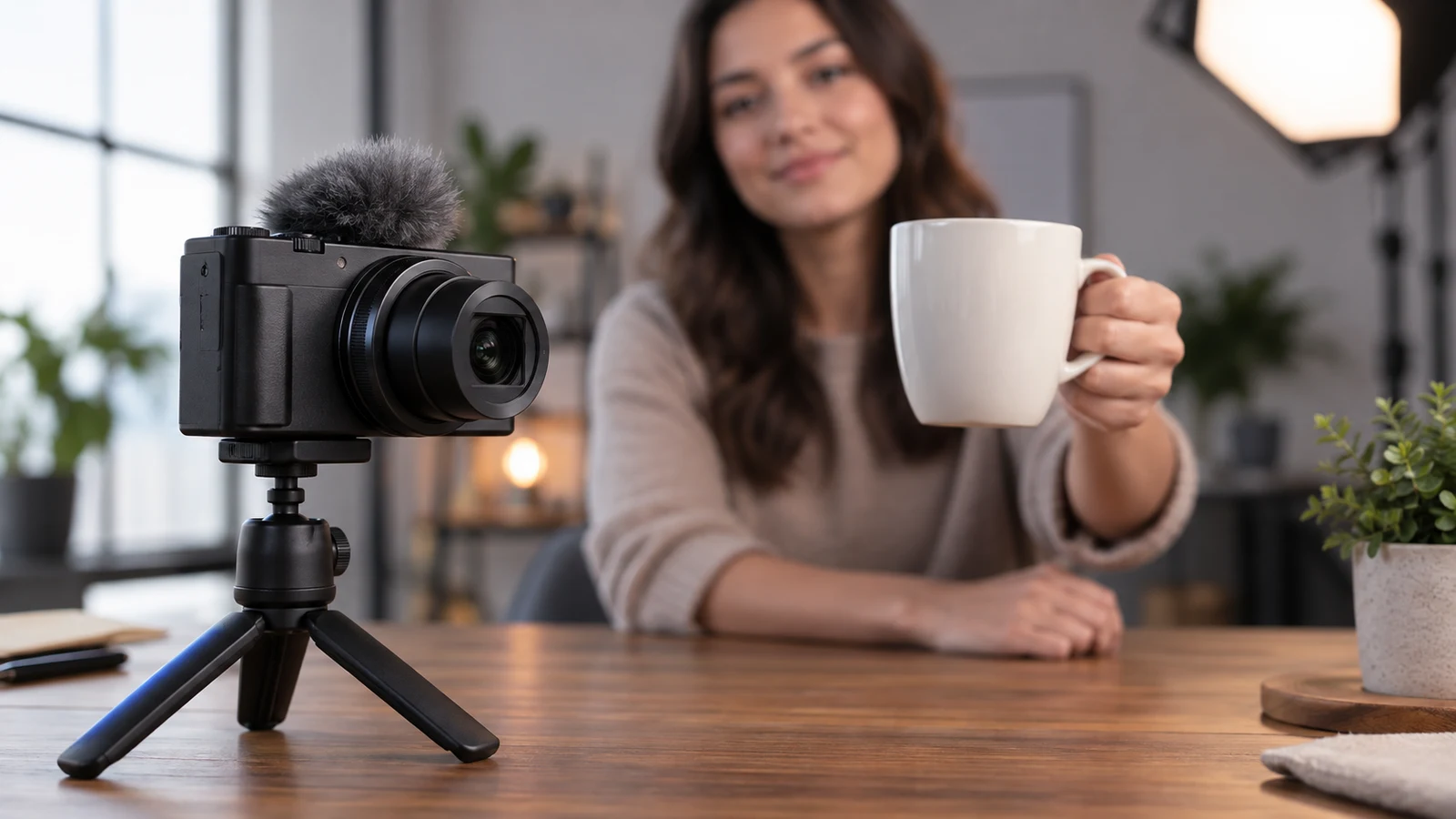
A seated presenter is explaining an ordinary object. For most of the explanation, viewers need a clear view of the presenter. When the object is held forward, they need to see the object instead. Once it is lowered, their attention returns to the presenter. A camera listing can identify the model and describe its video features, but it cannot show how that particular change of attention looks in the recording you intend to make. Before choosing a camera, ask for a representative clip and judge what is visibly clear at each of those moments.
A seated presenter is explaining an ordinary object. For most of the explanation, viewers need a clear view of the presenter. When the object is held forward, they need to see the object instead. Once it is lowered, their attention returns to the presenter. A camera listing can identify the model and describe its video features, but it cannot show how that particular change of attention looks in the recording you intend to make. Before choosing a camera, ask for a representative clip and judge what is visibly clear at each of those moments.
The useful question is whether Sony ZV-1 II focus transitions support that presenter-to-object-to-presenter change in your proposed recording. The answer depends on footage and on what the person operating the camera did, neither of which follows from the model name alone. The same question can be put to an alternative camera independently. You can reach a provisional decision even when a seller cannot supply every detail, provided you mark the unanswered parts as unknown rather than treating an attractive sample as proof of unobserved behavior.
Product Demo Video Planning Begins With Intended Attention
Describe the moment to the demonstrator without asking them to reproduce a whole finished video. The presenter speaks while seated, raises an object with an easily visible feature for inspection, then lowers it and continues speaking. Name the intended clear subject for each interval: presenter, object, presenter. Choose an ordinary object that the demonstrator may safely handle and that can be shown at the positions you actually expect to use. Permission to record the presenter and object should be settled before requesting footage.
The feature should be recognizable enough that a viewer can tell whether the object or the presenter is clear. You do not need a tiny printed marking to answer this question. For example, an object with a broad colored control or a visibly shaped component lets you judge where attention settles without turning the inquiry into a test of extreme proximity. Tell the demonstrator which feature a viewer is supposed to notice while the object is forward. Otherwise, an apparently attractive transition may emphasize a different part of the scene from the one that explains your point.
Keep the request tied to your actual seated explanation. If your presenter normally holds the object near their chest, a sample made with it at an unrelated position leaves an important question open. If the presenter plans to keep speaking while showing it, footage that cuts away from the presenter cannot answer what happens when both subjects share the recording. A continuous sample of the relevant moment makes changes of visible clarity easier to identify; it need not be an edited demonstration or a finished script.
Product Demo Video Planning And The Separate-Clarity Check
Before interpreting a change between subjects, establish whether each subject can be made clear on its own at the proposed positions. Ask for a view in which the seated presenter is visibly clear, and another in which the held object is visibly clear where it would appear during the explanation. If either view is missing, the transition question remains unresolved: you cannot fairly diagnose a change of subject when one endpoint has not been shown clearly. This is a prerequisite for reading the sample, not a claim that the camera will choose the intended subject when both are present.
Once both endpoints have been established, pay attention to their coexistence. A clean view of the object by itself tells you little about a recording in which the presenter's face is still visible behind it. Likewise, a clear view of the presenter before the object appears does not predict where attention will settle after the object is raised. Keep these observations in separate notes so that a successful isolated image is not mistaken for a successful change within the recording.
Product Demo Video Planning For The Sony ZV-1 II Inquiry
The Republeq listing for the Sony ZV-1 II focus transitions inquiry identifies a white Sony ZV-1 II, model ZV1M2/W, as the camera candidate. Its catalog description establishes the product identity and video capability, but does not establish what happens to clarity when your presenter raises and lowers an object. Ask a seller or demonstrator for a recording made with that model, using the proposed seated positions and the three subject intervals. Confirm which exact camera made the clip rather than assuming that a sample from a related model answers the question.
Ask the operator to describe any intervention during the sample. Did they do something at the moment the object became the intended subject, or when attention returned to the presenter? What was done, and at what point? Frame these as questions, not instructions about controls. A clip can look suitable while depending on an operator's action you would not be able or willing to repeat during your own explanation. Conversely, an operator-assisted result could be acceptable if your production allows that assistance. The footage and the account of how it was made answer different parts of the purchase question.
Request a clip that lets you see the presenter before the object is raised, both subjects while the object is forward, and the presenter after it is lowered. A seller may supply an edited showcase or a short extract instead. Such footage may demonstrate image quality at selected moments, but an edit that removes the handoff cannot establish how the handoff appeared. Ask whether the relevant section of recording can be shared intact. If it cannot, record that the transition itself has not been observed; do not fill the gap with a feature claim drawn from the listing.
Product Demo Video Planning And Assessing The Sony Sample
Watch the Sony sample once with your intended subjects written beside the three intervals. In the first, is the presenter visibly clear? While the object is forward, can you distinguish the feature you told the demonstrator mattered? After the object is lowered, is the presenter clear again? Judge the recorded image rather than an on-camera preview or a description of what the camera was supposed to do. It is enough to identify where the viewer's attention would go in this particular clip; a single clip does not establish reliability across future recordings.
Different disappointments call for different follow-up questions. If the presenter remains clear throughout and the object never becomes clear, ask whether that was the operator's deliberate choice or whether a different demonstration is needed. If clarity moves toward the object and then repeatedly moves elsewhere while it is still being shown, note the visible shifts and ask what the operator was doing. If both subjects appear similarly clear, or the object moves so briefly that the relevant feature cannot be judged, mark the clip inconclusive rather than assigning it a success or failure. These are descriptions of possible footage, not predictions about either listed camera.
Consider how much of an imperfect transition your explanation could tolerate. A presenter who verbally identifies a broad feature may still have a usable sample if the feature remains distinguishable. If your explanation depends on viewers seeing the feature precisely while it is discussed, a moment of misplaced clarity may make that recording unsuitable. This is a judgment about your own content, not a universal performance threshold. Write down the specific passage in the sample that supports your conclusion so a pleasing opening or closing frame does not stand in for the relevant moment.
Canon G7 X Mark II Bundle Under The Same Viewer Requirement
For an independent alternative, the Canon G7 X Mark II bundle listing identifies a Canon PowerShot G7 X Mark II international-version camera, catalog model 1066C001_EDII0_4. Its description includes video specifications but does not answer the presenter-to-object question. Request a separate demonstration made with that exact model. Give the Canon demonstrator the same seated context, object positions, feature of interest and intended subject changes that you gave the Sony demonstrator. Matching the question makes the observations easier to compare without assuming that the two cameras operate alike.
For this candidate, establish the same separate-clarity prerequisite first: a clear presenter at the seated position and a clear object at the held position. Then inspect footage containing both subjects through the change in intended attention. Ask the Canon operator independently what, if anything, they did during the handoff. Do not transfer an explanation of the Sony sample to the Canon sample; even if the clips look similar, their underlying operation has not been established by appearance alone. If one operator supplies a continuous recording and the other supplies selected frames, the evidence is uneven, not a head-to-head result.
Descriptions of accessories or unrelated specifications cannot settle this choice for you. A package name tells you which listing to open, not whether the object becomes clear at the right point in your explanation. Compare what you can actually observe: whether the requested feature remains distinguishable while presented, whether the presenter is clear before and afterward, and what intervention the operator reports. If no representative Canon clip is available, leave its transition behavior unanswered rather than treating the Sony sample as evidence against it.
Product Demo Video Planning Before The Purchase Decision
A short evidence note helps keep the decision honest. It might read: "Sony sample: presenter clear at the start; object's broad control distinguishable while held forward; presenter clear again after lowering. Operator reports an action during the change, but its role in the result is unclear. Canon sample: separate clear views supplied, but no continuous handoff footage." This is a hypothetical note illustrating how to separate observation, reported intervention and missing evidence. It is not a report of tests performed on either product or a promise that either camera behaves that way.
If a clip does show a useful handoff, decide whether it resembles the way you would record. Was the object held where you can comfortably show it? Could your setup accommodate any operator involvement that the sample required? Would the explanation still make sense during any interval when the intended feature was hard to see? These questions turn a demonstration into a purchase criterion without pretending that one example guarantees a future result. If the result depends on an intervention you cannot repeat, ask for a different representative example or keep the purchase question open.
Sometimes the camera question cannot be resolved because the content question is still vague. If you have not chosen which part of the object the viewer must see, use the separate product demo video planning guide to settle that explanatory requirement. Then return to the narrow focus inquiry with a named feature and an intended subject for each interval. The guide can help define what must be visible; it does not supply evidence about a camera's behavior.
When comparing listings, keep Canon G7 X Mark II bundle and product demo video planning in their proper roles: one is an independently assessed camera candidate, and the other clarifies what the video must communicate. The decision about Sony ZV-1 II focus transitions rests on representative footage, a clear account of operator involvement and your tolerance for what the footage actually shows. If you later consider checkout on Republeq, check the payment options and terms presented there at that time; this focus assessment does not establish a price, an available payment network or a merchant policy.